|
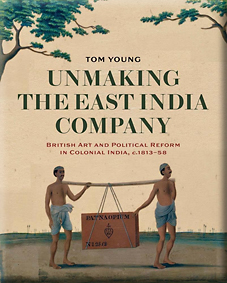
The title of this book somewhat surprised me but after reading every chapter I became aware just how appropriate it is for this remarkable contribution to the study ofAnglo -Indian Art. Mildred Archer and other art historians of the second half of the 20th century had largely dismissed the period between 1813 and the catastrophic upheavals of 1857 as one of meagre artistic output with few artists of merit working in the subcontinent. She couldn't of course have been more wrong. This pioneering book explores in depth the demise o f the East India Company between the loss of the trade monopoly in 1813 to the effective nationalisation of the East India Company in 1858. Tom Young argues effectively that new artistic mediums like lithography, published in periodicals and in other formats, and aimed at the emerging middle class, destabilised the entire structure of the Company's legitimacy and rule. A previously aristocratic concept ofcorporate identity in colonial India was eroded and undermined by the political and moral mores of this new emerging class. The author had previously written a detailed biography of the artist Sir Charles D'Oyly and his first chapter looks at how this artist, in founding the Behar School of Athens, shaped colonial self-fashioning but with the importation o f the lithographic press contributing to the promotion of art for the middle classes in India. The next two chapters reveal in stark detail how colonial racism, so prevalent in India in this period was connected to artistic technologies like lithography. A direct comparison is made between the brilliant 18th century artist Arthur William Devis and the work of the Gantz family in Madras. Devis, possibly under the direction of the founder of Calcutta's Asiatick Society, Sir William Jones, had proposed plans for a print series oflndian occupations called 'Economy of Human life'. It failed to materialise, but the paintings prepared for it are of the highest artistic merit in which every figure is individualised and characterised. They were frequently done on the spot. In contrast the Gantz Brothers' lithographic 1820s publication called the 'Microcosm of Indian Life' directly reflected the way that the colonial structure of 'extractivism' destroyed the South Indian economy and the labourer became the chief commodity. Each figure is illustrated not as an individual but as a type to be exploited. Lithography determined the way racism was fundamentally enacted. The fourth chapter turns to how artistic production shaped domestic perceptions of imperialism and the emergence of the monarchy as an imperialistic entity.
The final chapter considers one of the darkest aspects of East India Company rule - the opium trade in Patna. Shortly before the Great Rebellion of 1857 Robert Lyell, the personal assistant in charge ofopium at the Gulzarbagh factory commissioned the leading Indian artist of the day in the city - Shiva Lal - to paint murals of the various stages of opium production on the walls ofthe factory. Only his sketches survive but the very idea of using art to promote a trade that had extremely dark labour practices is bizarre. The author argues that the concept emanated from the emergence of murals in England to promote imperialism. On 3rd July 1857 two hundred Muslims, led by the book seller Pir Ali Khan, unfurled the green flag and rose in rebellion. Lyell rode out to meet them and was shot from the saddle.
This reassessment o f the role o f colonial art as a reflection o f identity and power - indeed of the concept of Britishness across the globe is long overdue and Tom Young has risen to the challenge brilliantly. The book is lavishly illustrated and extremely well produced as we have come to expect from the Mellon Centre's press. Every facet of this book is admirable even i f aspects o f the subject are a disturbing reflection o f British colonial rule in the last years of the East India Company and the inevitable progression towards the calamity of 1857.
|