|
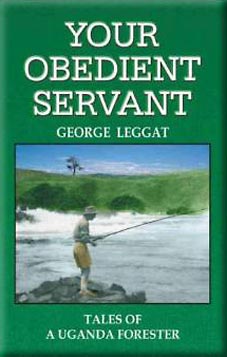
Leggat was recruited from Edinburgh University's Forestry
School before the war, but he did not take up his appointment until 1946
after he was demobbed. Staff were urgently needed in the colonies, and
he was thrown into his chosen career at the deep end, displaying his
Scottish qualities of enterprise, energy, efficiency and tenacity. He
managed his duties well, was devoted to his task, and commanded the
respect of his African staff and expat departmental colleagues. He
served in the Uganda Forestry Department during a formative period of
rapid development concerned with a great raft of issues: survey,
demarcation, stock-taking, gazetting, plantation, scientific research,
management, production, harvesting, regeneration, administration, and
finally localisation. The job required safari travel which he shared
with his wife Christina. He loved the country, and its sporting
opportunities. Our astute Colonial Office selectors were as almost ever
right in their choice.
In my recollection Uganda forestry never had a
high profile. It was over-looked by the 1953 East Africa Royal
Commission on Land and Population. In 1948 we Oxford Colonial
Administrators were informed by Worthington's 1938 Science in Africa and
were examined on forestry questions about land use for forestry
plantations and exploitation of reserves. Leggat writes in Chapter 13
about the Budongo mahogany forest, my first confrontation with real
forestry where many policy issues arose. He also betrays his passion for
fishing for Nile perch in nearby Lake Albert. This is a nostalgic read:
a memoir about the simple social life, with too little about his
industrious departmental routine fieldwork, and almost nothing about the
Department's over-arching policy framework. It reflects the life of the
post-war colonial expat, not racist, but racially organised.
Some of his
stories embarrass, e.g. his decision not to hire a sleeping dictionary
because this would have damaged his career prospects, and a rather dry
account which makes it sound like a marriage of convenience rather than
a love-match, which clearly it was. There are errors and omissions, but
I leave the reader to discover these.
Like many of his colleagues he
left at Independence in 1962, aged 45, to do forestry in New Zealand.
Three years before there were 23 expat conservators and 15 African
foresters in the Department with George as No 3. Three years after his
departure a local, not in the 1959 staff list, took over as Chief
Conservator. But solid foundations had been laid, and the Department
survived rapid changes and Amin's civil war, and forestry still thrives
"with the current emphasis on natural forest in reserves and parks,
aimed at bio-diversity at the expense of timber production ... but which
could carry the seeds of its own destruction ... without alternative
supplies of timber from fast growing plantations" (Osmaston, see below).
Surely a living memorial to Leggat and his colleagues?
The style of
Leggat's memoirs reminded me of a very readable booklet by Dr Wiggins on
his Early Days in BEA and Uganda. He walked up from the coast in 1899,
and 27 years later sat in Exco as DMS, had a contretemps with HE, became
a missionary, founded the Kumi leper settlement, took Holy Orders, was
appointed to an Oxfordshire living by Lord Macclesfield, married us in
1948, and at Independence told me that he had drawn more from his Uganda
pension than in pay. Could this be a subject for OSPA research?
Having
read this book, your appetite will have been whetted for more. I
therefore commend for further reading two excellent papers delivered at
OSPA's 2004 How Green Was Our Empire seminar by Henry Osmaston and John
Mackenzie. The former has a useful reading list.
|