

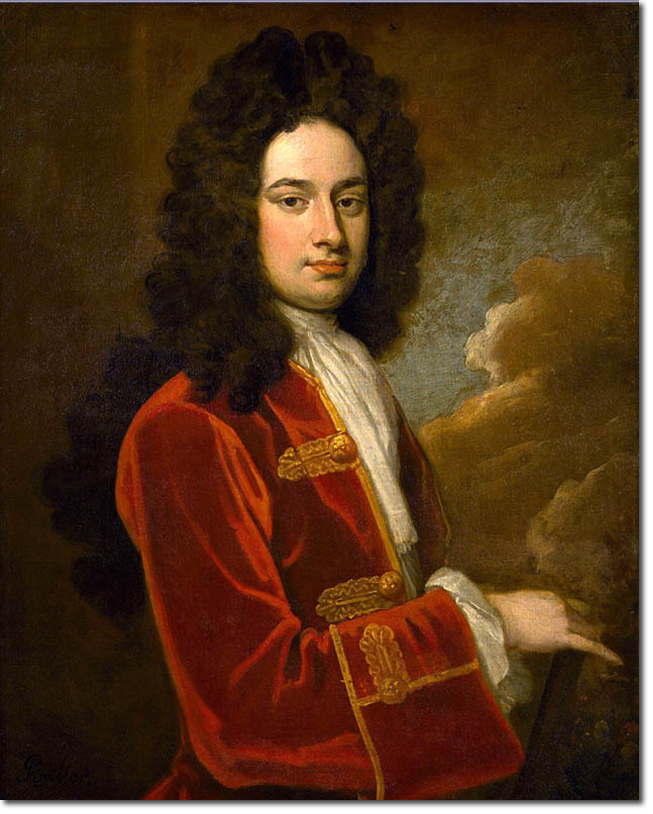
James Stanhope was a soldier and politician, born in Paris in 1673. He was educated at Eton and Trinity College, Oxford. His father, Alexander Stanhope, was the English Ambassador to Spain, so he spent much of his youth in Madrid. He served as a volunteer soldier in Italy and Flanders, and in 1695 held a commission in the British Army. In 1705 he was in Spain, serving under Charles Mordaunt, 3rd Earl of Peterborough, at the siege and capture of Barcelona. In 1706 he acted as both minister and soldier, and in 1708 was placed in command of the British army in the Peninsula. He favoured a more offensive strategy than Peterborough and demonstrated this by taking Minorca. He captured Port Mahon from the Spanish and made it a winter base for the British fleet. He governed the island for three years until 1711.
After the defeat at Brihuega in 1710 he was held prisoner in Spain for a year, returning to England in August 1712. In 1713 he married Lucy Pitt, the sister of Thomas Pitt, Colonel of the 3rd Horse (Queen's Bays), and aunt of Pitt the Elder. He left the army and entered politics, standing for Parliament at Wendover and leading the Whigs in opposition. He helped secure the Hanoverian succession and played a prominent role in suppressing the Jacobite rising of 1715. In 1717 he became First Lord of the Treasury and Chancellor of the Exchequer. In 1718 he was created Earl Stanhope and was, in effect, the first Prime Minister of Great Britain.
He opposed the expansionist policies of Russia, Spain and Austria, and entered difficult negotiations over Gibraltar. These talks collapsed, leading to the 13th Siege of Gibraltar. He sent a force to capture Vigo after Spain supported the Jacobites. At home he clashed with Walpole and former Whig colleagues over reform of the House of Lords and his attempts to introduce greater religious tolerance. He was partly responsible for the South Sea Bubble crisis, and while making an impassioned speech in the House of Lords he suffered a violent headache. He was carried out and died the following day, 5 Feb 1721. The King ordered a funeral with full military honours. The procession took place on 17 Feb and he was buried at Chevening. He and his wife Lucy Pitt had seven children, including two sets of twins.

