

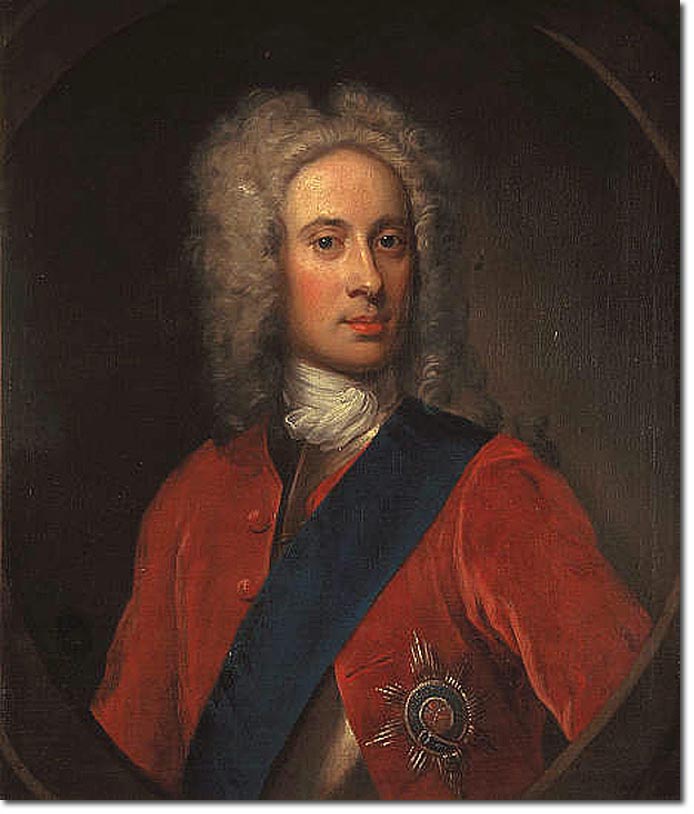
John Campbell was born at Ham House in Petersham, Surrey, on 10 Oct 1680. His father was Archibald Campbell, 10th Earl of Argyll, who was involved in the Glencoe Massacre and became the 1st Duke of Argyll in 1701. John inherited the title 2nd Duke of Argyll and Chief of Clan Campbell in 1703. He was a politician and soldier, supporting the Union of Scotland and England in 1707. He was made a Knight of the Garter in 1710 and resigned from the Order of the Thistle. He commanded the government army at Sheriffmuir during the 1715 Rebellion; the battle was inconclusive, but he later defeated the Jacobites. For his efforts he was rewarded with the title Duke of Greenwich in 1719. He reached the rank of Field Marshal in 1736 and was appointed Commander‑in‑Chief of the British Army. The portrait is by William Aikman, one of at least fourteen paintings he made of this sitter. Campbell encouraged Aikman to settle in London, where he had a flourishing career. John Campbell died on 4 Oct 1743 and was buried in Westminster Abbey on 15 Oct.
He was first appointed as colonel of a regiment raised by his father at the age of fourteen, and served in the Nine Years’ War. His later positions included two re‑appointments to the colonelcy of the Royal Horse Guards (The Blues):
1694 Colonel of The Earl of Argyll’s (Lord Lorne’s) Regiment of Foot — 1694–1697
1696 Colonel of 4th Troop Horse Guards — 25 May 1696 to 28 Sep 1703
1707 Colonel of Prince George of Denmark’s Regiment (The Buffs) — 24 Feb 1707 to 25 Feb 1711
1712 Governor of Minorca — 1712–1716
1715 Colonel of Royal Horse Guards — 13 Jun 1715 to 7 Mar 1717
1715 Lord Lieutenant of Surrey — 1715–1716
1725 Master‑General of the Ordnance — 1725–1740
1726 Colonel of The Princess of Wales’s Own Royal Regiment of Horse (2nd Dragoon Guards) — 26 Aug 1726 to 5 Aug 1733
1733 Colonel of Royal Horse Guards — 6 Aug 1733 to 5 May 1740
1742 Master‑General of the Ordnance
1742 Colonel of Royal Horse Guards — 24 Feb 1742 to 11 Mar 1742

