

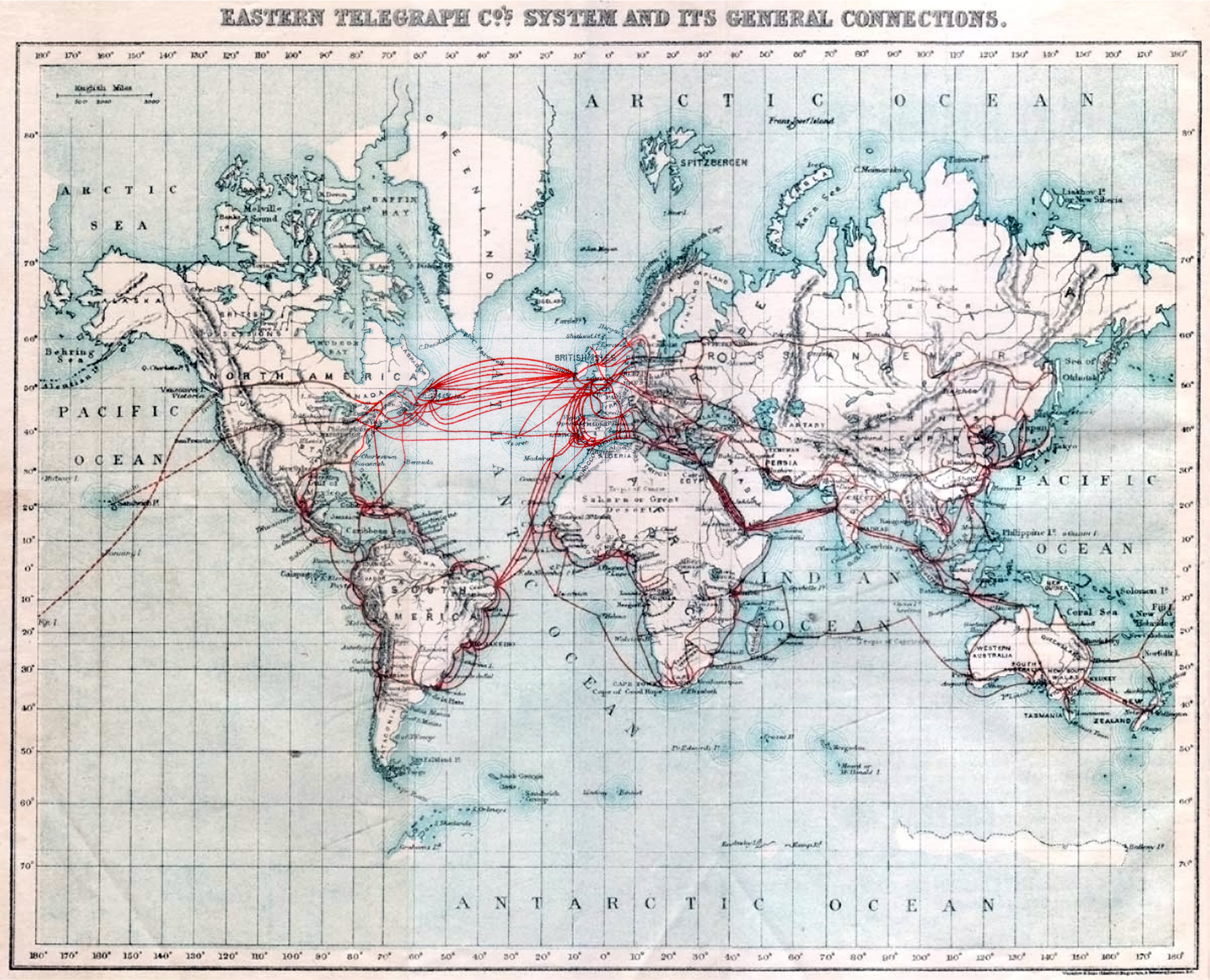
By 1901, the British Empire’s commercial lifeblood pulsed through copper cables laid across the ocean floor. The Eastern Telegraph Company’s map from that year reveals a world reordered by signal—where red lines traced not just routes of communication, but corridors of influence, trade, and control. With over 100,000 nautical miles of submarine cable in operation, the company had become the silent engine behind imperial administration and global finance.
Founded in 1872 through the merger of several regional cable companies, the Eastern Telegraph Company quickly established itself as the dominant force in international telegraphy. Its network was designed with strategic foresight: cables avoided foreign jurisdictions where possible, routed through British colonies and protectorates to ensure secure transmission. From Cornwall, messages travelled through Gibraltar and Malta to Egypt, then down the Red Sea to Aden and across the Indian Ocean to Bombay. From there, the system extended to Madras, Penang, Singapore, and onward to Hong Kong and Shanghai.
Australia entered the network via the Dutch East Indies to Port Darwin, while Africa was served by a coastal loop from Bathurst to Cape Town, with eastern extensions to Mombasa, Zanzibar, Seychelles, and Mauritius. The Americas were connected through Halifax, Bermuda, and Cuba, linking the Caribbean colonies to London. Each cable station functioned as a miniature outpost of imperial logistics—staffed by technicians, clerks, and signalmen who maintained the flow of information that underpinned governance and commerce.
The scale of influence was staggering. By 1890, over one billion pounds sterling in annual imperial trade was coordinated via telegraph. The system allowed colonial governors, military commanders, and trading houses to communicate with Whitehall in minutes. It also enabled real-time market updates, diplomatic instructions, and press dispatches, reshaping the tempo of empire from weeks to seconds.
Yet the network was not without its vulnerabilities. The South African War exposed delays and bottlenecks in communication between London and Cape Town. In response, a direct cable was laid from Cape Town to Ascension Island and St. Vincent, bypassing Portuguese relay stations. A further cable between Australia and South Africa, completed in 1901, supported troop coordination and reflected growing inter-Dominion rivalry. Eastern Australian states, meanwhile, backed a trans-Pacific cable linking Norfolk Island, Suva, Fanning Island, and Vancouver.
The Eastern Telegraph Company operated in close partnership with the Colonial Office, and its infrastructure became a tool of soft power—quietly shaping the rhythms of diplomacy, trade, and administration. The 1901 map, with its confident geometry and imperial reach, stands as a testament to a time when wire and empire were tightly intertwined. Though later eclipsed by wireless and satellite systems, the legacy of this network endures in the very architecture of global communication.

