

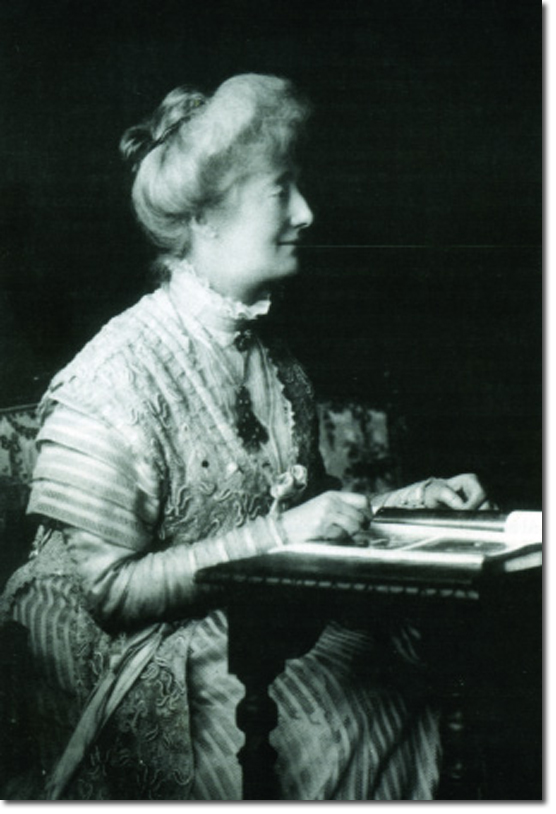
Green [née Stopford], Alice Sophia Amelia [known as Alice Stopford Green] (1847–1929), historian and Irish nationalist, was born on 31 May 1847 at Kells, co. Meath, the seventh of the nine children of the Revd Edward Adderley Stopford (1810?–1874), archdeacon of Meath, and Anne Catherine Duke of co. Sligo. The Stopford family had played a prominent role in Irish academic and ecclesiastical circles since the early eighteenth century. Edward Adderley Stopford upheld the family tradition by combining his pastoral duties with scholastic pursuits, publishing on a number of questions, most notably on ecclesiastical law. He also involved himself in the political side of church affairs by conferring with Gladstone on the Irish Church Bill of 1869. Although he disapproved strongly of the disestablishment of the Church of Ireland, he lent his expertise to the debate in the interest of producing a fair settlement. His wife was a fervid evangelical who led her children in family prayers every morning and presided over a disciplined and orderly household. Strict religious observance featured strongly in the lives of the Stopford children, but Alice Stopford became increasingly disenchanted with evangelicalism and gradually subscribed to a broader form of Christianity.
Stopford and her three sisters were educated by a succession of governesses at the family home. An eager student, she was given the run of her father's library and struggled to teach herself Greek, German, and metaphysics. Her studies were interrupted, however, by eye trouble which led to near blindness at the age of sixteen. She was forced to spend a year in a darkened room and was unable to read until an operation in 1871 restored her sight. The family left co. Meath and moved to Dublin while she was recovering. She took advantage of both her improved health and the intellectual opportunities available in Dublin by seeking permission to attend lectures at the college of science. To the amazement of male students, she and a female companion attended physics lectures at the college. The death of her father forced another move, this time to England, where she settled with her mother and sister at Chester in 1875. This arrangement was by no means agreeable to Stopford, who found her mother's evangelicalism and her disapproval of female intellectuals stifling. By the time she moved to Chester, Stopford was in her late twenties, and resigned to becoming what she described as an 'old maid'. Despite this, she developed a fondness for debate, fun, and lively company. Travels throughout Ireland and further afield to Scotland and the continent had broken the monotony of life in co. Meath, and Stopford's Chester home provided a useful base from which to visit English friends and relations. In particular, she enjoyed the literary environment at the London home of her cousin Stopford Brooke. A literary and liberal man, Brooke entertained a number of intellectuals at his Manchester Square home and it was there that Stopford met her future husband, John Richard Green (b. 1837), to whom she became engaged in 1876, and whom she married on 14 June 1877.
A former curate in the East End, Green had established a reputation as a journalist and historian by the time he met Alice Stopford. Although Green had been educated at Oxford and was more widely read than his haphazardly educated wife, the couple enjoyed a stimulating and mutually beneficial intellectual rapport. J. R. Green directed his wife's reading while she acted as his research assistant and intellectual confidante. The marriage was by all accounts a happy one. As well as pursuing their mutual and individual intellectual interests, the couple enjoyed an active social life, visiting and entertaining friends. Their happiness was, however, clouded at regular intervals by Green's poor health. He had a weak chest and was susceptible to colds and influenza; he suffered a haemorrhage a month after his marriage and winters were subsequently spent in Italy or in the south of France. Green was often so weak that he was forced to dictate his work to his wife, and together they produced A Short Geography of the British Islands in 1879. After a last painful attempt to return to his work, he died on 7 March 1883.
Although she was devastated by the loss of her husband, Alice Stopford Green was committed to establishing herself in her own career. In 1884 she applied for the post of mistress of Girton College, Cambridge, but despite the support of Florence Nightingale, her application was unsuccessful. She turned instead to history, initially because of her connection with her husband, but eventually on her own terms. She completed one of her husband's books (The Conquest of England, 1884), and produced a new edition of his most famous work, the Short History of the English People (1888); she was also approached by John Morley to contribute a short life of Henry II for the Twelve English Statesmen series (1888). Her next project, a history of urban life in fifteenth-century England, was far more ambitious. This two-volume study (Town Life in the Fifteenth Century, 1894) contributed greatly to her growing fame as a historian and as an intellectual in her own right. Her husband's death had left her with an annual income of about £1800, more than enough to allow her to give away a third of her income each year and to entertain regularly at her Kensington Square home. She moved to Grosvenor Road in 1903, and her reputation as a lively and generous hostess who provided a good table grew. Red-haired, vivacious, and allegedly fonder of the company of men than women, she attracted a diverse collection of guests to her home, entertaining statesmen, writers, journalists, and civil servants among others. She became deeply interested in colonial affairs, most particularly those relating to Africa, and after visiting prisoner-of-war camps on the island of St Helena during the South African War in 1900 she publicized and urged the need for their reform. In 1901 she co-founded the African Society (Royal African Society from 1935), became its vice-president and edited its journal. Her main interest was in discussing African conditions and she objected to what she saw as the politicization and commercialization of the society. Despite this, in 1905 she helped to finance the African Mail, and through her connection with this publication she joined the Congo Reform Association. Her interest in the Congo brought her into contact with Roger Casement, an Irish diplomat who had published a damning report on labour conditions in the Congo Free State. Their common nationality and interest in both Irish and African affairs led to a strong friendship and a combined effort to gain support for the association from Irish nationalist leaders.
From around the turn of the twentieth century Stopford Green became increasingly interested in Irish issues. She was enthused by the Gaelic revival, which boosted interest in the Irish language and in Irish history. Although she never mastered the Irish language, she strongly supported its teaching and in 1903 she helped to set up the School of Irish Studies in Dublin. She became increasingly interested in Irish history, disapproving of the way in which historians had tended to focus on the Anglo-Irish at the expense of Gaelic tradition, history, and culture. She consequently published in 1908 The Making of Ireland and its Undoing, 1200–1600, a book which concentrated strongly on Celtic civilization. Its nationalist tone offended some sections of Unionist opinion and it was banned by the Royal Dublin Society. Stopford Green went on to publish a number of books on Irish history, each of which exhibited a distinctly nationalist outlook. Her interest in the subject strongly informed her developing political beliefs. As a Liberal, she had supported Irish home rule in a passive sense since the late nineteenth century, but her politics became increasingly practical as she formed close friendships with Irish economic and political reformers in the early twentieth century. She lent her support to a number of causes, including the publication in 1905 of an anti-army recruitment pamphlet and the establishment of a non-denominational Irish university. A constitutional nationalist, Stopford Green was greatly enthused by the Home Rule Bill of 1912 and dismayed by Ulster Unionist threats to resist its implementation. She consequently endorsed the foundation of the Irish Volunteers, an organization established in 1914 to defend the Home Rule Bill. She became chair of the London Committee, an illegal organization which raised funds and co-ordinated the purchase of arms for the Irish Volunteers. She contributed personally a large proportion of the £1500 raised; this money was subsequently used to secure German arms.
This dramatic episode was overshadowed by the outbreak of the First World War, which split nationalist opinion. While Casement abhorred the involvement of Irish soldiers in the British army and attempted to involve Stopford Green in his anti-British campaign, she supported the decision of Irish party leader John Redmond to pledge Irish support to the British war effort. As an advocate of the attainment of Irish self-government by constitutional means, she was profoundly shocked by and disapproved of the 1916 Easter rising in Dublin. Despite her condemnation of Casement's role in the rebellion, she intervened after his arrest, writing letters about his treatment, visiting him in prison, and organizing a defence fund to which she contributed generously. After Casement was tried and sentenced to death, she worked towards securing a reprieve, drafting petitions, speaking with MPs, and even making an appeal to Buckingham Palace. Her efforts were in vain, but Casement's execution and the dramatic shifts in Irish politics after 1916 absorbed her almost completely and led to her decision to leave London, at the age of seventy, and to take up residence in St Stephen's Green, Dublin.
Stopford Green remained a constitutionalist, but she acknowledged that simple home rule would no longer satisfy Irish demands and advocated dominion status instead. She published widely on Irish issues, expounding her nationalist views in a number of pamphlets between 1917 and 1918, and maintaining that the strongest obstacle to Irish self-rule of any form was Ulster Unionism, with which she had little sympathy despite her own protestant and Unionist upbringing. Although she disapproved of violence and strongly condemned offences committed by crown forces and republican rebels, she admired some young members of Sinn Féin, and received many of them—including Michael Collins—at her home while they were on the run from British authorities. Her home was raided and searched by crown forces on several occasions. When the end of the conflict between British forces and Irish rebels initiated another war—this time between supporters and opponents of the Anglo-Irish treaty of 1921—Stopford Green supported the treaty strongly. As a defender of the Commonwealth, she distributed pro-treaty leaflets and joined Cumann na Saoirse (the ‘league of freedom’), a women's pro-treaty organization. She was appointed in 1922 to a seat in the senate of the Irish Free State, an honour which carried certain risks and which necessitated the instalment of a military guard outside her house.
The end of the Irish Civil War saw Stopford Green once more engrossed in her favoured pursuits: history, Gaelic culture, and entertaining. Her Dublin home became a centre of intellectual debate which attracted numerous guests, both Irish and foreign, who were prominent in the arts, politics, and academe. She helped to found the Irish Book Shop, which became an informal centre of literary Dublin, produced a number of short books on Irish history for schools, and became an active member of a senate, to which she presented in 1924 a casket of silver and bronze which was decorated with Celtic motifs. Her health began to fail as she approached her eightieth birthday. Her hearing deteriorated and she suffered a heart attack in 1925, but continued to preside over convivial dinner parties. After a short illness, she died at St Stephen's Green on 28 May 1929.
Courtesy of Oxford Dictionary of National Biography
Her role in establishing the African Society (which helps explain her generous relationship with Charles Orr is detailed here
Charles Orr's Memoirs Volume 6

