|
Continued from Sir Charles Orr's Memoirs Volume 5b

I had reached the great dark cavernous gateway that led through the high village walls when I noticed what looked like a bundle of rags lying beside the path. Suddenly the bundle stirred, and from the ground rose an old grey-haired Hausa woman, scantily clad in what I had taken for a heap of dirty rags, and as I rode up to her she stretched out her arms towards me and called out in Hausa "Hail, oh hail, you of the race that cleans up the corners of the world!" The word she used was one applied by the Hausas to the sweeping out from their huts of accumulated dust and rubbish on the rare occasions when it occurs to them to make the hut clean and tidy. I was struck with astonishment. Undoubtedly the old woman had lain all night at the entrance of the gateway, knowing that I must ride that way in quitting the village. Why she had done it, or why she had bestowed on me that greeting I had no idea, nor shall I ever know. It is possible that I may in the course of my duty have saved a daughter or granddaughter of hers from the Emir's harem, or her husband or son from some piece of gross injustice. But the effect that it had on my drooping and despondent spirits was electrifying. I put my hand down gently above her head as she knelt in the muddy roadway and said "Peace be with you, mother", and then rode through the gateway and out into the open country which was growing clearer every minute as the first rays of the sun began to appear in the east. My depression had vanished, my heart was singing, and my weariness and fever were forgotten. That simple old peasant woman had by her obviously sincere and spontaneous act resolved all my doubts and dispersed all my gloom and despondency. Henceforth whenever I began to question the value of the work I was trying to do in Nigeria and the effect it might be having on the hundreds of thousands of men and women entrusted to my care, I recalled the words of the old Hausa woman, and hope and courage at once returned. The incident burnt itself into my memory and I have never forgotten it.
I settled the boundary question in 24 hours and was back at Zaria within a week, better in mind and body than I had been when I left 10 days before.
The normal tour of duty for administrative and other officers at that time was 18 months, at the conclusion of which leave was granted for 5 months on full pay with free ocean passages to England and back - generous terms I have always thought, though justified no doubt by the treacherous nature of the climate and the bad conditions and manifold discomforts which we had to endure in those early pioneering days. I came across not long ago an old letter of mine written from Zaria about the end of my second tour, that is to say in March or April 1906, in which I mentioned this matter and gave a list of the officers in my Province alone who had been either invalided home or had died during the previous 12 months. Unfortunately, I cannot now remember the figures but I know they were somewhat staggering. Malaria, dysentery, and blackwater fever were the most common and most dangerous of the diseases at that time, the first two predominating. Cases of black water were rare, but when they did occur were nearly always fatal - certainly 2 out of every 3 cases were so. My first experience of blackwater was in Zaria, when our doctor went down with it. At the time there were only three others of us in the station - the officer in command of the WAFF Company, the Police Officer and myself. I immediately arranged that we should take it in turn to sit up all night with the doctor, who of course gave us full instructions as to what to do - our main duty was to give him a drink of barley or lime water every hour or half hour if necessary. It is no use denying that it was somewhat of a strain to sit up all night, and after handing over to one's 'relief' at 7am and refreshing oneself with a tub and breakfast to go straight on with their usual day's work, which never ended till about 6 o'clock in the evening. But we naturally did our amateur nursing with all the fervour of which we were capable, with the firm determination to save the little man's life; and we succeeded. Once the crisis was passed we were able to send him down to Zungeru hospital in a hammock, and he was ultimately sent back to England and made a complete recovery.
I have said that the length of the normal tour of duty was 18 months. But actually I went home after only 14 months of my first tour, partly because it happened to be administratively convenient that I should do so, and partly because I was particularly anxious to get as much of the English summer as I could into my leave. As from the very first I was Resident in charge of a Province I was always able to arrange my leave - within limits - according to my own personal wishes and convenience, and I therefore always managed to get home about the middle of May, returning in October or thereabouts. During my eight years service in Nigeria therefore I was fortunate enough to spend every other summer in England, at the same tie missing every other rainy season in Nigeria. The summers of 1904, 1906, 1908 and 1910 I spent in England, and the intermediate years in Nigeria. As I have previously remarked, the strenuous life in Nigeria, full of physical hardships and discomforts and not a few dangers, adventures and excitements, found a complete contrast to the life of ease and enjoyment at home on leave, especially in London during the season, with Henley, Cowes and Goodwood to follow. It was partly this contrast which led to so much zest in living, for there could never be a dull moment from years end to years end. In fact, every 'unforgiving minute' was almost automatically 'filled with sixty seconds' worth of distance run.'
Even in Nigeria itself one enjoyed the privilege of contrast, for life at my Headquarters at Zaria with most of the day filled by office work, and in close and daily touch with the doctor, police officer, WAFF officer and one of my Assistant Residents, differed entirely from life on tour in the Province, spending the whole day on horseback in the open, mapping and seeing new country, talking to peasants, and blessedly free from office files and accounts. The end of each day, when after a hot tub and a simple dinner I sat in my deck chair outside my tent or hut, smoking my post-prandial pipe before turning in for my night's rest, this was to me a most precious and well remembered time. Sometimes I would get my boy to put my hurricane lamp on my camp table beside me and I would read till bed time. Possibly a home mail might have reached me that day, sent by runner from Zaria, with the home letters which were so tremendously welcome, and also the batch of newspapers which I always ordered before I left England - the Weekly Times, the Weekly Westminster, Black and White or the London Illustrated, Punch, the Spectator. The letters, I need hardly say, were devoured the moment they arrived - sometimes the runner would overtake me when I was having my lunch by the roadside, and I would forget my food in my eagerness to get the latest news from home. How well I remember receiving the mail which brought the news of the 1906 election which the Liberals won by an immense majority, much to my amazement and disgust, for up till then I had been, ever since I first thought anything about politics a confirmed Conservative, narrow-minded and somewhat intolerant. As a schoolboy I had grown up in the belief that everyone who mattered was a Conservative, that Liberals were wrong-minded doctrinaires, Radicals and not quite gentlemen, and anyone who ever suggested Home Rule for Ireland was a traitor who deserved to be hanged from the nearest lamp-post. The very name of Gladstone was anathema to me because of his foreign policy - his peace with the Boers after the humiliating defeat at Majuba Hill, and his dastardly and criminal (as I thought) failure to organise an expeditionary force in time to save Gordon at Khartoum. My training in the Army had tended of course to confirm my earlier views, and I had been very much rattled by the so-called "Pro-Boers" amongst the Liberals at the time of the Boer War, although I had been able myself to take a somewhat detached view as I have already related, when I wrote - from South Africa - the article which was published in Sydney, subsequently reproduced in a Shanghai newspaper.
It was not however so much the fact of a Liberal Government having won the election as the news that the new Prime MInister was to be Campbell-Bannerman, the very man who had, I considered, slandered the British Army and traduced the entire British nation by referring in the House of Commons to some of our reasonably humane measures for dealing with the Boer guerillas after the fall of Pretoria as "methods of barbarism". I had been in South Africa at the time and I shall never forget the fury that seized me when I heard of this calumny - as I considered it then. I still think it was unjustified, though years have brought me more tolerance and understanding than I then possessed. The same fury overcame me when I opened my newspapers which the runner had brought me, and found that Campbell-Bannerman was now Prime Minister. So great an impression did the news make on me that I can recall to this day the exact spot in the bush where I had halted and I remember getting up from my camp stool, flinging the paper on the ground in a rage, and stamping up and down, muttering to myself so that my boys and the carriers must have thought I had suddenly gone mad. Little did I then think that I should soon develop into an ardent admirers of the Liberal Party myself!
I always took with me when I went on tour some book or books to read, if I felt so inclined, during that one hour of leisure I had, before turning into bed at night. I had brought out from England a small and very handy edition of Gibbons' "Decline and fall", in I think 10 volumes, and one of these used almost invariably to accompany me on tour. I never read a book of any kind so far as I remember when I was at my headquarters at Zaria because I was too busy to read anything except my home newspapers and journals.
There were however many days when I was on tour in which I was either too tired or felt disinclined to read after a long day in the saddle and carrying out the endless administrative tasks that fall to the lot of a Resident on tour. On such occasions I would settle myself down in my camp chair in front of my tent or hut after dinner under the canopy of the marvellous African sky, and give my thoughts free rein. How many such nights can I recall, and what wonderful memories they bring back. Near me would probably be a shea-butter tree with its leaves rustling gently in the evening breeze, a murmur of voices would come from the nearby village, and the scent of wood fires as the villagers cooked their evening meals; while overhead the sky was ablaze with stars, dazzling in their brilliance. Sitting there in the dark, a feeling of the inconceivable immensity of the universe would come over me, and I would recognise that I was nothing but a minute dot on this planet, itself only an insignificant star in a great solar system, which in turn formed a mere fragment of the whole universe. And had that universe, I wondered, any limit or did it extend to infinity? Had it ever had a beginning or could it ever have an end? Surely not, I felt convinced. There must, I felt certain, be some Master Mind behind it all. This little planet of ours, hardly greater in comparison even with the visible universe than a grain of sand on the sea shore, must fulfil some special purpose in the Great Scheme of Things. And I, an insignificant individual must likewise fulfil some special purpose, or at least be designed to fill it. The Great Scheme! The phrase seemed to come into my head with peculiar meaning as I sat in the darkness near that unsophisticated village in Central Africa gazing at that dazzling array of stars overhead. Homo sapiens - a species of animal - on this little dot in the heavens, what was he, with all his vaunted discoveries and inventions, when compared with that Master Mind directing The Great Scheme? He must, I reflected, bear much the same relationship to the Master Mind as the fly on the wall to the mathematician working out a problem by differential calculus, or a mosquito watching a bridge being built over the Zambezi river. How can we hope to understand in the slightest degree the workings of the Master Mind that controls the universe? Our philosophers from Plato onwards, our finest intellects, can formulate a thousand theories, but these are mere guesses and may only touch the very fringe of the great purposes enshrined in the mind of the author and administrator of the Great Scheme.
So my thoughts ran as I sat watching the vast expanse of star-sprinkled sky overhead. I felt so infinitely small, far smaller than a drop of water in a vast ocean. And yet, if as I felt sure, the universe itself was merely the stage for The Great Scheme, surely the Great Mind must be present in some form throughout the universe; it must be present in this planet and in every living thing and even in seemingly inert organic matter. Everything must in face be an expression of the Great Mind. If so, I myself as an individual must be an expression of the Great Mind. I must have my place in The Great Scheme, there must be some reason for my existence, I must have some part to play in The Great Scheme.
My thoughts seemed to be taking shape. I felt that I was beginning to see a faint gleam of light in the hitherto unfathomable mystery of life. The Great Scheme seemed to give a meaning to what had up to now puzzled and perplexed me.
If I were indeed a part, however infinitesimal, of the Great Scheme, it followed that my whole object in life must be to devote myself to furthering the Great Scheme. I must identify myself with the Great Scheme. I must at all costs avoid hampering the Great Scheme. I must not - I smiled at the thought - throw a spanner into the machinery. But how was I to know whether I was helping or hampering the Great Scheme, any more than the fly could know whether it was helping or hindering the problem in differential calculus, or the mosquito in the building of the bridge? Well, I argued, if my existence on this planet is an expression of the Great Mind, I ought to be able in some way to obtain - intuitively - some guidance as to what conduct to adopt and what to avoid if I were to fulfil the purpose of my existence by helping on the Great Scheme.
Thus far I had been using my reason - whether I had used it correctly or incorrectly I could not say. But the various steps in my argument seemed logical. I had come to the conclusion that life was a challenge to me so to regulate every thought, act and deed that I might help on the Great Scheme; and further, that I could in some way - I knew not how - obtain guidance as to how I could achieve this end. But my reflections on those quiet nights when I was on our carried me further than the point that I had reached by a process of mere reason. A growing faith developed in my that if I remained steadfast in my endeavours to further the Great Scheme, all would go well with me, whereas if I failed or faltered in my endeavours, the contrary would be the result. I was aware that such a faith rested on no firm basis, and lay under the suspicion of being invented by me in order to provide a heaven for myself here on earth as a reward for good deeds coupled with the threat of a hell as a punishment for evil deeds. Nevertheless, this faith persisted, and vague as it is, has never really left me.
The mystery of the existence of evil, of pain and suffering in a world which ought by all reasoning to be perfect and free from such cruel phenomena remained of course unsolved. My belief in a Great Scheme administered by a Master Mind provided no solution whatever. I had however read Winwood Reade's Martyrdom of Man when I was a young subaltern in India and had been immensely impressed by his reasoning and conclusions regarding the place of man in the universe. And I remembered the illustration he gave to reinforce his arguments - of the fly crawling over the picture and wondering at the variety of colours, some bright and some sombre; then stretching its wings and glancing back it saw the picture as a whole, each colour blending into the other, and recognised it as a masterpiece.
This, I agreed, must surely afford an explanation of the precedence of all the apparently hideous evil in this world, in contrast to the countless beauties - of nature, of character, of conduct, of emotion, of act. The ghastly cruelties which man constantly inflicts on man, the poverty, the slums, the gin ships and brothels, the racking physical pain and terrible diseases and plagues - is it not possible that if man on this planet could only view the Earth from some distant point of the universe, all these would somehow fall into their place in the Great Scheme, and the latter be seen and understood as the masterpiece which I believed it to be? Once more, how could the keenest intellect that had ever existed or could ever exist on this planet have the slightest knowledge of the meaning and purpose and working out of the Great Scheme?
This long diversion is due to my desire to recall so far as I can the effect which my life in Nigeria and my all absorbing work there had on my character. Had I stuck to my profession as a soldier with the constant companionship of my brother officers and the men which it involved, it is extremely improbable that I should ever have indulged in these speculations and philosophisings which were the direct result of long periods of loneliness cut off from all communication with my fellows. Only on looking back on one's past life does one realise the tremendous effect on one's character and its development that is produced by environment and more or less chance circumstances. Is it right to use the word "chance"? I often wonder. Obviously every detail of one's life cannot be preordained; there must be ample room for free will in every individual - the ability to choose one road instead of another, to act in this way rather than that. Yet what about those strange premonitions of coming events, examples of where one meets from time to time, well authenticated? What of those curious instances when of tow people one is taken and the other left, or when some event occurs owing to an extraordinary concatenation of circumstances or a combination of coincidences which seem to point inexorably to the hand of fate, or chance, or call it what you will. My Great Scheme solves none of these problems, but it has at least given me a faith which has stood the test of many years during which I have had my full share of joys and sorrows, difficulties and disappointments and many buffetings at the hand of what, for want of a better word I will call fate.
 |
|
|
I have already recorded how, when I was staying with Lugard at Governor House on my way home on leave in the spring of 1904 he had asked me to find someone to fill the appointment of Assistant Political Secretary which he was creating. I had not been home many weeks when, walking up Bond Street one morning I found myself face to face with Freddie Poole, whom I hadn't seen or heard from for quite a long time. "Where on earth have you turned up from?" I asked him, "and what are you drinking?" He was just back from Somaliland, he told me, where he had gone a year or more before on special service in an expedition against the well-known "Mad Mullah". Peace had been patched up after some fierce fighting, and the expedition had been broken up and he had come home and was now on leave, expecting shortly to be posted to some battery. "Come and have lunch at my club", said he in his old cheery way, "and we'll swap news."
As we were chatting at lunch, I suddenly remembered Lugard's request, and it occurred to me that Poole was just the man who suit the job of Assistant Political Secretary admirably. He was at a loose end, having been seconded from the Regiment for service, and not yet re-absorbed. "Would you like a job in Nigeria?" I asked, and I proceeded to describe the kind of work which an Assistant Political Secretary would have to do. Poole was much interested, asked a few questions about the climate and so on, and said he would certainly think it over. A few days later he called at the Colonial Office and made a definite application for the post, and after some delay was accepted and out to Zungeru.
I confess I felt somewhat nervous about the matter, as I was by no means sure that Lugard would find Poole suitable for the post, or that Poole get on with Lugard or find the work and conditions of service in Nigeria congenial. I may say that things turned out even better than I expected, for Lugard found Poole just the type of man he wanted, and Poole liked the work and conditions and proved a great success. He was, like myself, seconded from the Army for five years, but unlike myself he went back to regimental work, or indeed before, the five years were up, and did only 2 tours - or about 3 years in all - in Nigeria. Then he married, and West Africa saw him no more.
To me it was of course a great joy to have my old friend near me in Nigeria, and Zungeru being actually in Zaria Province we were comparatively close to one another. We used to correspond fairly often, and on the rare occasions when I had time to visit the south western part of my Province we made a point of meeting. Furthermore, it was a great convenience to me to have a friend at Headquarters to whom I could confide all my complaints about the faults and shortcomings and stupidities (as I in my irritation considered them) of the "Bureaucrats of Zungeru", while he on his side could explain to me from his point of vantage at Headquarters the reason for many orders and actions which had appeared to me unnecessary and senseless.
 |
|
|
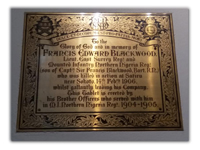
Towards the end of January 1906 I set off to vist the Gwari country in the south west corner of my Province, where Zungeru was situated, and I took the high road along which all traffic went from Headquarters up to Zaria, Kanu and beyond, as I wanted particularly to inspect the rest huts all along the route, for the upkeep and adequacy of which I was responsible. I had reached a point about 3 marches from Zungeru when I met a runner bearing a letter carried in a cleft stick, showing that it was an important government communication. It was from Government House, and was addressed to me and marked "Very Urgent". I opened it and found that it was a hurriedly written memoranda from Major Lugard, the Political Secretary, and ran somewhat as follows: " Serious trouble has broken out at Sokoto, Company of Mounted Infantry escorting Acting Resident attacked by insurgents. Hilary acting Resident and Scott Assistant Resident killed also Blackwood commanding the Mounted Infantry. Reinforcements being despatched at once. H.E. wishes to see you at once."
Here was news indeed, and most serious. Apart from the fact that poor Hilary and others had been killed. I knew only too well the result that was likely to follow such a disaster, the news of which would spread like wild fire throughout the whole of the Northern Provinces and must have the most damaging effect on our prestige. I pushed on that afternoon and marched all through the night. At dawn I came to a place where a track leads to the north in the direction of Sokoto, and here I found a company of West African Field Force infantry which had left Zungeru on the previous day with orders to make its way to Sokoto by forced marches. I had a few words with the Captain in command - an old friend of mine - and I then pushed on and reached Zungeru in the afternoon. I went straight to Government House where I was met by a somewhat agitated Private Secretary who showed me my room and told me that Lugard would like to see me as soon as possible.
After a month and a little refreshment I went to see Lugard in his office. I found him calm and collected as I had expected, with a sheaf of telegrams all round him, which he pushed over to me and told me to look through, after which, he said I should be in a position to discuss the matter with him. The telegrams, I found, were from the doctor at Sokoto - the sole survivor - and from the Resident at Kano; Cargill. From the Sokoto telegrams I learnt the story of what had happened. It appeared that for some time past, a native of some standing who had lived in a village some 20 miles from Sokoto City had been stirring up the people in the neighbourhood against the new regime and urging them to rise against the whiteman. The Sultan had reported the affair to Hilary, and at the latter's request had sent messages to the disaffected area with orders to put a stop to this subversive propaganda and to inform the leader that if he persisted in his disloyal activities he would be arrested and brought into Sokoto. The leader merely moved to another village, and continued his activities. Finally, Hilary decided to go to the district in person, summon the leader before him, persuade him if possible to cease his disloyal activities - disloyal to the Sultan as well as to the Government - and if he proved recalcitrant, arrest him, and bring hm back to Sokoto and hand him over to the Sultan to deal with, or if circumstances showed that it was wiser, try him in his own Court. Knowing that the man had collected a following of some 2 or 300 villagers round him and had begun to proclaim himself a "Mahdi" - a common occurrence amongst the more fanatical of the Moslem population - Hilary decided to get the OC Troops to accompany him with the whole of his force - a Company of Mounted Infantry - leaving merely a guard at the Residency Headquarters. At dawn the little force set for Satiru, a village about 17 miles away. Hilary took with him his Assistant, a young fellow named Scott. Blackwood had with him his British Colour Sergeant, and the doctor, Ellis, accompanied the force in case his services were needed.
Hilary was determined to do his very utmost to settle the matter without bloodshed, so when they arrived within a mile or two of Satiru he requested Blackwood to halt his force whilst he, Hilary, rode ahead with Scott to interview the insurgent leader and induce him, if possible, to see reason. Blackwood therefore did as Hilary requested, dismounted his men, and sent the horses to the rear, while he watched Hilary and Scott ride on and disappear within the walls of the village. Presently, however, he began to grow anxious, and finally made up his mind to advance a short distance in order to be nearer the village in case trouble arose and Hilary required his help. Hardly had he given the order to bring up the horses, when out from the village in front rode Hilary and Scott and began galloping at top speed towards him, followed by a mob of two or three thousand white robed natives, shouting, waving spears and brandishing swords, in hot pursuit. He was unable to open fire on this mob, because Hilary and Scott were between his men and it, and in any case the horses had just been brought up, and half the men were struggling into their saddles, while the horses, frightened by the sight and sound of the shouting natives bearing down on them, were plunging and kicking. Before anyone had time to think, the mob was in amongst them, shouting, hacking with their swords, thrusting with their spears. The Mounted Infantry had not time even to get at their rifles, far less to load and fire them, and indeed in such a melee rifle fire was practically impossible. No stand could be made, and in an instant Blackwood was down with a spear through his chest and a terrific sword cut over his right shoulder. Ellis, the doctor, received a graze from a spear while he was struggling to mount his plunging, frightened horse, gallantly held for him by a trooper of the Mounted Infantry. There was nothing for it but to make for Sokoto 17 miles away. Ellis, the Colour Sergeant, and the bulk of the Mounted Infantry eventually got back to barracks, no pursuit being undertaken by the triumphant mob, but Blackwood, Hilary and Scott all lost their leaves, besides some of the escort.
Ellis immediately sent a telegram to Headquarters reporting the disaster and asking for reinforcements. Fortunately the self-styled Mahdi and his followers made no attempt to follow up their success, but remained in Satiru, feasting and boasting and rallying others to their banner. The Sultan, who remained completely loyal throughout, had no armed men at his disposal wherewith to attack the rebels and could do nothing except assist the garrison with supplies and by obtaining such information as he could about the rebels and the feeling throughout the Sultanate. Nothing could be done but await the arrival of reinforcements from Zungeru.
So much I learnt from the batch of telegrams from Sokoto. There was however another batch of telegrams from the Resident of Kano, Dr Cargill, who had of course received full information from Sokoto of all that happened. He reported that the news of the disaster had caused considerable consternation in the city of Kano and throughout the Province. There were several posts scattered about under charge of Assistant Residents, each with a small garrison of from 10 to 20 foot soldiers. The Officer Commanding the troops at Kano (who was none other than my old friend Major Green) regarded this dispersal of force as constituting a great danger, since in the event of a general rising it was only too probable that each of these posts would be overwhelmed in turn. Green considered, said Cargill, that it was of the utmost important that we should take the offensive and attack at once before the people had had time to make any plans. He advocated therefore, the immediate withdrawal to Kano of all outlying posts including that of the small but important Emirate of Katsina lying north of Kano and between it and the French boundary. When everything had been collected at Kano, Green advised that we should march to a neighbouring large walled city to the east of Kano called Hadeija, for long a centre of anti government intrigue and disaffection, and attack it. Such action, Green insisted, was the one safe policy to pursue. To delay, and wait on events, with small scattered detachments all over the Province, would be to court disaster.
When I had read through these telegrams, Lugard asked me what I thought of the proposals of the Officer Commanding Troops, Kano. I asked in turn, whether Cargill (on whose judgement I knew Lugard placed great reliance), supported the proposals. Yes replied Lugard, Cargill in following these proposals, said he agreed with and supported them. "Then, Sir," I said, "I don't think you have any option but to sanction them. After all, Cargill and Green are on the spot, and know or ought to know what is the feeling of the natives. If you were to reject their advice and disaster were to follow, the Secretary of State might find it difficult to defend your action when the matter came to be discussed in Parliament, as it would undoubtedly be." "I cannot help what may be said in Parliament" replied Lugard, "The responsibility for the action taken at this moment is mine, and rests solely on me, and I must do what I, after full consideration of the fact and any advice given me, consider to be right. It seems to me that the withdrawal of all our outlying posts at this stage would give a very false impression throughout the Protectorate and exaggerate the importance of what has happened at Sokoto - a mere local affair: whilst to go and attack a formidable walled city like Hadeija without careful prior preparation seems to me little short of madness. I will think it over and then make my decision." An hour later a telegram was despatched to the Resident Kano that "His Excellency was unable to concur in the proposals made, and that no action in that direction should be taken till further instructions."
I myself felt greatly disturbed. Lugard, I said to myself was incurring a very heavy responsibility in disregarding the advice of the men on the spot civil as well as military, and I could not help feeling that there was much to be said for a policy of concentrating one's forces and striking a blow before disaffection had begun to spread throughout the northern Emirates, as I feared was only too likely to happen when the news of the Satiru disaster - for such it was - became known. However, the responsibility was Lugard's, as he said. I telegraphed at once in code to Zaria to find out how matters were there. Arnett was home on leave, and a young Assistant Resident lately out from home and posted to the Province, Lethbridge by name - was in charge of the office. He replied that all was quiet, but that he was watching events carefully and taking every precaution.
There was nothing to do for the moment. Lugard expressed his wish that I should stay on at Government House for a day or two, as he was thinking of sending me up to Sokoto to take temporary charge of the Province in place of Hilary. But first it was necessary to see whether the self-styled "Mahdi" of Satiru intended to exploit his success forthwith, and possibly proclaim a "Jehad" (or holy war 'against the infidel'), or rest on his laurels for the time being. Most fortunately he showed no signs of doing the former, and our relief force from Zungeru was pushing its way north with the marvellous speed with which the West African Field Force infantry can move when necessary. Personally I wanted to get back to Zaria as soon as I possibly could, realising as I did the danger of a sudden revolutionary movement throughout the Mahomedan Emirates (I knew something of "jehads" through my experience on the Indian Frontier), and feeling sure that if any such thing occurred I could exert a strong influence on the Emir of Zaria than anyone else could, since he knew me and I knew him. It was with relief therefore that I heard from Lugard on, I think the third day, that he had decided not to send me to Sokoto as he felt that I should be of most use in my own Province. I immediately asked his permission to return at once to Zaria, and in a couple of hours time I was off, telegraphing to Lethbridge that I should be back in a few days. I made forced marches and reached Zaria on the morning of the 7th day. Lethbridge reported that all was well and all quiet. News from Sokoto was he said, that the insurgents were still at Satiiru, that there was no sign of disaffection spreading, and that the relieving force from Zungeru was expected in a few days. But the best news he had to give me was that my own Emir of Zaria, Alieu, when he heard the news of the Satiru affair and the death of the officer commanding the Mounted Infantry and the two political officers, had at once summoned his headman and office bearers, informed them of what had occurred, and told them quite definitely that he was on the side of the "Turawa" (white men - plural of "Baturé"), and that anyone who attempted to make any trouble would have to reckon with him - and "they all knew what that meant." In other words, instead of sitting on the fence or taking up a half-hearted or lukewarm attitude, he came down without a moment's hesitation on the side of the whiteman, knowing full well that, if the latter were overwhelmed, he would be the first to be killed by his compatriots.
It may be thought that he was merely shrewd enough to know that, having cast in his lot with the whiteman when he was installed as Emir, he would in any case be put out of the way if the whiteman were destroyed: and also that he knew that the whiteman's power was so immense that, if all the Residents in the country and their West African Field Force officers were killed, it would be only a momentary triumph, and that others would be quickly sent to take their place. But this is to misunderstand the situation. Alieu was a strong enough personality to hold his own in and outside his Emirate whatever happened, provided that he had not definitely declared himself on the side of the whiteman - which was the very thing he did, without any pressure being put upon him. And no native in Nigeria at that time had, or could have, any conception of the immense power that lay behind and at the back of the alien people who had invaded their country and conquered them by dint of superior weapons and organisation. How could the native mind realise that if the whole population rose and annihilated the administrative and military officers throughout the country, a return could be made to their old independence and isolation which they had enjoyed for centuries. No, the act of the Emir of Zaria in declaring openly without hesitation his support for the whiteman, in spite of the situation created by the Satiru disaster, deserves, I consider, the highest praise and I have never ceased to honour him for it. The tragedy is that he should a few years later have been disgraced and sent into exile for some action or actions of which I am not myself aware (since it all happened some time after I had left the country), in circumstances which I have been since assured caused them to be misunderstood and misinterpreted.
It only remains to say that the relieving force reached Sokoto in ample time to restore order and confidence. The insurgents at Satiru were attacked and put to ignominious flight, the so-called Mahdi being amongst those killed. There was no reaction in any part of the Protectorate. Poor Hilary has been blamed. I think unjustly and unfairly, for taking unnecessary risks. But the whole object of the action he took was to settle the matter peacefully and amicably and without bloodshed or the mere weight of overwhelming force, and I am sure I am correct in saying that there was not a Resident in the whole Protectorate at that time who would not willingly have risked his life with the same object, whatever the circumstances. The basis of Lugard's whole policy in what was significantly called 'The Protectorate of Northern Nigeria" was to gain the confidence of the people from the ruling class to the humblest peasant, and induce them to cooperate with us in introducing law and order, peace and prosperity. Force he was always prepared to use if it became actually necessary; but he preferred to keep it in the background, and to use instead sympathy, understanding, tolerance, reason and the right hand of friendship and mutual confidence in building up an administration suited to the mentality and traditions and customs of the people whose welfare had been entrusted to his care. I do not think it unreasonable to claim that this wide-minded, liberal, understanding policy was justified itself by events. It is now just over 40 years since Britain assumed control over this great tract of African country known as Nigeria, and during that time there has practically been no disturbance whatsoever throughout the whole area, nor sign of discontent. On the other hand, it has shown in two major European - or rather, World - Wars, the greatest loyalty to the country which has administered it. It has voluntarily provided men, money and materials, and Nigerians have fought with the greatest gallantry in many distant parts of the World in aid of Britain and her Allies, whilst the rulers and people have shown the greatest interest in all that concerns the latter and with marked generosity have made such contributions as they could do to the common cause.
But what struck me most perhaps about the whole episode was Lugard's immense strength and courage in rejecting the advice of the men on the spot at a critical moment when a large number of lives depended on a correct decision being made. Events proved Lugard's judgement to have been correct and that of the men on the spot mistaken. I am convinced now that to have hastily withdrawn our outlying posts in order to concentrate them at a central spot would have damaged our prestige, possibly for many years - and in a vast country like Northern Nigeria, administered by a handful of men and policed by a few native troops commanded by a small number of British officers, prestige is all. As for organising hurriedly an attack on a formidable and fanatical walled city like Hadeija such action would have been to court disaster. Actually, 2 or 3 years later, an expedition had to be organised against this very town, and only the thoroughness of the preparations and the size of the force brought success.
I believe the strain of responsibility from the moment of the receipt of the news of the Satiru disaster until the final defeat of the rebels and the collapse of the movement, told on even Lugard's iron constitution and resolution; and I fancy that the greatest part of the strain was caused by the necessity of making this critical decision in the face of contrary advice. Lugard went on leave a little later in the year, and while on leave was offered and accepted - with some reluctance I imagine - the Governorship of Hong Kong, where the next 5 or 6 years of his life were to be spent. When he returned to Nigeria shortly before the outbreak of the First World War it was as a Governor General of a United North and South Nigeria, hitherto distinct and each with its own governor.
When events had settled down again after this somewhat disturbing episode, I decided to carry out the project on which I had already started before I was interrupted, and tour the south-western part of my Province. Shortly before I started from Zaria however, I received a report from Assistant Resident White who I had placed in charge of that district with his headquarters at my old station Wushishi, which caused me some anxiety. A large, walled, Gwari town called Paiko, lay on the main road from Kano and Zaria to Bida, the capital of the Nupe Province, whence it continued to the River Niger. All caravans from north to south and vice versa used this road, and were accustomed to halt a night or two at Paiko to buy supplies. The Seriki-n-Paiko was an independent Chief, paying his tax direct to the Assistant Resident at Wushishi, and I had a high opinion of his ability, loyalty and strength of character. But a number of caravan robberies had taken place in the vicinity of the town the previous year, and to put a stop to this I had asked for an officer of the West African Field Force to be sent to Paiko with about 30 men there to be stationed for a few months. My request was granted, and a young subaltern, whom I will call S. arrived there towards the end of the year with his detachment and built himself and his men some mud huts on some rising ground outside the town. The presence of a military detachment had the effect which I had expected, and the robberies soon ceased. Then suddenly White received a report from S. that an attempt had been made on his life; a man armed with bow and arrow had crept into his camp during the night, but luckily S. had been on the alert and had fired his revolver at the would be assassin, who had promptly disappeared. S. had immediately reported the matter to the Seriki-n-Paiko, who had taken steps at once to trace the culprit, but without success. On receiving this report White had gone forthwith to Paiko, where S. had explained the whole incident to him. White had taken a serious view of the matter and had sent for the Seriki-n-Paiko and informed him that he held the town responsible for the outrage, and that if the culprit were not discovered and brought to him within a week he would be obliged to levy a fine of £100 on the village. The Seriki had assured White that he was quite sure that none of his people would have attempted such a crime, and pleaded that there were a number of bad characters in the neighbourhood, riff-raff from the surrounding district and unknown to him or his people, and that one of these was probably the culprit. White however stuck to his point, and when at the end of the week the guilty man had not been produced, he made the Seriki hand over the £100 fine which he had inflicted.
On receiving this report from White I felt very uneasy. The imposition of punishment - usually in the form of a fine - on a town or village in respect of a crime committed within its jurisdiction was a well known method of dealing with such cases, and I had myself made use of it on more than one occasion in my pagan districts. But in this instance I was extremely doubtful whether it was justified, more especially since no actual crime had been committed. I understood that S. Had merely seen a man pointing an arrow at him, but that no shot had been actually fired. As I was about to visit the district in which Paiko was situated, I determined to investigate the matter myself on the spot before confirming White's action.
In due course I reached Paiko, and was greeted by S. who was returning the next day with his men to Zungeru as I had decided some weeks before that there was no longer any necessity for keeping my soldiers there, the robberies having ceased and the district was perfectly quiet. I had my tent pitched near where S. had built the huts for himself and his men, and I asked S. to dine with me that night. He was a very nice lad, frank and open, and as I had known some of his relations who lived near South Stoke we fell at once into friendly conversation. When dinner was over I asked him to tell me about the attempt on his life a month before. He at once grew very serious and told me his story. "It must have been about 2 in the morning," he said "when something woke me. It was bright moonlight, and the inside of my hut was lit up by the moonlight pouring through the open doorway" (The ordinary circular mud hut of course has no doors or windows but only a wide opening through which one goes in and out and which gives light to the whole hut). "Suddenly," he went on, "I saw on the wall the figure of a man leaning forward with a bow at full stretch and an arrow in it, pointing in my direction - or rather, I saw the reflection of the bow and arrow though the man was himself was invisible, behind the wall of the hut. I sat up at once in bed and pulled out my revolver from beneath my pillow, but as I did so the figure drew back. I hesitated a moment, thinking whether I should jump out from underneath the mosquito net and make for the doorway before the man had time to escape, or stay where I was and wait. In a moment the shadow on the wall came once more into view, the man evidently peering forward very stealthily and once more I saw the reflection of the bow and arrow on the wall. Again it drew back, and after a few seconds it gradually came forward again. The third time it appeared I jumped out of bed and fired my revolver and rushed to the doorway. But the man had disappeared. I searched all round in the bright moonlight but could see nothing and eventually I went back to bed. I want you to understand, sir," ended S. very earnestly, "that there is no possibility of any mistake. I didn't just imagine it all. I saw the shadow of that bow with the arrow pointing at me just as plainly as I see you now. There could be no mistake." "That's all right", I said, "but I just want you to tell me one thing. Do you always sleep with a loaded revolver under your pillow?" "Always here," replied S. "but not in Zungeru. One never knows what might happen here." "No," I said "one never knows." Next morning S. and his men reached back to Zungeru and I saw them off, all very pleased to be returning to the comforts of HQ once more. I addressed a few words to the men, expressing my appreciation of the excellent behaviour they had shown during the whole of their stay in Paiko, shook hands with S. and watched them march off. That day I had some work to do in some villages about a dozen miles away, but I decided to move from my tent into S.'s quarters so I told my boys to carry all my things across and everything ready by the time I was back. Sure enough when I returned in the evening I found all my possessions in the hut just vacated by S., and very comfortable it was. He had built quite a little fort on the side of the hill, with a 3 foot wall running round it, and there was even a bamboo flagstaff from which he had flown the Union Jack every day. The place commanded a splendid view of the surrounding country.
I turned in soon after dinner and was quickly asleep, as I had had a long and busy day and was very tired. Then in the middle of the night I suddenly woke up. The moonlight was streaming into the hut through the open doorway, and a slight breeze was stirring outside. I was about to turn over and go to sleep, when to my amazement there crept slowly and stealthily on to the wall beside the doorway in the brilliant moonlight the shadow of a bow at full stretch with an arrow pointing directly at me. I sat up in bed and as I did so the shadow drew stealthily back, and then came slowly forward again; I found myself expecting to see at any moment the figure of a man peering into the hut, holding the bow in his hands ready to fire the arrow at me. The solution to the problem of S.'s story of attempted assassination flashed at me. I got out of bed and walked to the open doorway. There, close by, stood a young tree of the acacia family, its branches swaying backwards and forwards in the gentle breeze. Each time the breeze caught the branches, a perfect pattern of a bow at stretch with arrow in place was reflected on the wall of the hut by the moonlight. I had indeed discovered S.'s 'Assassin'!
Next morning I was faced with the problem, what was to be done about the hundred pound fine which had been inflicted on the village of Paiko? To tell the whole story would be highly damaging to the prestige of the whiteman, the maintenance of which, as I have explained, was so important. What I finally did, when the Seriki and all his headmen and office holders were assembled before me to discuss the usual matters of state, was to inform them all with what sorrow I had heard of the event when I was in Zaria but to say that I realised that there many scoundrels and cutthroats in Paiko who didn't belong to their community at all, and that one of them might be the guilty party. For this reason and because of the excellent behaviour of the Seriki and the people of Paiko had shown, I had decided to remit the fine; and after this little homily I handed over the whole sum of a hundred pounds to the Seriki in the presence of all his followers. I am quite sure that no one suspected the truth. The levying of a fine on a village for a crime committed within its borders was as I have previously explained a well known practice in Nigeria long before our advent. They regarded the repayment of the fine on this occasion as an illustration of the clemency and understanding of the whiteman and his wonderful sense of fair play and his habit in cases of doubt of giving the benefit to the accused, so the incident had in reality a good rather than a bad effect, as I found out by careful enquiry subsequently.
As for S., the fact that he always slept with a loaded revolver under his pillow and that he had built a sort of miniature fort at Paiko had already shown me that he had entirely misjudged the situation and had imagined that he must guard against a fierce attack at any moment from a dangerous lot of people, whereas the Gwaris of Paiko were an exceptionally peaceful and friendly community. I was not surprised when I heard a short time afterwards that he had been sent into hospital at Zungeru suffering from illusions. After a couple of weeks in hospital he was invalided home and never returned to West Africa. Once back in England he entirely regained his sense of proportion, rejoined his regiment and became perfectly normal again. I believe he served with great distinction in the Great War, and for all I know is still alive, as I heard he had married and settled down on the family estate in Somersetshire after retiring from the Army.
When I got back to Zaria after making a thorough tour of the south western part of the Province I began to think of leave for home, for it was March and I had been nearly 18 months in the country. Arnett was back from leave and I could hand over to him, so before very long I was on my way down to Zungeru once more on my way home. I received the usual invitation to stay with Lugard at Government House, and found him as cordial and kindly as ever, though he looked somewhat tired and worn out. He had been High Commissioner (as the post was then called) of Northern Nigeria for six year, and the strain of those early pioneering days must have been tremendous. He had had to build up an administration from nothing at all, and to pacify and take over the great series of Hausa States, stretching from the River Niger to Lake Tchad, and to take great risk and shoulder heavy responsibilities. Throughout the six years he had worked something like ten to twelve hours a day, and even when on leave in England he had never spared himself and most of his time had been spent on work connected with Nigeria, so that he had no real holiday. And I felt that the unfortunate episode of Satiru the previous January had left its mark on him.
As for myself, I was feeling tired and no doubt in due consequence a little depressed after 18 months of very hard work, many disappointments, appalling living conditions and that often recurrent doubt as to whether I was really making the lot of the native happier than it was before our arrival in the country. I had been seconded from the army for five years, I reflected and by the time my leave ended between three and a half and four years of this period would have slipped by. Would it not be better, I asked myself, to give up Nigeria and go back to the Army when my leave was up and work for the Staff College exam before it was too late?
The night before I left Government House I was sitting on the verandah after dinner as usual with Lugard and his brother and we were discussing one thing and another when i said, a propos of some remark, that I might possibly not be returning to Nigeria at the end of my leave. Lugard was silent for a moment, and then he remarked very quietly, "That would be a pity just when you have got to know the work and the people." "I can't see that it would make any difference Sir." I rejoined. "There are scores of men in my Regiment alone who would do the job just as well as I and better." "That may be so" replied Lugard, "but they haven't your experience. You have learnt the language, and have got to know something of your Emir and the people of your Province, and have gained their confidence. But I don'y want to try and influence you in any way. It is for you to make your own decision. For myself however, I felt strongly that those of us who had put our hands to the plough ought not to turn back." Seldom in my life can a phrase ever have made a deeper impression on me. Lugard, I think, knew his man. In a flash I saw where my duty lay and how entirely self-regarding I had been in thinking of giving up my work in Nigeria and going back to the Army. "If you really think Sir that I can be of use if I stay on," I said "that puts an entirely different complexion on the matter." "Of course I do," replied Lugard. "Indeed I had been thinking of promoting you to 1st Class Resident when you return from leave. But as I say, I don't wish for an instant to try to influence you in any way in your choice of what you will do with your life. That is for you to decide."
The conversation made a tremendous impression on me. It startled and astonished me that a man of Lugard's calibre and experience should put anything but a very slight value on my work as an administrative officer under him - one of the Residents in charge of Provinces - for I myself was far more conscious of my faults and shortcomings in that capacity than any virtue. Especially had his statement that he was thinking of promoting me to one of the few 1st Class Residentships amazed me, for I had only been a little over 3 years in the country, I was one of the most junior 2nd Class Residents in a list of some 20. Nothing more was said on the subject that evening, and only a few months later Lugard had been appointed Governor of Hong Kong and had left Nigeria.
 |
|
|
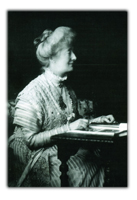
Once more I experienced the thrill of boarding the ocean going ship at Burutu and heading for home. Once more I felt the exhilaration of seeing the red earth and lush green grass of Devonshire as we steamed into Plymouth Sound on a sunny May morning. Once more my brother welcomed me with his usual hospitality to his bachelor house in Bennet Street. I heard again the jingle of hansoms and the clip clop of the horses' hooves, and again I revelled in the sights, sounds and even the smells of Piccadilly. My sister Lou had married the previous year and settled down in a house in Chelsea where she made me welcome at all times. The London season was in full swing and all my friends seemed to be in town, so that what with dinners, and lunches and theatre and supper parties and all manner of social functions I never had a dull moment. On the voyage home I had made friends with a man named Richard Edward Dennett who was coming back to England for the first time after no less than eighteen years in the Congo where he had gone out as a trader and then settled down amongst the natives and studied their superstitions, their religion, their manners and customs and their history. He was a most interesting man to meet and had a great charm about him, and incidentally he had seen a great deal of Mary Kingsley during her visits to West Africa and had supplied her with a good deal of most useful information about the natives and their beliefs and customs. Through Mary Kingsley he had become acquainted with Mrs J.R. Green, the widow of the historian, and when we arrived in England he took me to call on her. Thus started one of the most valued and treasured friendships of my life. Mrs Green lived in a charming house in Grosvenor Road, looking across the river at Lambeth Palace, and it always seemed to be sunny. She lived along with her books, but her hospitality was boundless, and one met at her house some of the most interesting people of the day. In politics she was an ardent Liberal and a convinced Home Ruler (She was a Stopford from Ireland) and some of the most distinguished Liberals were constant visitors at her house. The Liberal Party had had a striking success at the recent General Election, after a long period 'in the wilderness', and it was preparing and rapidly putting on the statute book a series of liberal measures which had been held up during the long period of Conservative ascendency.
 |
|
|
Mrs Green welcomed me because her friendship with Mary Kingsley had made her keenly interested in West Africa and anything to do with it and in her I found a marvellously sympathetic listener when in my enthusiasm I talked to her of Northern Nigeria and of Lugard and of all we were trying to do for the natives. She constantly invited me to little informal lunches and dinners at her house, and to tea parties which filled her not very large rooms to overflowing; and at all these functions I met people who were to me of the greatest interest, many of whom were well-known in politics, literature, art, travel and so forth. In this way I became acquainted with quite a number of men who were either at that time Cabinet Ministers or later became so, and it was fascinating to me to hear current problems of the day discussed at informal gatherings of perhaps 6 or 8 people by men who really knew what they were talking about and were in many cases dealing themselves with the problems discussed. No one seemed to mind being asked questions, nor did they seem to regard with any sort of superior wisdom the eager but curiously ill-informed young man from one of the newest of our African colonies and protectorates who appeared so anxious to learn about subjects which had been familiar to them all their lives. Of course I had to thank my hostess for this. She had a genius for collecting at her table or in her house men and women who she knew would get on well together and who had mutual interests and as she once explained to me, men who had been in politics most of their lives were interested to meet a young man who had spent all his years of service in different parts of the Empire and could give them first hand information about countries, and particularly those forming part of the Empire, of which they knew little but the name.
I have said that I was in my early days a convinced and somewhat narrow-minded Conservative. When I first went out to Nigeria the Secretary of State for the Colonies was the great Joe Chamberlain and though I was of course far too junior a colonial officer ever to come in contact with him I felt immensely proud to be serving under a Department of State presided over by such a colossal figure. Shortly after I went out however he resigned from the government (Mr Arthur Balfour being then the Prime Minister) in order to be able to devote himself to his great crusade for Tariff Reform. When I was home on leave in 1904 I had been given a ticket by my friend Miss Violet Brooke-Hunt for a giant meeting held in the Albert Hall which was addressed by Mr Chamberlain who stated the case for Tariff Reform with immense force and eloquence and a vigour which was astonishing for a man of his age. So far as I was concerned I was already a convert, though I knew nothing and perhaps cared less about economics. I was willing enough to conclude that Fair Trade was the best policy, provided it were world-wide; but I was unable to see how any one nation could continue indefinitely to admit manufactured goods free of duty from all over the world whilst other nations penalised by heavy duties the import of manufactured goods.
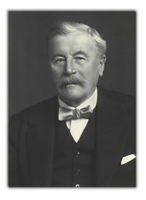
When I came home in 1906 and became a frequent visitor at Mrs Green's house all those I met were of course Liberals and Free Traders and when politics was discussed - as they often were - I heard the view of the Liberal Party and nothing else, unless it were a vigorous refutation of the tents of the Conservative Party. I remember once sitting next to Sir Herbert Samuel (now Viscount Samuel) at a small informal dinner party at Mrs Green's house and asking him whether two subjects then being very widely discussed, viz Conscription and Tariff Reform, were fundamentally contrary to Liberal policy, and if so why. He replied that he could hardly give me a complete answer in the course of a dinner time conversation, but that he had recently published a book on the Principles of Liberalism which dealt fully with both subjects. A few days later I wrote to him and reminded him of our conversation and I asked for the name of the book to which he had referred. By return of post came a copy of the book with a charming little note enclosed asking me to accept it, and I still have the book somewhere with the note posted inside. On another occasion Mrs Green asked me to lunch to meet H.G.Wells and I found myself sitting next to him, only four other people being present I think, besides our hostess, one of the guests being a young Irish poet, and the other a girl of about 24 who had just graduated from Girton College after a brilliant university course. I found myself upholding with great eagerness the view that the best form of government in thought at least was that of a beneficent dictator, a view to which H.G.Wells was naturally strongly opposed, being supported by the Socialistically inclined girl graduate. In the end Mrs Green tactfully closed the argument by saying "I am inclined to support Captain Orr's contention provided he will add the word 'Intelligent'." How characteristic of her to take the side of the weak against the pundits! Looking back now that summer of 1906 I realise what a deep debt of gratitude I owe her for her overflowing hospitality and friendliness to me, and even more, if that is possible, for the encouragement she gave me in developing my ideas and learning something of the important domestic, imperial and foreign affairs which the newly installed Liberal Government was tackling with such energy and earnestness. To her I owe many friendships, a number of which have lasted till today. There was Sir Antony (later Lord) MacDonnell, summoned from the Governorship of an Indian Province to try to settle the vexed Irish question - in which alas he failed. There was Josiah Wedgewood and his wife, the former just starting his Parliamentary career. Mr and Mrs Runciman, he being a rising Liberal Member of Parliament who distinguished himself a few years later as President of the Board of Trade during the critical early years of the Great War. Both he and Jos Wedgewood were raised to the peerage not many years ago. Other men either already distinguished or to become so later I met at Mrs Green's house - H.G.Wells, as I have already related, John Burns, Sir John Simon (a nephew of Mrs Green's), the ill-fated Sir Roger Casement, and many others!
One day I said to Mrs Green, "You are always asking me to your house and showing me hospitality and I don't seem to be able to do anything in return." "A great many people come to my house," she said "and very few seem to trouble much about asking me out because I am a grey-haired woman I suppose. I appreciate very much what you say, and I should love to be taken one evening to supper at the Savoy as few things give me so much pleasure as seeing young people enjoying themselves." I was delighted that I really could do something in return for all the hospitality she had shown me and I promptly bought a couple of tickets for - I think - one of the Gilbert and Sullivan operas that was being revived at the time, and ordered a table for supper at the Savoy. Mrs Green throughly enjoyed the evening, and it was good to see her delight in watching the supper parties all around us at the Savoy, and seeing as she had said "the young people enjoying themselves," the men in immaculate evening dress, the girls in all sorts of pretty frocks, for supper at the Savoy was in those days the most fashionable evening social function in London.
These constant contacts with interesting people were to me a new experience, and immensely interesting and exciting. But besides them there were also all the excitements which the London Season provided - lunches, dinners, dances, theatres, supper parties, teas at Hurlingham and so forth, forming such a complete contrast to my life in the middle of the African continent. In those days all London society was open to an unattached young men who belonged to any well-known Club, for London hostesses were generally short of young men, and were often hard put to it to get enough for their dances and even dinners or the social entertainments. After I would find amongst my letters at the Club when I went round in the morning one or more cards of invitation for some social entertainment from a hostess I only knew by name, and sometimes not even that. I think hostesses used to pass on to their friends the names of men who had been guests at their houses, with the recommendation "Quite respectable, my dear" or even "Quite nice". I must say that I didn't altogether appreciate these cards of invitation from ladies whom I didn't know for I had a disagreeable feeling that I was mainly being made use of. Certainly I do not remember every availing myself to any such invitation, and I fear I usually left the cards unanswered, realising that they had been made out by some private secretary, given a pretty wide distribution. In any case I was never particularly keen about dances because I felt that one was always changing partners; and I used to say that if ever I were rich enough to give a ball, I should have say only four dances during the whole evening so that partners could keep together for at least a quarter of the time instead of being obliged to change about every fifteen minutes or so. I was, however, taken by some old friends of mine, shortly after my arrival from Nigeria, to a big and fashionable dance in Park Lane, and there introduced to a variety of partners. Having just come home on leave I was out to enjoy every minute of my time and I was fascinated by the brilliant lights and decorations, the pretty frocks of the women and the general movement and air of gaiety that pervaded those handsome rooms in Mayfair. Soon my eyes fell on a girl who looked pretty and interesting and especially attractive, so much so that I contrived to get an introduction and found that she had one dance to spare - the first supper one - which I promptly booked. In due course I found myself taking her down to supper, and having pounced on a table for two I brought some refreshments and had our glasses filled with champagne and sat down to enjoy myself. She was the daughter of a rather distinguished man, and evidently in a position to know most of what was going on in the world at home and abroad and was obviously well read and intelligent. She was, in fact, or seemed to be, just the sort of person I had often dreamed of meeting and possibly falling in love with. It all seemed very romantic, adventurous and exciting. Conversation was delightfully easy and we both made rather obvious attempts to find out about each other whilst trying to disguise the fact that we were doing so. Presently it came out - in answer I suppose to some question that she asked me - that I had been in the Boer War. "Oh" she said, "you were in the Boer War, were you?" (It had ended only four years previously, when she was no doubt in her teens). She paused a moment, and then said casually as she took a sip at her champagne, "Did it amuse you, or were you bored by it?" In a moment the picture flashed into my memory of that dark, grim February morning when I marched my men from Woolwich barracks through the thick yellow fog down to the docks to embark for South Africa, followed by the crowd of weeping women. Was I amused or bored, this girl was asking me. She would surely be asking me next whether my life in Nigeria, which stirred to the depth every emotion and enthusiasm of which I was capable, amused or bored me. Apparently amusement and boredom were the only two reactions which events, however stirring or vital or thrilling they might be, could produce in this London society of which she formed part. I stammered out something, I forget exactly what, and at that moment the music struck up for the next dance and we made our way back to the ballroom. All my feelings of romance and adventure had died out for the moment, and I wanted only to get away from this atmosphere of cynicism and artificiality and breathe the fresh air once more. I made some excuse to the kind friends who had brought me, bid my host and hostess goodnight with a formal expression of gratitude for their hospitality and was soon walking home through the almost empty London streets. I don't think I went to another dance that Season. No doubt I made too much of a casual and rather conventional remark, but it ran counter to everything I cared for and respected and everything that seemed to make life worth living.
Coming back to Bennet Street late one night in mid-June I found two notes awaiting me, each containing a thrilling piece of family news. The first was from a cousin staying with my sister Lucy in Chelsea to announce that a daughter had been born to the latter (I forget if I have already mentioned that she had married Harry Thackeray of the Board of Education the previous summer when I was in Nigeria). The other was from my sister Mindie to tell me of her engagement to Jack Evershed an astronomer who had been given an appointment to an observatory in India. They planned to get married in about 3 months time and to go out immediately afterwards to India.
By the end of July the London season was over, and most of "society" had left for their country houses. The MacDonnells had very kindly asked me to stay with them in Ireland for the Horse Show in August and I duly went across to Dublin and presented myself at Under Secretary's Lodge in Phoenix Park, where Lord MacDonnell had been permitted to stay on until October, although he was no longer Under Secretary, his plan for a National Council for Ireland having been rejected by the Irish Nationalists. Lady MacDonnell and her daughter Anna had collected a big house party, for they both adored entertaining, and they realised that this was the last chance they would ever have of doing so on a large scale. We used to sit down little short of 20 at meals, and most of the party were young - by which I mean between 20 and 40 or thereabouts. Every day we went to the Horse Show, Dublin's great and time-honoured annual function, always attended by the Viceroy in State and by every man and woman in the United Kingdom and Ireland who cared for a horse, and many others who didn't know a horse from a mule. The MacDonnells were kindness and hospitality itself, but somehow I could not help feeling that there was a kind of forced gaiety in that house, and I cannot say that I altogether enjoyed the visit. Lord MacDonnell after a long and distinguished career in India had, as I have said, been summoned home to help the Government settle the vexed and seemingly insoluble Irish question. This had been for him not only a great and unprecedented honour, but an opportunity almost without parallel for finding a solution to the age-long quarrel between Ireland and England and thus crowning his career by an achievement which would go down in history. And now it had ended in failure. He could not go back to India, and there was no sort of Government post at home which could be found for him. The peerage with which he had been rewarded meant little to him, especially as he had no son to inherit it. His career of distinguished public service was at an end, and retirement on a not particularly large pension was not an alluring prospect for a man of his ability, vision and record. While I was at Under Secretary's Lodge we seldom saw him except at meals, and then he was always courteous and a delightful host, entering fully into the conversation and giving his attention to all his guests with a wide and generous sympathy and interest which made all of them feel at home with him. Yet I was always conscious of the tragedy behind it all, and it was this that made my visit to this kind and hospitable Irish family less enjoyable than it otherwise would have been.
I paid another visit to Ireland that summer, this time to the north where I took my sister Harriette and my cousin Isobel Gardner (Mitchell as she was then) to see some of the beauty spots of that loverly part, Country Donegal. Later I hired a car, with chauffeur, as I had on my previous leave for a few weeks, and went off up to Scarborough so as to be near the Thackerays who had taken for the summer holidays a small house near Robin Hood bay, not far from Scarborough. From this house my sister Mindie was married to Jack Evershed early in September, and I lent them the car for their short honeymoon - only a week - whilst I dashed up to London to be present at the wedding of my cousin Bill Acworth.
By the end of September I had given up my car and was back in London once more, staying as before at my brother's house, and I then settled down to work for my army examination for promotion to Major as I wanted to get it over, and an examination was to be held in London in October. I may add that I sat for it in due course and passed, though I was far from repeating my feat in my examination for promotion to Captain in India, and only gained a 'distinguished' (80% marks) in two, I think, of the subjects instead of all 5. But I had not set out to get more than a mere pass as Nigerian affairs were uppermost in my mind, in any case it was doubtful whether I should return to the Army when my 5 years secondment should end in 1908.
 |
|
|
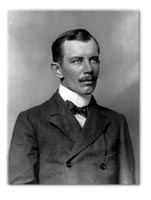
It was at this time that an event occurred which had an indirect but very definite effect on the course of my whole career. My uncle, Sir William Acworth, who had acquired an outstanding position in the country as one of the recognised authorities on railway matters, told me that he was giving a dinner party at the Reform Club to a small number of friends, mostly railway men, amongst them being Sir Percy Girouard, and asked me if I would care to come and meet the latter, as a rather distinguished soldier. I jumped at the offer, more particularly as the question of railway construction in Nigeria was at that time of extreme interest to me, as indeed it had been ever since I first went out there. I was therefore delighted at the idea of meeting Girouard, as I thought I might get the opportunity of discussing the matter with him and obtaining his views.
 |
|
|
The Colonial Office had during the past 6 or 7 years received a number of proposals for railway construction from the various Governors of the 3 separate but contiguous colonies situated in the Niger Basin - Lagos and Southern Nigeria on the coast, and Northern Nigeria in the hinterland. A railway had already been constructed from the port of Lagos west of the river and northwards a short distance into the interior, and the Governor of Lagos was strongly advocating that this should be continued, parallel to the Niger till reached the bend of the river. From this point it could then cross the river and be extended into Northern Nigeria, which would then have direct railway communication with the sea. The Governor of Southern Nigeria (which lay to the East of the river) recommended on the other hand that a line should be built into the interior from one of the principal ports of his Colony, Calabar for choice, pointing out that only by this means could the Colony be properly developed, and that such a railway might easily be continued into Northern Nigeria across the Benue River. Lugard for his part was strongly advocating that a light railway line should be constructed at once from the highest navigable point on the Niger to the Hausa States, the produce from the latter thus being brought down by rail to the river where it could be transferred to steamers which would take it the three or four hundred miles to the sea.
Here then were three conflicting schemes, each backed by solid arguments and each possessing obvious advantages, put up by three Governors in whose judgement the Colonial Office placed great reliance. How was the Colonial Office to decide between them? It consulted its Crown Agents and other authorities, and various criticisms of the schemes were sent out to the several Governors and many lengthy despatches drafted and sent both to and from the three colonies, but nothing was decided and nothing tangible done. I need hardly say that I was backing Lugard's scheme for all it was worth. What we needed in Northern Nigeria was a light, narrow gauge railway from the highest navigable point of the river up to Kano, and we needed it urgently. It would be maddening to have to wait till a railway ponderously and slowly built from the coast should at length reach our southern boundary. Moreover, we were prepared to build a light line ourselves, with our own Public Works Department, if the Colonial Office would grant us the money or even sanction a loan. And we asserted that we could build it in this way far more cheaply and more rapidly than if the work were handed over to a firm of Railway Contractors, as in the case of the Lagos Railway.
When the Liberals came into office in 1906, Winston Churchill was appointed Under Secretary of State. Churchill did not, as may be imagined, let the grass grow under his feet. He applied his immense energy as well as a fertile imagination to colonial problems. Amongst the mass of questions with which the permanent officials of the Colonial Office were dealing in their own slow, cautious, painstaking way, was this matter of railway construction in the three adjacent colonies in West Africa which bordered on the River Niger. Not many months elapsed before the bundle of papers and despatches dealing with this problem came into Churchill's hands. Here was an urgent matter which had hung fire for years for want of a decision as to which of at least three schemes, put up by three separate Governors, should be approved and sanctioned. Evidently, thought Churchill, this is a matter on which some man well versed in railway construction but entirely unbiased, and so far as possible unconnected with the Niger Colonies, should be consulted. He remembered that when some nine years previously he had accompanied Kitchener's expedition to Khartoum in the role of subaltern in a cavalry regiment, he had met a Sapper subaltern called Girouard who under Kitchener's orders had constructed a light railway across the Desert and had made such a success of the job that he had subsequently been appointed Minister for Railways in the Egyptian Government! And that when the Boer War had broken out, Kitchener had sent for this Sapper Officer to take over the management of the railways in South Africa. Churchill remembered Girouard as being endowed with a very good head and a forceful personality. Here, thought he, was just the man to advise on this railway problem.
On making enquiries he found that Girouard, after leaving South Africa, had returned to army work and at that time was holding a staff appointment at Chester the Headquarters of the Western Command. He wrote to him, and asked him to get ten days leave and come up to London and see him.
 |
|
|
Girouard's career had been an exceedingly interesting one. He was a French Canadian, the son of a judge in Quebec and he had been educated at the Royal Military College at Kingston, Ontario. After passing through the college he had been employed for a short term in the Engineering Branch of the Canadian Pacific Railway and had then obtained one of the commissions in the Royal Engineers which the War Office gave from time to time to graduates of Kingston College. Coming to England he went through a two year course at the School of Engineering at Chatham and was then sent to Woolwich to take charge of the miniature government railway that had been constructed in the Woolwich Arsenal as a convenient way of transporting material from one end of the Arsenal to the other. Though only a miniature railway it must have entailed some skill in management, for Girouard once told me that, with all its little branch lines and sidings it was just short of 40 miles in total length at the time and grew substantially more later.
When Kitchener was preparing for his advance on Khartoum to attack the Khalifa in 1897 he decided to build a railway across the desert where the River Nile takes a wide loop and runs over rapids. He therefore applied to the War Office for a senior officer in the Royal Engineers who knew something about railway construction. It happened that Girouard was the only officer who had had any experience of this kind of work, and though Kitchener was displeased at being fobbed off with a mere subaltern, the War Office had its way and Girouard was despatched to the Soudan. On arrival he received his instructions and immediately set to work to make his estimates, compile a list of his requisitions and survey the line. Kitchener, as was his wont, proceeded to cut down the estimates very considerably, and at the same time informed Girouard that he must have the line constructed in about two thirds the time that Girouard had estimated would be required. Most subalterns would have been afraid to cross Kitchener, but not so Girouard. He clicked his heels together and informed Kitchener quite definitely and firmly that the estimates he had made had already been cut to the bone and that the work could not possibly be completed a day before the date which he had given. Kitchener, unused to being stoop up to, unexpectedly told Girouard to "get on with the work." and said no more. In the end, Girouard had the bit of railway constructed and in working order by the very date he had given, and at the end of the campaign he had received a brevet majority and a DSO. What was more he was offered and at once accepted the appointment of Minister of Railways in the Egyptian Government, and found himself a high official in Cairo with a salary of something like £2000 a year, when only 18 months before he had been an obscure subaltern in the Sappers looking after a miniature railway in the Woolwich Arsenal.
Two years later, the Boer War broke out, and within a few months Lord Roberts was sent out as Commander in Chief, with Kitchener as his Chief of the Staff. The latter, realising the important part that railways would take in the struggle, asked for and obtained the services of Girouard from Egypt and on his arrival entrusted him with the entire management of all the railways. So great a success did Girouard make of this task that at the end of the war he was given a brevet Lieutenant-Colonelcy and a Knighthood - the only instance I have ever known of any soldier being created a Knight in an order in which he had held no previous rank. What is more, after peace had been signed in May 1902, Girouard was appointed Minister for Railways in the new South African Government under Lord Milner.
After holding this very responsible post for 3 or 4 years however, years during which he had the tremendous task of reorganising the entire railway system, devastated by three and a half years of war, he resigned in circumstances of which I never knew the precise details. There was some local agitation, I believe, and representations had been made to Lord Milner that there had been extravagance in the matter of replacing old and worn-out rolling stock. Girouard in telling me the story hinted at local intrigue, and once asserted - without any malice - that Lord Milner had "Let him down." However that may be, he resigned his appointment as Minister for Railways and returned to England where he reverted to Army duty in his substantive rank in the Royal Engineers, viz that of Captain. As such he was posted to Aldershot to a company of Sappers where his main duty was looking after and repairing the barracks. After his meteoric career - he had risen in some 8 or 9 years from an unknown Sapper subaltern to become a Brevet Lieutenant Colonelcy, a KCMG, a Minister for Railways first in Egypt and then in South Africa - he suddenly found himself back again as a junior regimental officer, building barracks. During the course of his campaigning in the Soudan and South Africa however he had made many friends in high places, and before long he was given an appointment on the staff of the Northern Command at Chester, and here he settled down with his wife - whom he had married in South Africa, the only child of Sir Richard and Lady Solomon, then Attorney General in the South African Government. Sir Richard had been Chief Justice in the Transvaal and when South Africa was given its constitution he was sent to London as High Commissioner for the new Dominion. Girouard was holding this staff appointment in Chester when Winston Churchill sent for him in London.
I must now return to my uncle's dinner party at the Reform Club. There were altogether I think ten of us, and on sitting down I found that my uncle had placed me next to Sir Percy Girouard, Mr Paish, The Editor of the Economist (subsequently Sir George Paish) being on my other side. From the moment we sat down however Girouard never addressed a word to me - although we had of course been introduced before dinner - and carried on a lively conversation with his other neighbour Lord Farrer I think, during the whole of dinner. I was not unnaturally somewhat disappointed and felt a little snubbed, but I found Mr Paish a delightful conversationalist and a charming person, so I decided when we got up to have coffee and cigars in another room that I hadn't missed much after all. I was sipping my coffee and talking to someone else when to my surprise Girouard hove down on me from across the room and said "You're serving under Lugard in Nigeria aren't your? Well, I want to talk to you. I will make our excuses to your uncle and take you to an upper room where we can be quiet - I'm a member of the Club." With those words he went up to my uncle and said "I'm carrying off your nephew as I want to discuss some business with him, and it will take some time, so please excuse us." Leading the way upstairs he opened the door of an empty room, opening a despatch case he drew out some papers and maps. He then explained that Churchill had asked him to read through all the voluminous paper and blue books which dealt with the various railway projects put forward for the Nigerian territories during the past seven or eight years, and make an unofficial report and recommendation. "What I want from you", he said, "is a little local information, as to climate, nature of country, navigability of rivers, population etc, as I have never been to West Africa and have no first hand knowledge of these details." Here indeed was my chance - the chance of a lifetime. I gave him enthusiastically all the information I possessed and answered all his enquiries with eagerness. It must have been past midnight when we separated, but not before I had promised to meet him again in 2 or 3 days time at the Army and Navy Club, to which we both happened to belong. By then he calculated he would have been able to arrange his ideas clearly and would be in a position to start on the draft of his report; but, he said, before doing so, he would like to get some more information out of me. Actually we met two or three times, by arrangement, at the Club, and he read me a good deal of his draft Report, though not his recommendations. Then he returned to his post at Chester, and I saw him no more. But I felt sure in my own mind that he had decided that the correct solution of the problem was the one that Lugard had put forward viz to build, by our own Public Works Department, a light line from the highest navigable point of the Niger River, to Kano, and to put the work in hand at the earliest possible moment.
About this time I received from Lugard's Political Secretary a document which raised a very important question to which I had given a great deal of thought during my two tours in Nigeria. When I was acting as Resident of Zaria during my first tour in 1903 I had remarked in one of my monthly reports to the High Commissioner that the mass of work which devolved on a Resident in charge of a Province was so vast and so diverse that it was quite impossible for him to get through it adequately even if he worked seven days a week, and 8 to 10 hours every day and I suggested that to remedy this situation more of the administrative work might be left in the hands of Native authorities themselves. At the time I sent in this Report (about August 1903) Lugard was at home on leave and Sir William Wallace was acting as High Commissioner. The Report had been pigeon-holed at Zungeru, but two years later Lugard, looking through old papers had apparently come across it, and had instructed his Political Secretary to send it to me with a minute to the effect that he (Lugard) would like to hear more definitely what I had in mind in suggesting that more administrative authority should be left in the hands of the Emirs and Ruling Chiefs, although my suggestion was now two years old.
I remember very well receiving this document when I was nearly at the end of my leave in 1906, and taking it to a quiet 'Silence" room in my Club and sitting down to answer it. My reply was, roughly speaking, to the effect that it had long been patent to me that it was physically impossible for a small staff of Residents and their Assistants to administer directly so vast a tract of African territory as Northern Nigeria with its millions of inhabitants. Apart however from the physical impossibility, it was, I submitted unwise and unfair to endeavour to foist on an African community, steeped in its own traditions and accustomed to its own way of life, an alien civilisation differing in many ways fundamentally from its own. I recorded my conviction that we Europeans, coming into contact with an African people with a mentality, traditions, customs and a way of life wholly different from our own, ought first to study the African mentality and rules of conduct before endeavouring to uproot them and replace them with our own. I felt strongly that, to impose our way of life on the unsophisticated Africa could and did only result in the latter sloughing off is own native, indigenous habits and adopting instead the customs - or an imitation of the customs - of the Europeans; he was apt in fact to discard his own indigenous virtues and appropriate instead the least desirable of the characteristics of the European; or, to put it more bluntly, the African would discard the virtues of his race and retain the vices, while at the same time assimilating the vices of the European and neglecting his virtues.
I concluded my memorandum with these words: "It is an invidious task to complain of overwork, and very thankless. But when I think of the death roll and invalidings and shattered constitutions, and put it down as I do far more to the effects of constant overwork than to climate conditions, I naturally ask myself if it is not possible by some radical change to lessen the strain without at the same time permitting culpable misrule and oppression under the aegis of the British Government, It is impossible, then I accept the death roll."
I find that this memorandum bears date and place "Army and Navy Club, 29th September, 1906". Lugard himself must have been in England at the time, for I find his reply, written on the back of my sheet of foolscap in his tiny neat handwriting, is dated the very next day, viz September 30th.
His answer to my suggestion that the Hausa States might be administered as "Protected Native States" where a Resident should merely act as a sort of final Court of Appeal and stand in the background behind the Emir who would collect his taxes and administer his dominions under the advice and veto of the High Commissioner and Residents, what that he had no precise knowledge as to how "Native States" were run in India. But in general, he thought that the general principles were not very dissimilar from the system established in Northern Nigeria "Except in matters where more direct control is in the nature of things unavoidable." "For instance," he wrote, "a Resident in India has not to collect any revenue from the Native State. This touches the whole root of the matter, and constitutes the greater part of a Resident's work in Northern Nigeria." "I am all for utilising the Native Administration," he continued, "to the utmost extent possible as you know, but we found it in a rotten state, and until slave raiding and trading had been suppressed, and the Native Courts trained to better work, neither rulers nor judges were of much use. Again we have to do the police work and the fighting, and as we have no great military power behind us (as in the case of the Residents of Indian Native Courts) it is necessary that for our own safety the country should be disarmed, and we could not tolerate large armies at the disposal of Native Chiefs as in Gwalior and Indore etc. If you consider these things you will, I think, agree that the Indian "Protected States" system cannot be adopted in its entirety, but I think we have got a fairly good compromise between puckah administration and it." He then goes on to say that the staff of Residents had been from time to time increased, and work decentralised. "I think myself." he wrote, "that work does not kill; it is the bad food and bad housing, the latter especially, that is I think accountable for the death roll." And went on that he hoped to get good houses shortly up up in Kano and Zaria. "I think the Government" (he meant the Imperial Government i.e. Colonial Office and the Treasury) "is much to blame in this matter, considering how strongly I have represented matters."
I have dealt with his correspondence at some length because it obviously bears on the Lugardian policy now known to the world as "Indirect Rule" Lugard and the Protectorate of Northern Nigeria broke entirely new ground in pioneering this entirely new policy in Colonial Administration, which has since been established in every African Colony under British control, and has been copied and adopted by many foreign powers with colonies or protectorates in Africa and elsewhere, e.g. by General Lyautey in Morocco. It is unnecessary to point out that this policy of "Indirect Rule" points the way to that eventual "self-government" by communities within the British Empire and Commonwealth which is the avowed goal at which our nation is aiming, and is a kind of half way house between complete domination by a Ruling Power of a community or a federation of communities, and the complete and unfettered independence of the latter. It is my view that Lugard, after a period of trial and error, established in Northern Nigeria this system of Indirect Rule and built it better than he knew. for during the past 40 years world opinion has made tremendous and startling advances in the conception of the duties and the attitude of European Powers towards colonised peoples and those who have not advanced far along the road to civilisation, culture and a high standard of living.
I find that I made some pencil marginal notes on Lugard's reply to my memorandum (which never went further than my desk, where it still lies). Against the paragraph where he wrote "We found it a rotten state", I scribbled some obvious acerbity "This seems to me the fallacy underlying all our previous attempts at governing native races. We say with our usual British contempt of all that doesn't exactly square with our ideas 'It is rotten' and proceed to oust all native officials and substitute British officials with foreign ideas till such time as as we may be pleased to consider 'the natives' sufficiently trained to help in the administration of their country. I say, leave the native officials, and let us devote our energies to watching them carefully, checking abuses, and gradually weeding out anything radically bad. We shall need a far smaller foreign staff, thus reducing the financial burden on the country, and I will guarantee that the native is much happier and far more contented. 'Jekadas (native tax collectors) are corrupt.' says Sir Lugard 'Sweep them away; natives can't be trusted. Residents must personally assess, etc, etc....' and so we are being broken down with overwork, and the natives are sullen and discontented."
I also criticised in a marginal note Lugard's remark that "work doesn't cause the casualty list but bad food and housing." I can just read my pencil scrawl, nearly 40 years old. "No, it is ceaseless overwork, combined with bad houses and bad food. Anyhow the money for Zaria houses was all expended on the Kaduna Bridge - now useless!"
Only 3 or 4 years ago I sent this correspondence to Lugard to see, as I had mentioned it to him a short time before; and although he had of course no memory whatsoever of it himself he was always immensely interested in anything bearing on the old days in Northern Nigeria and said he would like very much to see it. Unfortunately I was stupid enough to leave attached to it the paper with the scribbled comments which I have noted above. He returned the correspondence a few days later with a brief expression of thanks and interest, adding a somewhat acid remark that it was not clear to him who had written the pencil comments attached, or to whom they had been addressed. Fortunately the letter needed no reply and I did not send one.
Sadly the memoirs come to an abrupt and unexpected halt at this point. Sadly, there is no mention of his return to Northern Nigeria nor of his service in other colonies nor of his service during the First World War. He did at least write other published memoirs which give a well rounded view of his professional experience in Northern Nigeria and in Cyprus.
|