

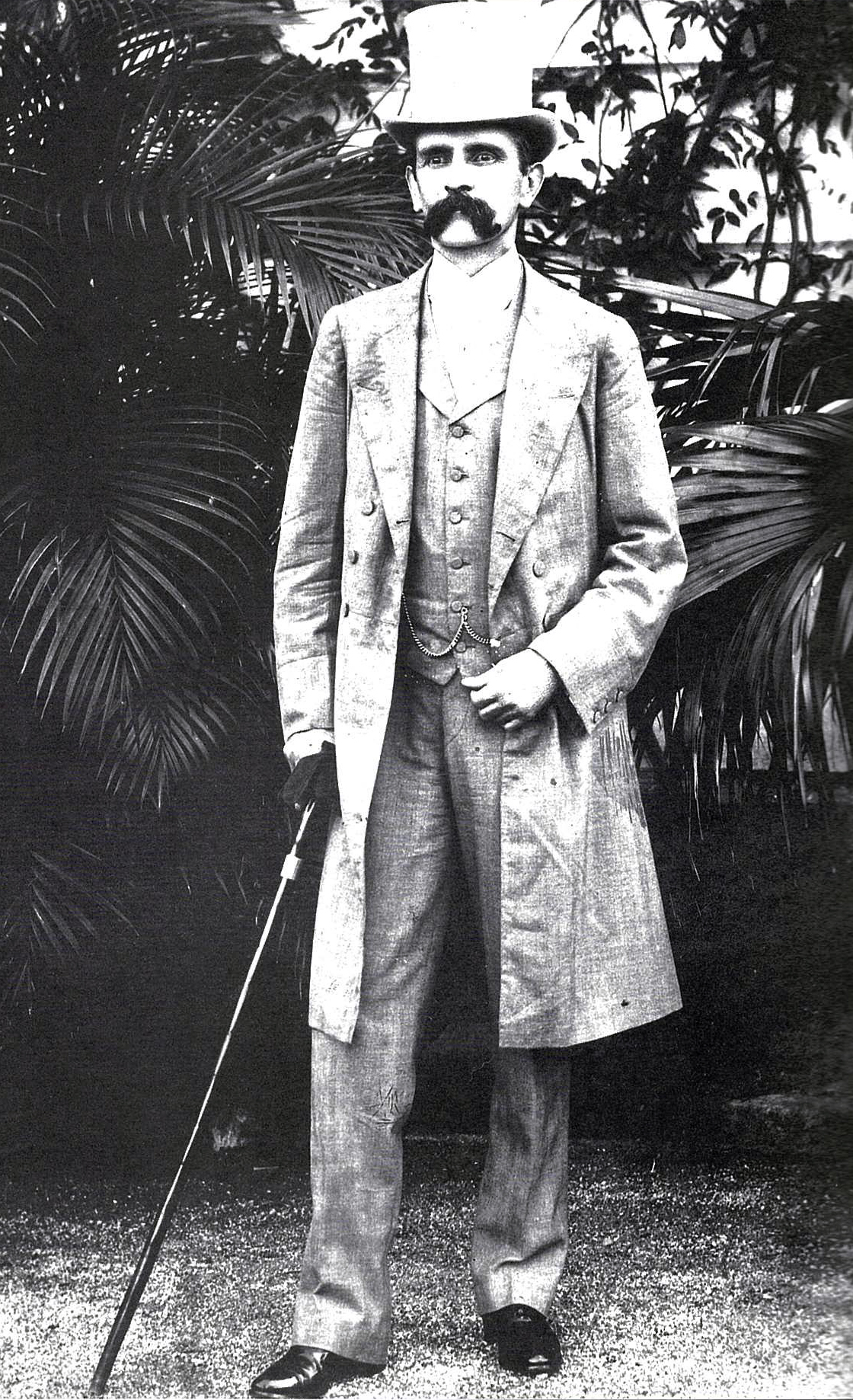
This picture is from the 1890s. It shows him dressed as a civilian but you can see the deep set eyes that Charles mentions.
The following extract was written by A. H. M. Kirk-Greene:
Lugard was appointed in 1897, with the dual title of her majesty's commissioner for the Nigerian hinterland and, in the temporary rank of colonel, commandant of the West African Frontier Force which he was to raise. As his second in command he asked for his old transport chief from India, Colonel Willcocks. The force was soon committed to implementing the Chamberlain–Lugard policy on the Niger, though Lugard's strategy was a far more forward one than Chamberlain's chess-board policy. Lugard's promotion to substantive major came in 1896 and to lieutenant-colonel in 1899.
In 1900 the government terminated the Niger Company's charter and declared a protectorate over Northern and Southern Nigeria. Lugard's African record made him a prime candidate for the first charge of the north. Although the company had entered into treaties with a number of chiefs, it had taken no effective steps to bring the area above the Niger–Benue confluence under administration. Some of the Fulani states in Hausaland enjoyed an established military history and could be expected to fight for their independence. Lugard's time in Africa had taught him how a combination of military force and firm diplomacy could ensure control. It had also given him a realistic and statesmanlike conception of the relationship which could most effectively exist between an administrator and chiefs. A long-suffering War Office gazetted him in the temporary rank of brigadier-general and in 1900 Lugard assumed office as high commissioner of Northern Nigeria, and was appointed KCMG a year later. Thus reinstated in official esteem, Lugard's transformation from seconded soldier to imperial administrator was complete.
It was not in public life alone that Lugard now entered the establishment. He came to know well Flora Louise Shaw [see Lugard, Dame Flora Louise (1852-1929)], the brilliant colonial editor of The Times, whom he had first encountered, in reproof, when he had gone to seek a sympathetic review of his forthcoming book on east Africa. Her admiration of Chamberlain and Goldie brought her and Lugard closer. Their friendship deepened, and during his first tour in Nigeria they married, in Madeira, on 11 June 1902, he sailing from Lagos and she, a month before the wedding, from England. Together they returned to Nigeria, sailing up the Niger to Government House at Lokoja.
Lugard's administrative staff was small and his finances restricted, but the speed with which he brought the protectorate under control was remarkable. A measure of force was inevitable, but by 1902 the kingdoms of Nupe, Kontagora, Yola, and Bauchi had submitted, and Bornu too, despite the confusion generated in the north-east by Rabeh, the French, and the Germans. A greater trial of strength, however, would clearly be called for in such traditional strongholds of Fulani supremacy as the emirates of Sokoto, Kano, and Katsina. Lugard, well aware that the Colonial Office was opposed to armed intervention, did not hesitate: the office could be told later that the expeditionary force had already been ordered to advance. He marched against Kano, which surrendered in early 1903, and Sokoto fell in March after a brief battle. Lugard, gaunt and dust-covered, and looking anything but a high commissioner, rode into the sultan's capital, and on 21 March delivered a subsequently famous address in which he elaborated the principles of British rule outlined in Kano a fortnight earlier. The chiefs were to be recognized and supported, yet firmly guided by British officials in their rule and unambiguously controlled in the abolition of slave trading and the administration of taxation and justice. Under this system of indirect rule, which Lugard codified and with which both his name and his major writings are indissolubly linked, the traditional rulers were not to be treated as semi-sovereign princes in the Indian and Malayan fashion but as an integral part of a single administration. By 1905 the protectorate was functioning well, though in the first months of 1906 the thunderclap news of a grave setback at Satiri, where British officials were murdered, and of an armed revolt in Hadeija—both resulting in military reprisals and heavy casualties—clouded his achievement.
Lugard resigned his post in September 1906. If he felt dissatisfied with the restraints put on him, the Colonial Office was equally disturbed by the frequent friction that coloured relations and by his military tendency to act first and request permission after. On both sides, too, there was the irritation of the idea he urged on Whitehall of allowing him, quite exceptionally, to carry on the administration of Northern Nigeria while he was on leave in England. The scheme had been devised by both the Lugards, combining his continuous distrust of the Colonial Office and its senior officials, his reluctance ever to take a holiday, and his inability to delegate with his desire to spend as much time as possible in England with his wife, whose health had broken down after five months in Nigeria and who could not return there. Together they conjured up a new dimension of tropical administration at the Colonial Office, with Lugard spending half the year in his territory and the other half administering it from Downing Street. The office was less than enthusiastic, especially when Lady Lugard published an article in The Times praising the merits of the scheme. Colonial Office staff felt alienated and sidetracked. In March 1906 the much lobbied scheme was ruled out and Lugard was recalled for consultation. Disappointed by what he interpreted as Lord Elgin's reneging on a promise given by his predecessor, Alfred Lyttelton, disillusioned by his reception at the Colonial Office, and determined never again to let Africa come between him and Flora, Lugard sent in his resignation.
Charles Orr's Memoirs Volume 5b

