|
Continued from Sir Charles Orr's Memoirs Volume 5
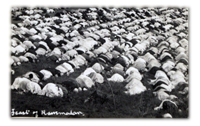
The day following the fast is observed throughout the Islamic World as one of the greatest of Moslem holidays. A religious ceremony is held in some wide open space as the sun rises, attended by the whole male community attired in spotlessly clean white robes, after which all retire to their homes and indulge in feasting and festivities of all sorts. At the invitation of the Sultan I rode out at dawn to watch the ceremony at sunrise. It took place on a great open plain outside the city walls sloping down gradually to a small stream, which ran almost due north and south, so that the sun rose above the top of the slope, and all the people were assembled facing the rising sun. At the top of the slope were the mullahs or priests; immediately below them were the Sultan and his entourage and his office holders, and below those again were the whole of the male inhabitants of Sokoto, old and young, rich and poor, sturdy and infirm, stretching all the way down to the stream. All were dismounted, grooms holding the horses of those who had arrived on horseback, but holding them alongside their masters. As the first first rays of the sun appeared in the east, the mullahs began reciting the appropriate passages from the Koran, and the entire multitude prostrated themselves, touching the earth with their foreheads, going through the prescribed genuflexions, and making the usual responses to the passages intoned by the mullahs. It was one of the most impressive sights I have ever seen. As the sun gradually rose above the horizon it lit up the shining white robes of the entire assemblage, and all the genuflexions were carried out in the most perfect harmony, so that the crowd looked almost like an immense field of wheat, bent to and for by a passing breeze. Sultan and slave, master and servant, performed the same genuflexions alongside one another, and the entire concourse as one man rendered their homage to Allah the all-high. A truly democratic and most impressive spectacle.
The ceremony was as short as it was simple. I stood apart, deeply stirred by the sight. Then the Sultan and his office bearers mounted their horses once more and rode back to the city, the whole assembly following them at a respectful distance, and the ceremony, as far as I was concerned, was over. No one who has witnessed such a ceremony or heard the Muezzin's daily call to prayer at dawn in some Mahomedan town or village can have anything but respect for a faith so simple, so democratic and so wide-spread "There is One God, and Mahomed is his Prophet".
My journey back to Zaria was almost as dull and fatiguing as the journey from Kano to Sokoto had been a short while before, and was roughly the same distance. On one occasion I had to spend the night in the bush as my boys had mistaken the road and we did not make contact till next morning. As they had with them my cook's box and cooking implements and all supplies I had to spend a supperless night, since all I had with me were some tinned food which I found myself unable to open though I hammered at them with rocks but without avail. On another occasion I found that my cook through some carelessness had let some of the kerosene from my hurricane lamp seep into the soup and all the food he had prepared, making it utterly inedible, so again I went supperless to bed. But food never meant much to me, and after an explosion of anger I lit a pipe and sat down and wrote a letter to my sister by the light of the flickering hurricane lamp which had been the indirect cause of the trouble. "I have just finished", I wrote, "a delightful dinner. It consisted of of Mulligatawny soup, sole, roast beef (undercut and very tender), a delicious sweet and a most tasty savoury. You didn't know that I got dinners like that in the bush, did you? Well, I do, but only in my imagination. As a matter of fact my dinner consisted of one mouthful of greasy soup made nauseous by a flavouring of kerosene oil, and I spat it all out." And then I told her what had really happened, knocked the ashes out of my pipe, went to bed and thought no more of it.
At long last my tedious journey came to an end and to my great joy I saw the massive rock that I had named "Gibraltar" in the distance, and soon I was back in Zaria, receiving a warm welcome from a new Third Class Resident named Arnett who had arrived a couple of months before and had been running the Province pending the appointment of a successor to George Abadie. How glad I was to be back in the old familiar surroundings! And the welcome I received from the native staff seemed genuine, as was the welcome given to me a day or two later by the Emir and all his office bearers.
Arnett I found to be a competent, keen, understanding, and a very pleasant companion. Little had been changed since I had left the Province a short while before, and I was glad to find that the general lines I had laid down had not been altered, though this is not to say that Arnett had not put any amount of energy into his work. Much indeed had already been accomplished by him, and I have never come across a harder worker, but he had made no attempt to introduce novel ideas of his own. He had loyally accepted the policy which he found, and during the whole of my service with him I always found him only too willing to carry on the affairs of the Province as I wanted, though he was always ready with suggestions and ideas if he were asked for them, and in fact I derived much help from him in this way, and owe much to him.
I now began to think of leave to home, though the normal tour of duty had been extended just before I came out, from one year to 18 months. Nevertheless it occurred to me that it would be best for me to go home just before the rainy season, leaving Arnett in charge, as I should then be back again about the beginning of the dry season when the real work of the Province began. I therefore applied to Headquarters for permission to go home on leave about the middle of April, adding that I was satisfied that Arnett was fully able to carry on during my absence, and in due course my application was approved, and I was informed that Lugard would like me to stay at Government House as his guest when I passed through Zungeru. Accordingly, about the second week in April I packed my few belongings, handed over to Arnett, and started on the 10-12 days march down to Zungeru. Arriving there I rode up to Government House where I was greeted by Lugard's Private Secretary Hopkins who showed me my room and said Lugard was in his office but that I should see him at dinner.
A good deal of correspondence had of course passed between Lugard and myself, mostly in the form of monthly Reports on the Province which I had had to submit, and of Lugard's comments on them which were usually terse, somewhat abrupt, and occasionally, I thought, rather crushing. I had however never actually met him, and I wondered very much what kind of a person I should find him to be. I imagined him a big man, with a stern and somewhat forbidding face, curt in speech and distant in manner, rather inhuman and unsympathetic, something of a martinet, if not a slave-driver, taking life very seriously and almost entirely devoid of any sense of humour or fun. I was prepared to be distinctly afraid of him, and to receive nothing but very definite orders from him; he was not the kind of man, I fancied, who would suffer fools gladly, or listen with patience to views that differed from his own.
What a surprise then I received when he came into the drawing room that night and Hopkins presented me to him - "This is Captain Orr, Your Excellency, Resident of Zaria." Instead of the tall stern-visaged man I had imagined I saw a small man with a pair of deep set brown eyes, with a kindly expression in them, who greeted me with a welcoming smile and out-stretched hand saying. "I'm glad to meet you at least, Orr. I've heard quite a lot about you from my wife and niece. I expect you're glad to be going home on leave after the strenuous tour you have had." There was a trace of shyness about him which was to me very attractive, and I found myself reflecting, "Here is the sort of man I can work for with all my heart and soul." And so indeed he proved, and now, forty years after that first meeting with him I bear him a regard and indeed an affection which has never once in all those years suffered the slightest diminution. All that I know of Colonial Administration I learnt from him, and his influence on my whole character has been profound. It was from him that I learnt to put my work before any mere personal consideration - salary, comfort, ambition, promotion, climate and so on. In his own life Lugard exemplified the saying "L'oeuvre, c'est tout; l'homme, c'est rien." With him, his work always came before everything else. He had a rare singleness of purpose from which nothing could deflect him. Yet he was by no means insensible to the joys of life, as opposed to its stern duties. In fact I remember him well pointing to a copy of the Laughing Cavalier which hung in his dining room at Government House, and telling me that he regarded it as a special and ever present reminder to him of the lighter side of life, the recognition of which kept a man balanced and integrated. This, by the way, is almost the only direct allusion I ever remember him making in the many talks I have had with him, to his philosophy of life. The immense influence he had on those who had the fortune to serve under him came practically entirely from his own conduct, his own manner of life. The immense influence he had on those who had the fortune to serve under him came practically entirely from his own conduct, his own manner of life. I found myself over and over again asking myself, when some problem arose either in my work on my own private life. "What would Lugard do?" Apart from his singleness of purpose, his outstanding characteristic was his courage, but moral and physical, and his readiness to shoulder tremendous responsibilities without a though as to what might be the consequences to him personally if he made a wrong decision. This was no doubt partly due to the fact that before coming to a decision on an important point he would try and weigh all the pros and cons, and seek the advice and opinions of anyone on whose knowledge or judgement he relied. But at whatever decision he arrived, it was his own decision and no one else's.
After dinner that night we all sat out on the verandah chatting till bedtime, and we did the same every night I was there - three in all, so far as I remember. Our conversation was mainly about local affairs, but it was only on the last night that Lugard brought out some official papers relating to Zaria Province about which he wanted some information from me. It was on this occasion that he asked me about the incident of the previous year when I had sent my official protest to Sir William Wallace about the Treasurer charging an item over expenditure to my personal account, but I have already narrated this.
During the course of our conversation I had mentioned incidentally that there were many young men in my own regiment, the Gunners, who I was sure would jump at the chance of coming out to Northern Nigeria if they knew about it. Now Lugard had with him his brother, Major E.J. Lugard, commonly known under his nickname; "The Spanner" who had been in the Indian Army and had later joined his brother in East Africa. "The Spanner" had been appointed by Lugard his "Political Secretary", in which capacity all administrative or political questions passed through his hands, since they could hardly be dealt with either by the Secretariat or by Lugard's Private Secretary. But when Lugard went home on leave, his brother naturally accompanied him, with the result that Sir William Wallace as acting High Commissioner had no one to deal with such questions. Lugard therefore was on the look out for some man with tact, experience and ability whom he could appoint Assistant Political Secretary, to take his brother's place when the latter went home on leave. Somewhat to my surprise he asked me if when I was at home on leave I could find someone whom I regarded as qualified for such a post. I said I would certainly try, and made a note of the various characteristics which Lugard would for in deciding on anyone recommended.
Next morning I left after my delightful and thrilling three days at Government House, took the little train to Bari-juko, found canoes waiting there for me, dropped down to Kaduna to Murejji where it joins the Niger, and in due course arrived once more at Lokoja. Here I embarked on one of the Government sternwheelers and three days later boarded the weekly Elder Dempster steamer and started off on my homeward trip. How exciting it was to be once more amongst the comforts of civilisation, and on my way back to England. After nearly 15 months of living on dry cabin biscuit and drinking lukewarm whisky and water, what joy to have decent meals and sleep in a comfortable bunk between cool, clean sheets!
The voyage home was completely uneventful, but how can I describe the joy of arriving at Plymouth Sound on a lovely sunny morning in mid-May and gazing lovingly at the warm red earth and brilliant lush grass of Devonshire after what seemed years in Central Africa? Other home-comings had been joyful, God knows - my arrival at Dover after 6 years in India, my return to England after a year and a half of soldiering in South Africa and China, for instance - but I think this first home coming after a year and a quarter of hard and responsible work in primitive living conditions and a complete absence of every comfort was the most thrilling and joyful of them all. My brother Herbert had invited me to make my headquarters at his comfortable bachelor house just off St. James' Street, where my sister Lucy was keeping house for him, and for my return he had got my mother to come up from the country stay a week or so with him. On landing at Plymouth I took the train straight to London and drove to my brother's house, and in a moment had my mother's frail, tiny frame in my arms. What a home-coming it was! How many questions there seemed to be to ask and to answer. I had never missed a week writing home to my mother and generally one at least to my sisters as well, but, lengthy as most of my letters had been they seemed to have omitted all sorts of details which those at home wanted to know. My brother, when he came in from his rounds as a busy West End general practitioner, gave me a warm welcome, and all four of us sat up late exchanging our news and discussing everything under the sun.
Never in my life before had I returned home to find any balance at my Bank beyond possibly a few pounds, but now I seemed to be a semi-millionaire with cash at my disposal to buy anything I wanted and spend as I pleased. During the whole of my absence in Nigeria I had lived almost entirely on certain local allowances which practically sufficed for all my inexpensive local needs, with the result that my salary which as a 3rd Class Resident had been I think £400 a year and on my promotion had risen to £600 or £700, had accumulated at the Bank where I found a credit balance of well over £500. Incidentally, when I came to unpack my tin cases I found quite unexpectedly a bag of about £5 in shillings, which had been paid over to me by the Treasure in Zungeru just before I left, in respect of some allowance or other due to me. This hoard of shillings I found most useful for hansom cabs and other incidental expenses of a similar nature, and I used from time to time to plunge my hand in and replenish my pockets, feeling a sort of miniature Croesus. And all the time I was at home on leave I was drawing my full salary - about £50 a month - so I felt indeed rich.
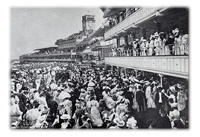
I had arrived home just in time for the Great Races, and I was determined to go on Cup Day and go in style. I therefore applied to the Lord Chamberlain for a ticket to the Royal Enclosure, which in due course was sent to me, and on Cup Day I borrowed a light grey frock suit from my brother and went off to Ascot. On the way to Waterloo I called in at my Bank and presented a cheque for £30, and received in exchange six crisp five pound notes. It was a superb, brilliant day, and on arrival at the Racecourse I presented my pass and walked proudly into the Royal Enclosure, watched the Royal procession drive down the course and later examined the distinguished assembly in the Royal Box through my binoculars. I ran into a few people I knew, enjoyed a glorious lunch with champagne and other luxuries in the Royal Artillery Luncheon Tent, put five pounds on the horse of my choice for every race, failed to strike a single winner, and came back in the evening joyous and excited, having had one of the most delightful days of my life, and laughing at the thought that I could lose thirty pounds of good money, which I had certainly earned, and yet care not one whit. I really think I should have been almost concerned if I had won my bets instead of losing them for it was the splendid novelty of having for the first time in my life money to play with that gave me so much invigorating pleasure. All this was very childish and very foolish, I realise, but the whole incident stands out so clearly after all these years - just forty - that I know that it must have given me a tremendous thrill at the time, or I should not have remembered it. Perhaps it was the beginning of my great hatred of the money motive in life, which I can now recognise as a characteristic of mine, though not one of which I am by any means proud when carried to extremes as I fear I have usually done. I have always protested against the saying "Take care of the pence and the pounds will take care of themselves", for I think it tends to develop a "Penny-Wisdom" which if definitely objectionable when it turns anyone - as it is apt to do - either into a skin-flint, or into a person who is always thinking of the money cost of everything. I should prefer to turn the proverb about and say "Take care of the pounds, and don't worry about the pence." To my mind, the ideal is to live comfortably within one's income whatever it may be, and always have a margin - to keep one's tastes simple and inexpensive in fact. Of course, those on starvation level whose income hardly suffices for their bare necessities are in a different category altogether - they have no choice. But I have seen many people continue to increase their expenditure as their income rises, so that there is never an appreciable margin between income and expenditure, and they are always on the brink of insolvency and always financially unhappy.
Anyhow that was a right royal leave, arriving as I did at the height of the London season, with money to burn, and all in such a tremendous contrast to the life I had been living in the back of beyond for more than a year. I joined the Hurlingham Club and took my sisters and my friend to polo matches and tea on the lawn. I gave luncheon and dinner parties, and supper parties at the Savoy after the theatre. At night if I were not dining out I would sally out from my brother's house about 11 o'clock on the excuse of posting a letter but really to watch and mingle with the crowds in Piccadilly when the theatres were emptying; for the sparkling lights and the jingle of the hansom cabs and the coming and going of the people, and all the brilliance of that crowded West End highway just fascinated me and stirred all my imagination, after my long exile in Central Africa.
When the London season ended I went back to the country and settled down with my mother and sisters at Highbridge, satiated with the exuberant excitements of town life, and in love once more with the countryside of England in the summer. My sisters and I used to make great expeditions on our bicycles, and visit our friends and ride through the lovely country lanes and watch the hay harvest and the great waving fields of ripening wheat and barley.
It was a fine summer that year, 1904, and England was at its very best, and I was in the mood to appreciate every detail of it. The contrast between the hard life I had been living under pioneering conditions, and this wonderful, peaceful, lovely countryside was almost too much to take in. yet I had enjoyed every minute of my time in Nigeria, more particularly the last couple of months when I had not only got on top of my work, but was definitely in a position of real responsibility and not merely acting for someone else. Moreover, I had been immensely encouraged and enheartened by the recognition and promotion I had received in so incredibly short a space of time. In the Army I had worked just as hard at my job, and I had passed my promotion examinations "with special distinction", and had also learnt and passed examinations in three vernacular languages, yet I did not get my promotion (which in the junior ranks went solely based on seniority) one day before fellow subalterns who had given little time or thought to their work and had scraped through their promotion examinations with the least possible margin to spare. It had taken me just under eleven years to reach the rank of Captain, and although I had been given the temporary rank of Major during the last few months of the Boer War, this was the mere accident of being appointed 2nd in Command of a battalion of Yeomanry and was not due to any merit on my part. Yet within a few months of arriving in Nigeria I had been selected for promotion from the very bottom of my grade, and given an important post of great responsibility. Here indeed was encouragement to give of one's very best. Yet I needed no encouragement fro the work itself was of such absorbing interest that there was an abiding and ever present incentive to give all one's brains and energy and though to it.
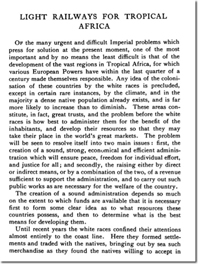
Hence, ever amidst all the distractions and diversions of a London season at its height and the beauties of an English summer in the country, my mind was never far away from Nigeria. I was obsessed with the idea of getting a light railway constructed to link the interior with the coast, remembering the weeks which I had taken on my journey from Burútu to Zaria, and how all the stores had to be poled laboriously in canoes up the Kaduna after leaving the Niger, and then carried for nearly 2 weeks on the heads of natives till they could be delivered at Zaria. By some lucky accident I came upon a small book published not long before in Germany entitled "Light Railways in Tropical Africa", and I read this through when I went down to the country, induced one of my sisters to translate and type out some of the relevant passages and figures, and sent these extracts off to Lugard. I received in reply a very appreciative little note informing me that he was embodying some of the extracts in the Annual Report on which he was then engaged. Sure enough when the Report was published a month or two later as a "Command Paper" and presented to both Houses of Parliament the extracts were included, together with a comment from Lugard that "He was indebted for them to Captain Orr, Resident of Zaria." That, by the way, was another of Lugard's characteristics - he would never take credit for anything which he owed to anyone else; he always acknowledged the work of the most junior and unimportant of his juniors - or his "colleagues" as he preferred to call them.
The five months of my leave flashed by all too rapidly, and looking back I think that that summer must have been an exceptionally fine one, for I can recall no dull or gloomy day; but one's memory is apt to resemble the sun-dial whose motto is "I mark only the sunny hours." But I decided to celebrate the last four weeks of my leave by hiring a motor car - in those days in its early stages. I discovered that for the sum of 20 pounds a week I could hire a car, complete with a competent chauffeur, the firm undertaking to supply all the petrol (up to a generous maximum, I forget the exact quantity), lubricating oil, etc... and pay for any repairs necessary and replace the car with another if it broke down. Although the firm paid the chauffeur's wages, I undertook for my part to pay for his board and lodging (outside London), meals on the road etc. And it was of course stipulated that the chauffeur was to be regarded as being in sole charge of the car, and that no one but he should at any time drive it. This made no difference to me as I did not know how to drive a car - indeed I did not learn to drive till nearly twenty years later when I was in Gibraltar. The reason for this apparent lack of enterprise on my part was that I only required the use of a car while I was in England on leave, and therefore never purchased one, but found that I obtained most value for my money by hiring car and chauffeur for as long as I wanted the use of both.
The car I hired in that September of 1904 was a French one of some rather obscure make, which I have forgotten. Wind-screens had not been invented in those days, neither had tarred roads come into existence, so motoring was a dusty business, and women wore immense veils to keep the dust so far as might be from their hair and faces. My car was an open one, built rather like a pony trap, in that the door was at the back and the passengers sat on either side facing each other. But we had a tremendous amount of fun out of it, and we used to take my mother out and show her the countryside all round, and we also had lunch and tea picnics, and visited friends and neighbours within a radius of about 80 miles. We had many a breakdown, and many a time when we came to a stiff hill most of us would have to get out and walk while the car coughed its way with difficulty to the top. Fortunately the young chauffeur was not only well-mannered and good-tempered but exceedingly competent as well, and practically all our break downs were soon put right by him after some mysterious manipulation of the machinery under the bonnet. The only time that I can remember the car letting me down was once when I was driving to Brookward Station, about 4 miles distant, to catch a train for London when I had an important appointment either at the Colonial Office or the War Office, I forget which. The chauffeur and I started off in good time, but something seemed wrong with the engine, and when we had covered about two miles it ceased to function and the car came to a dead stop. The chauffeur jumped out, raised the bonnet cover, but could find nothing wrong; but as I couldn't wait indefinitely I hailed a passing tradesman's van and got a lift to Brookwood Station, my train of course had gone, but I induced the driver of a broken down old hansom cab that was waiting at the station to drive me to Woking, where I managed to catch an express train which landed me in London just in time for my appointment. When I returned in the evening I found the chauffeur waiting for me at Brooklands Station with the car. "I was two hours on the road, Sir:" he said "and pretty well took the engine to pieces but could find nothing wrong. Then it struck me that it might be due to a bad tin of petrol. Anyway it was worth trying, so I emptied out the petrol from the tank and filled up from another tin. Off she went as soon as I touched the starting handle and I've not had a spot of trouble since - she's running like a bird."
At last it came to my last week at home. My ship was due to sail from Liverpool on Saturday morning and I had booked a berth in the sleeping car on the night mail that left Euston on Friday night. I had to go up to London on the Wednesday to buy some odds and ends to complete my outfit which was other wise practically all packed and ready. On Monday night my mother had one of those racking neuralgic headaches of which she never complained but which we all knew were terribly painful, and though it had left her by Tuesday morning she said that she would prefer not to go out in the car for the afternoon picnic we had planned, so I said cheerfully "Very well, you and I will stay at home together and have tea by ourselves." After lunch therefore my sisters went off in the car with a friend whom we had invited to be one of the party, and I walked down with my mother to the canal bank and we sat on the mossy branch of a fallen oak tree and chatted about one thing and another till it was time to go back into the house for tea. It was a perfect October day, one of those still autumn afternoons with a pale sun lighting up the many-coloured leaves of the trees. The peace and beauty, the autumnal colouring, the quiet restfulness of that little spot by the water of the canal were, I knew, affecting my mother exactly as they were me, and we were both trying to keep our minds away from the parting that was now so near. At last a chill began to arise from the water, the sun sank lower, and we knew it was time to go indoors, so we left our seat on the fallen oak and walked back, she leaning on my arm, to the house. I made her take off her bonnet in the drawing room while I ran upstairs and fetched her widow's cap, and presently tea was brought in and we had a delicious tête-à-tête tea together. Not long after we heard the sound of the returning car, and in came my sisters and told us of the delightful picnic they had had.
Next morning I drove up to London in the car as I had a number of big packages to bring back with me. My mother always breakfasted in bed these days, under strict orders from the doctor, and I used to go up after breakfast and chat to her. On this morning I only had a few minutes' talk, as I had to make an early start, but I remember she said to me, rather shyly, "That was a lovely afternoon we had together yesterday. How beautiful nature is, and how lovely the trees when they put on their autumn colouring."
It was after dark when I got back from London, and as the car turned to go through the gate into the drive I saw one of my sisters standing there. She put her fingers to her lips, and said to the chauffeur very gently "Drive in as quietly as you possibly can and try and make no more noise than is absolute necessary." I had already jumped out of the car, realising that something had happened. "What is it?" I asked. "Mother has had a stroke," she answered "We have made up a bed for her in the dining room. The doctor has been and is arranging to send a night nurse. At present she is unconscious and won't recognise you, but come and see her." I went in and knelt by the bed. The face was pale but peaceful, the eyes closed, but the breathing was even. I whispered a few words; her eyes opened and her lips made a slight movement as if she were trying to speak, but no words came. She looked at me for a brief second, smiled faintly and then her eyes closed again. It was obvious that she was completely paralysed, and whether she was conscious at all it was impossible to say.
My doctor brother (to whom my sisters had telephoned) arrived next morning and had a consultation with the local doctor. This was Thursday, I was due to go by the night mail next evening to Liverpool and sail the following morning for Nigeria. If sent a telegram or telephoned the Colonial Office I could no doubt get a week's extension of my leave, or possibly more. I had to make up my mind without any delay what to do, and I asked my brother for the medical diagnosis. "No one can say," he replied. "She might recover, though it is improbable. She might partially recover. She may not recover at all, in which case she might last a few days, or a few weeks, or even longer." This did not make my decision any easier. I felt sorely tempted to try and get a fortnight's extension of leave - which I was convinced would be granted when I explained my reason. It seemed too much to expect anyone to start off for the Centre of Africa when his mother had just had a stroke and was lying unconscious. Yet was it really any use delaying my departure?
It was a difficult decision to make, but finally I made up my mind not to alter my plans and to return to my post in Africa as arranged. By Friday morning my mother had not regained consciousness, nor did she do so during the day. My sisters were splendid the whole time though the strain and anxiety must have been very great, for they were completely devoted to my mother. When I went in to the room where she was lying, just before getting into the car which was to take me up to London, the slight figure was lying motionless on the bed, with her eyes closed but with a look of great peace on her face. I said my goodbyes to my sisters, and 24 hours later I was steaming down the coast of Wales on my way back to my work in West Africa. Before leaving I asked my sisters not to send me a cable whatever happened, unless I myself cabled for news. Somehow I dreaded receiving letters arriving long after news I might have already had by cable.
The voyage out was uneventful, though during the few hours we stopped at Sierra Leone I took the opportunity of calling on the Colonial Secretary and getting him to put me in touch with the General Manager of the tiny railway that ran a short distance into the interior. The latter gave me all the information I wanted, took me over the workshops, provided me with figures and statistics, and finally saw me on board after a strenuous couple of hours inspecting his railway and filling my notebook with all the information that I though might be useful in any scheme for constructing a light line from the River Niger into the interior of Nigeria.
I reached Zaria early in December and took over the Province once more from Arnett. The Mounted Infantry, I was glad to find, had moved to another site some three or four miles further up the road to Kano. There had always been a difficulty about water for the horses at the site alongside the Residence, which Abadi had selected for civil purposes before there was any any thought of raising a battalion of Mounted Infantry and making Zaria its headquarters. The new site was better in every way, the camp being built on an open piece of ground sloping up from a stream in which there was plenty of good water all the year round.
My first two or three weeks were fully taken up in going through all the records since I had left Zaria nearly eight months before, and receiving a report from Arnett about all that had happened during my absence. Otherwise, I lived for the weekly mail with its letters from my sisters about my mother and how things were going. What was my delight when the very first mail brought me a letter from my mother herself written the very afternoon that she and I had had our tête-à-tête tea, and posted surreptitiously when I was still in the house so that it might greet me on or just after my arrival. That letter I still have amongst my most treasured possessions.
i
The letters from my sisters reported continued unconsciousness - no change either for the worse or for the better. I had had a feeling that so great was the affection - and to a certain extent the understanding - between my mother and myself that I should by some kind of mysterious thought transference become aware of her passing when it occurred. But no premonitions came; and when we got into the third week of December I decided to cable home and ask how my mother was - letters took all of 5 weeks to reach me, and I felt that I could no longer go on waiting. About the 21st therefore I sent my cable asking for news. The reply came the next day "Mother died peacefully on the 9th". So it was over, and she had found rest at last after her busy life, her eleven years of happy marriage followed by more than 34 years of widowhood during which she had had the tremendous weight of responsibility of bringing up seven children under very great difficulties. What loneliness she must have experienced at times, and how many unspoken sorrows must she have endured during those 34 years. Yet she must towards the end have realised the affection and devotion of all her children, and this knowledge and experience must have sweetened the last years of her life.
With the telegram in my hands I sent my thoughts back to the 9th. What was I doing on that day? Had I any premonition of what was happening in that little home of ours thousands of miles away? I looked through my diary. I had had a touch of fever about that time but on the 9th I had got over it and was feeling fit again and in better spirits. So, clearly there was no premonition; no message passed between us.
There was nothing to do but get on with my work. But before I had had time to turn my mind to it, the realisation came flooding over me that, everything that was decent in me - and the very realisation told me that there was much, very much, that fell short of that standard - was due directly to my mother's influence and entirely owing to her. That influence seemed to begin with that incident of the catapult, when I was a tiny boy of seven, and she had said to me so gently. "I must believe you because I know that no son of mine would ever tell me a lie." What an agony of shame I suffered, knowing that I had lied to her. From that moment, how often during my life had I, perhaps at the last moment, refrained from some act owing to the sudden recollection of that quiet voice saying "No son of mine would...." That gentle influence was, I believe, always present throughout my life, although I was for the most part wholly unaware of its presence; and if this be so, what a tremendous effect it must have had on the formation of my character. And yet that restraining influence was only one part of it - on my negative side, so to speak. My mother's influences had also guided me unconsciously to all that I found lovely in life - the beauty of nature, of art, of music, of poetry, of all that is good and fine in human character and behaviour. I am quite sure that the impulse that has occasionally induced one to show some slight generosity, or unselfishness, or pity, or charity or kindness or sympathy has come from the unconscious feeling that it was what she would have done if she had been in my place. It is quite impossible to over-rate or over-estimate the deep and widespread effect which contact with a person like my mother has on everyone who meets her, and it is multiplied a hundredfold in the case of her children.
The year 1905 found me firmly established as the Resident of Zaria Province, with the destinies of its million or so of people - or whatever its population might be - in my hands. And I was at last being given a staff to help me - Arnett, a 3rd Class Resident and Bracken, a Police Officer, and a little later Henry Connop, as Assistant Resident, while the faithful Gold Coast clerk, Friar, had long ago been replaced by an excellent man from the same Colony, as faithful and as efficient as his predecessor. With such a staff I should at last be able, I reckoned, to get about my Province and throughly tour and map it. Not only that, but by sending Arnett down to the Southern district, I could through him, get into touch with the network of pagan tribes inhabiting those hilly regions, and so in course of time bring the entire Province under control and put an end to inter-tribal wars, caravan looting all the other evils which existed under an anarchical system of license and misgovernment, and the pitiful condition of tenor and insecurity caused by centuries of ruthless slave-raiding. What a marvellous task to set before a young, ardent Englishman of 33, working under the direct guidance of a man like Lugard! "To ride abroad redressing human wrong." How often did those words recur to me as I rode through my Province, from district to district, from village to village, now amongst the farm lands of the white-robed Mahomedan Hausas, now climbing up the rocky crags where clusters of huts of the naked pagan tribes lay hidden, now following my guide through a maze of swamp and undergrowth and forests where other pagan tribes had buried themselves to escape from the Fulani horsemen scouring the country on their perpetual slave-raiding expeditions?
But if the responsibilities which had been placed on my shoulders were great - nothing less than putting down slavery, rapine, robbery and injustice, and evolving some sort of ordered government in an area about the size and shape of Ireland - the powers conferred on me were almost unlimited, including the power of life and death. I realised from the first that I must not attempt to force European ideas wholesale upon these African peoples, but study so far as I might their own customs and traditions, get inside their skins in fact, and make every endeavour to see life from their point of view as well as my own. Yet it would obviously not do to leave them entirely in the dark as to the policy and intentions of the new administration whose members had suddenly appeared from a distant land and were introducing a "New Order", riddled with ideas that were strange and perplexing to them, and which merely puzzled them without appealing to them. The main thing I felt was to be absolutely frank in all my dealings with them, unswervingly just and impartial, and above all, firm and consistent, so that they might all know where they stood with me.
In January Lugard made a hurried tour of the Northern Provinces in the course of which he spent 2 days and a night in Zaria. He made a most thorough investigation into what I was doing in the Province, and no detail seemed to escape his eagle eye. But there was nothing alarming or disturbing about his enquiries - he seemed to be rather seeking for information than giving instructions as to how I should run my Province. This is one of the respect in which I found him so ideal a Chief to serve under. Once you had gained his confidence and he had realised that you were carrying out your administrative work in accordance with the broad principles which he had laid down at the beginning and which he explained further from time to time in admirably clear memoranda which were printed and circulated, he was content to leave the details to you without interfering.
I have already related the incident when during this inspection he asked me if I had enough secret service money, and my reply. This is a good instance of his readiness to allow a Resident whom he trusted to run his Province in his own way, even though he, Lugard, might not personally agree with it.
One small incident during this inspection gave me an insight into Lugard's character and showed me a side of it which I had not until then suspected. In order to get some document, he went to one of the tin cases in which his official papers and his own private possessions and clothes were packed and in his search he suddenly came upon and drew out a photograph which he held up to show me. "Do you know this photograph of Abadie?", he asked, with that charming, rather shy look of his. I did not, but it was an uncommonly good likeness and brought George Abadie vividly to my mind. I took it from him and examined it for a second or two, and then handed it back, with some conventional remark. But I was deeply touched and much impressed by "the Chief's" act in carrying this photograph of Abadie about with him, since it was proof - a very human one - of the regard and affection with which he had always regarded George Abadie, whose death the year before had been, as I knew, deeply felt by him and had been a severe shock to him. I learnt from it of the very human feelings that lay deep down under the somewhat stern and hard exterior that many in Nigeria thought represented the real Lugard.
One other incident I recall which caused me a good deal of quiet amusement. During the course of some enquiries about the accommodation I had at Zaria for natives undergoing sentences of imprisonment, Lugard asked me what was the average number of prisoners I had had during the past 12 months. I replied that I couldn't say off-hand but would send a note to my Police Officer telling him to examine the register and let me know. I did so, and in half an hour's time the answer came back, giving the figure, and I thought no more about it. Not for some weeks after did I learn the story. Dick Bracken was a delightful fellow, as honest and loyal as the day is long, a first class disciplinarian and an excellent Police Officer. But his education was somewhat lacking, as it had stopped short at the age of thirteen; for when he was 14 he ran away to sea and went round 'the Horn' as a boy on a sailing ship. After many years at sea he managed to get his Mate's "Ticket" and became an officer. On the eve of the Boer War the ship on which he was 3rd Officer put in at Durban and being by this time tired of the sea he signed off and enlisted as a trooper in the Natal Carabiniers. As such he served all through the siege of Ladysmith and subsequently saw a good deal of service in the Transvaal, and being well paid - as things go - and having nothing to spend his money on, he found himself at the end of the war possessed of a nice little sum of about £80. With his characteristic generosity he lent this to a pal who represented himself as in urgent need of it, with the result that he never saw the friend or the money again. Undaunted, he made his way to Durban and tried to get signed on as an officer on one of the score or more of home-going vessels, but everyone else seemed to be doing the same thing. Finally he managed with some difficulty to get taken on as a deck-hand by one Captain less stony-hearted than the rest. "Is that the same as a Stoker?" I enquired when he told me the story. "Good Heavens, no." said Bracken, "The Stoker is a prince compared with the deck-hand. A Stoker gets £7 a month with a gratuity at the end of the voyage. A deckhand gets his keep and 5 bob when he is paid off, if he's lucky. The only food he gets is the scrapings of each dish when the stokers have dabbed their filthy hands into it (no one uses knife, fork or spoon but just scoops out the food with his hand.)" Anyhow, Dick Bracken got home to Liverpool, raked out the one semi-respectable suit he possessed, a dark blue one and when home to his father's house. His father was an ex-Army Officer who had retired to his small property at Criccieth in North Wales of which he was Squire. Through the influence of Mr Lloyd-George, then a struggling MP, Major Bracken managed to get Dick appointed to the Constabulary then being raised at the Colonial Office for Northern Nigeria, and on arrival he was posted to my Province and duly arrived in Zaria. I had a real affection for him, which he repaid with a devotion and loyalty that touched me very deeply.
On receiving my note saying that "His Excellency wanted to know the average number of prisoners in gaol at Zaria during the proceeding 12 months," poor Bracken was scared out of his wits. What in Heaven's name was an "Average"? He had no idea. He went at once to Connop. "For the sake of Mike" said he "What's an average? Can you get the answer for me old boy? Otherwise I'm sunk." Henry Connop, an Ex Master of Foxhounds by the way, who had lost all his money and had been obliged in consequences to take a job as Assistant Resident in Northern Nigeria though much older than most of the men out there, was not over-intelligent himself. But the question was an easy one. "Bring your register along." he said. "Now add up the monthly totals of all the men who have been in gaol during the last year, divide the sum by 12, and that is the answer that H.E. wants." Bracken nervously did this under Cannop's supervision and sent the figure in to me. But I believe to this day he imagines "an average" to be dividing of some total by 12.
Henry Connop himself was a character. He knew less than nothing about administration, but he worked all he knew, and would do anything in the world for me, and was entirely reliable, and was loyalty personified. It was impossible for him to believe that anyone was less honourable and trustworthy than himself, and he was therefore utterly unsuspicious. One night an officer of the Mounted Infantry who had often hunted with the pack of which Connop had been Master was dining with him, and remembered during the dinner, "That's a jolly well-cut suit that boy of yours is wearing." Connop glanced at the boy, then looked rather more intently, and finally said "Yes; and it looks uncommonly like one of mine." Then a pause, "By Jove, it is one of mine." For weeks the boy had been selecting from his master's boxes such garments as he fancied and wearing them while his master was on duty, and not in or near his hut. but when he found that his master didn't notice anything, he grew bolder, and actually wore the clothes in his master's presence. On this occasion, when his master had a guest to dinner, the boy determined to look his best, and selected one of Connop's smartest suits to wear, never dreaming that it would attract the guest's attention to such an extent that he would remark on it to his master. Connop was too casual and too good natured to punish the boy, and merely laughed at the joke against himself. But after that, he kept his tin boxes locked.
Connop did one tour only, and then resigned and did not return. I never heard what happened to him, but I expect he went back to his hunting. Dear good fellow as he was, he was a misfit in the Northern Nigeria of those days, when one wanted youth and unlimited enthusiasm.
Appointments were made to the Northern Nigerian Political (Administrative) Service by the Colonial Office, one of whose staff would interview a candidate, look through his "credentials", his record, and the comments of the person and whose names he had given as "references" and if all these were satisfactory the candidate would be appointed and sent out "on probation." The probationary period was, I think, three years, and during this period the young man's services could be dispensed with at any time, usually at the end of one of his tours. If on the other hand he proved satisfactory, he would, on the recommendation of the High Commissioner, be "confirmed" in his appointment. He then came under the terms of Colonial Regulations, which make it almost impossible to get rid of an unsatisfactory Colonial official, nor could he be transferred to another Colony except at his own request. This was a highly unsatisfactory state of affairs; for often a man who started well turned out to be incompetent, or became careless and indolent, or developed a certain tactlessness, or became quarrelsome and difficult to get on with; and yet, unless some specific act could be proved against him, such as drunkenness or glaring immorality or dishonesty, he could not be dismissed or superannuated or got rid of in any way until he reached pensionable age. So keen was Lugard to secure the right type of man - for in the African's first contact with the European it is essential that the latter's character and behaviour should be such as to win the African's respect and loyalty - that when he was at home on leave he insisted on interviewing personally each candidate for appointment. As the Colonial Office could not or would not lend him a room for the purpose the interviews used to take place in the ante-room of a Club in St. James's Street of which Lugard was a member, and at such times a number of candidates might be seen standing in a sort of miniature queue on the pavement outside the Club, much to the annoyance of the members, who naturally resented their Club premises being use for a purpose of that nature. Such a thing did not however disturb Lugard in the slightest degree; he was never to be deterred from carrying out any purpose he had in mind. Always courteous, he could be adamant when he chose, and nothing could shake his resolution.
In those early days, the administrative officers sent out to Nigeria were certainly a mixed lot. The end of the Boer War synchronised more or less with the setting up of an Administration in Northern Nigeria. The War had brought Britishers from all parts of the world to serve in South Africa, and many of them were rough diamonds, but practically all were used to "roughing it". They gave up their jobs - mining, tea or coffee planting, sailing in tramp steamers, employment in scores of different jobs in foreign countries all the world over - and worked their passages somehow to England or South Africa where they joined some regiment or one of the many local irregular corps and went, many of them, through the toughest of the fighting. When peace came, they were discharged and most of them found themselves without a job. Many came to England and applied to the Colonial Office for employment representing the sacrifice they had made in leaving good and often well paid jobs to go and fight for King and Country. The Colonial Office did what it could, and we received in Northern Nigeria many Assistant Residents chosen from amongst these applicants. The great majority were sterling good fellows, though they required a good deal of handling and a great deal of teaching.
I was singularly lucky in the men who were posted to my Province the whole seven years I was out there. One or two were misfits, and didn't like the work or climate or rough conditions or loneliness or what not, but these only did one tour and did not return. The great bulk of the men who served under or with me were first rate, imbued with the utmost enthusiasm for their work, ready and willing to put up with every kind of hardship and make light of it, their whole minds and energies bent on improving the lot of the non-native inhabitants and developing the country for the latter's benefit. They were, in fact, intent as I was on "riding abroad redressing human wrong", though they would have ridiculed the phrase had I used it, and regarded the very notion as "sloppy" and un-English. Yet whatever phrase be used I have no doubt that the motive power behind their splendid energy and self-sacrifice was the urge to do their job of work well, cost what it might, and give the Africans a security and happiness which he had never known under the despotic rule of his Chiefs and masters before our advent.
Of course we all had days of depression and moments of disillusionment. Bouts of malaria were always apt to leave behind them black days when one wondered what good one was doing out there in the back of beyond, if indeed one were doing any good at all? Was the security and freedom from cruelty and oppression that one regime conferred on the peasant worth the trouble and arrogance caused by his being turned out to construct roads, grow fresh crops and clear the swamps and made to adhere to definite rules and regulations? I sometimes wondered?
I remember once when I was on tour in a rather distant part of the Province I was chatting to an old farmer in one of the villages, and I asked him whether it wasn't much better now to have his tax fixed and to know that once he had paid it he need have no more anxiety, rather than to have tax collectors continually coming and settling themselves down in the villages at the villagers' expense and exacting indefinite sums from them in the guise of taxes? The old man hesitated for a moment and then some instinct told him that he could speak frankly to me without fear. "Well, you see Baturé," he said "in the old days the tax collector came along and if I had been wise enough to find out his favourite dish I would invite him to my house and give it him. Then he would let me off with some very light tax or perhaps none at all. But if instead I angered him by some stupid act, he would make me pay a tax which would almost ruin me. Well, that would be my own fault; and next time he came I would be wiser." He paused a minute, and then glancing rather nervously at me, he went on. "Now you fix a tax; yes, it is a small one and a just one. Your messenger comes and looks at his book and tells me what I have to pay - five shillings. I tell him I have only one goat and I have sold it to pay my tax, and here are the three shillings I got for it; I can't pay more. He gives me a 'book' (receipt) for 3/- and says he will be back in a week or two, and I must have the rest ready. He comes back, and I tell him I have sold the two fowls I had, here is one and sixpence that I got for them, and I have nothing more. He gives me another book (receipt) and says I must have the rest ready when he returns. And he comes back again and will not let me alone till I have paid the sixpence." Again he paused, an then said rather sorrowfully, "I like the old times best, Baturé, though I know you are doing your best to help us poor telekawa (peasantry)."
I didn't of course attempt to argue - what was the use? If he and his like preferred the old gamble and were content, and indeed pleased to pay such tax as the whim of an unscrupulous tax collector chose to extort, what right had I to force our rigid system on them? What then, I asked myself, was the use of working myself to the bone, enduring a score of real hardships, damaging my health, and exiling myself in the back of beyond, under the absurdly mistaken impression that I was helping these African friends of mine to a happier and more secure life? It was a desperately depressing thought. Looking back on it all now, I think the truth is that the first contact between the unsophisticated African and the European is bound to bring into full daylight - when they speak frankly to one another - the wide differences in outlook between them. At first the African is unable to absorb into his consciousness the benefits introduced by the intruder, and feels a sturdy hostility to the interference with his old customs. By degrees however, he begins to appreciate the changed and new conditions, and in the end he would on no account whatever wish or agree to return to the old. The newly delivered District Officer in rural Africa must not therefore allow himself to be disheartened; he must possess his soul in patience (incidentally, the keener and more enthusiastic he is, the more difficult it is to do this); he must use all his imagination and human sympathy to try and understand the African's mentality and viewpoint, and at all costs check in himself any tendency or endeavour to force reforms and changes upon the people before they are ready for them. It was later in my life when I was Governor of the Bahamas in the West Indies in fact - that I invented a formula for the policy. It consisted of three words - Patience, Politeness and Persistence - and I called it my 'Three P's Policy'. Oddly enough the formula is now enshrined in the records of Hansard for my eccentric but great-hearted and very lovable friend, Colonel Josiah Clement Wedgewood, quoted them as my idea (and his) of what a District Officer's or a Governor's policy should be in any Colony, in the course of a speech he made on Colonial Matters in the House of Lords a few months before he died in 1943. I regard all three "P's" as of equal importance; certainly the first and last are vital.
Patience, Politeness and Persistence were unquestionably necessary in my dealings with the Emir. My task as I have said before was somehow or other to turn this ex-slave raider, ex-robber, into a constitutional ruler, carrying out his very responsible duty towards his subjects with all the justice and beneficence sacred to the Western mind. What a task! His age long ideas of the relationship between a ruling Emir and his subjects were totally different from ours. To oppress the helpless 'telekawa' (peasants), to exploit them, to extort such money and goods from them as he could, seemed to him the natural thing to do: the only thing that restrained him was the fear of an uprising if he went too far.
I felt sure that to set myself to force on him the adoption of our Western ideas and methods and the abandonment of his inherited and strongly entrenched ideas and methods would be to embark on an underground combat between him and me which could only lead to futility and possibly disaster, and whose inevitable effect would be destructive and not constructive. I therefore hit upon the idea of suggesting to him in private talks very carefully and at long intervals, administrative reforms, and inviting him to think them over, and then discuss them with his office-holders and Headmen (avoiding any reference to me). Then, if he secured their approval, I suggested that he should at a convenient opportunity when he visited me with his officeholders, put the proposals before me as emanating solely from himself and his advisers. I warned him that he must not be surprised if I received the proposals somewhat coldly at first, or perhaps offered some rather hostile criticism; he might be quite certain that they would in the end receive my approval, even if I appeared a little reluctant to grant it.
The plan worked; what is more, it exceeded my most sanguine hopes. I watched the Emir from the first with the keenest interest to see how he reacted to the scheme. He was no fool, and he was decidedly no weakling. On the contrary, he had an exceptionally good head on his shoulders; and, as his 'subjects' very soon found, he was a "strong man" if ever there was one, and in his strength was apt to be somewhat ruthless and tyrannical. A difficult man, indeed, for me to "manage" and use as my instrument for introducing justice and good government into the Zaria Emirate, in place of the previous injustice, tyranny, and misgovernment.
The plan I have described had, if my judgement was correct, this effect - or rather sequence of effects - on the Emir. At the outset, it tickled his sense of humour, and it appealed to his oriental love of intrigue. What is more, it established between him and me a kind of - what shall I call it? - camaraderie. I might almost say, partnership - which increased his confidence and self-respect, and aroused his interest. Later, when our plan had been carried into execution with complete success on several occasions, he began to take a real interest in the administrative measures themselves, and soon came to believe, or half believe, that they had really emanated from his own brain, as they were supposed to have done. I have little doubt that he impressed this belief on his office-holders, and made out that I was somewhat reactionary and unimaginative, and that he had persuaded me rather against my will to let him try out the measures he had advocated. I need hardly say that I had not the slightest objection to his appropriating every scrap of kudos that was going; it suited my plans exactly, and if it pleased his vanity (as it did, so much the better. The triumph in my eyes, consisted in the fact that by this rather odd kind of stage-play in which the Emir and I - with a metaphorical wink at each other - indulged, his real interest in the administration of his Emirate was, as I have said aroused, and grew almost to out-rival his previous interested i.e. "Palace Intrigues", additions to his harem, illicit bribes and "gifts" extorted from his people, and so forth. He actually did come forward with some suggestions of his own, and rightly or wrongly I came to the conclusion that he and I recognised each other as partners, both genuinely interested in administering the Zaria Emirate in the interests and for the benefit of all the inhabitants, including the hitherto somewhat despised and continually bullied "Telekawa."
That year, 1905, and the early months of 1906 constituted probably the most formative period for me of the whole of my service in Nigeria. I had to learn my work from the very bottom upwards, with no precedents to guide me, and nothing to teach me except the old expedients of trial and error. I don't think I did much theorising; indeed, working 8, 10 and even 12 hours a day and seven days a week, I was too busy to theorise. I spent as much time as I possibly could, touring every corner of the Province, mapping as I went, and getting to know the various tribes and their Chiefs and people, and discovering where I could solive their problems at the same time as I noted their respective boundaries.
My work at Zaria itself was considerably lightened, partly because I now had Arnett, whom I could at any time leave in charge with perfect confidence while I went on tour sometimes for 5 or 6 weeks at a time in the distance parts of the Province; and partly because, just before the end of the dry season the whole of the Mounted Infantry were moved up to Kano, as a better centre for their work. As soon as they had left, I moved the whole station to the site which they had occupied, leaving without regret gloomy "Lobb's Folly" and the mud courthouse and other mud huts which my staff and I had inhabited, knowing that the heavy rains and the tornadoes would soon reduce them to ruins.
At the new site I took over the excellent mud huts left behind by the M.I. and was delighted with the change. A row of these - some 4 or 5 - well spaced out stood some way up the slope that rose from the Danduwa River, and parallel to it, and this at right angles to the main road from Zaria to Kano. I chose for myself a hut that lay some distance back from this row (which with the broad road in front of it had been nick-named "Sparklet Alley"), and well on the flank furthest from the Kano road. I grew to love this hut, which had scrub at the back of it, stretching away almost for miles, with some cultivated fields interspersed, but no native villages or huts. Sitting in front of it in the evening when my work was for the time being done, I could see in the distance, some 3 miles away to the left, the high red walls of Zaria City; and turning my glance to the right, there some 5 or 6 miles away was the great towering mass of black rock which on my arrival at Zaria I had named "Gibraltar", and which formed a landmark, visible miles away. If I had been in the office all day and wanted exercise, I would take my gun and go for a walk in the flat scrubland at the back and hope to bring back a partridge or a guinea fowl for the pot. If I wanted company I would tell my boy to set out the table and some deck chairs, a bottle of whiskey and a sparklet syphon or two, and would get Arnett or Bracken or the doctor or the Officer Commanding the company of West African Field Force Infantry which had replaced the Mounted Infantry, or all of them, to come up and chat. Or I would invite one or more of them to dinner, after which we would sit out under the big shea-butter tree close to the hut and I would get out my gramophone and make a catholic selection of the eighty odd records I had with me.
The hut itself was of the usual circular type which I have already described, with mud walls, a mud floor raised well above the surface of the ground, and a thatched roof which extended all round the walls and formed therefore a broad and roomy verandah. In this verandah I slept, my camp bed fitting nicely into it close to the front, where I could get plenty of air. It also formed my bathroom, and my store-room. Thus the interior of the hut was left as sitting-room, dining room and private office, and I was as happy as a king. At the back the hut a short distance away were some small huts for my boys and the kitchen and a shelter for my ponies.
In the rainy season the floor of my hut became saturated with moisture, and grass and fungi would make their appearance, whilst if by accident one dropped a piece of blotting paper it was wet through when one picked it up a moment afterwards. I had a suspicion that a stream flowed somewhere underground either immediately below or close to the hut, but I was too busy and too much absorbed in my work to bother my head about the matter. Neither could I bother about food, except when I had a guest. I breakfasted at 7:30 every morning on Quaker oats, a couple of eggs in some form or other (but never boiled - one could never trust a Nigerian egg), coffee, and cabin bread. About 2 o'clock I would make a meal of sorts from biscuits (dozens of tins of which I could always get up from the Niger Company at Zungeru) and coffee or cocoa. And at 7.30 I would have dinner - some soup, chicken served up in any way the cook could think of, and possibly blancmange to follow. Bed about 10pm - unless I had guests to dinner when it would be nearer midnight.
There can be no doubt that a District Officer learns far more about his duties when touring his Province than when sitting in an office at his Headquarters, and I certainly learnt far more in that year 1905 than I had during the whole of my first tour in 1903/4. And I was never so happy as when I was on tour. It is a curious experience to spend many weeks on end, never speaking or hearing one's own language spoken, never exchanging an abstract idea with any other human being, often cut off for days and even weeks at a time from the outside world and thrown back entirely on oneself. Personally, I liked it; but to many men, perhaps more socially inclined, it was a trial, to some even a torture.
Admittedly one suffered plenty of physical discomforts when on tour, especially during the rainy season, or when tornadoes were about. Biting flies tormented one by day and mosquitoes by night. One could never get one's clothes properly washed, and one often had to spend the night in a vermin infested native hut. But these were mere details utterly insignificant compared with the thrill and interest of seeing the country and getting to know the people at first hand; of spending the whole day in the open air, mainly in the saddle, sometimes on foot, mapping one's route by prismatic compass as one went; observing the various kinds of trees, noting what crops were grown, trying to get some idea, amongst the motley group of pagan tribes, of their customs, beliefs and mentality. What a blessing it was to get away for a spell from such things as Treasury queries about the Provincial accounts; exasperating criticisms from the Legal Department of the criminal cases dealt with in the Provincial Court; petulant reprimands from the Secretariat because some of the endless "Returns" which it was continually demanding had been incorrectly made out or not sent in at all; all the seemingly petty details which tied one to the office and took up time and thought so urgently needed for practical day to day work. A couple of years later I was to see matters from the other end - Government Headquarters - and to realise that if Provincial Residents saw Government Headquarters merely as a nest of irritating bureaucrats without any practical knowledge of administrative matters, the Central Government had cause only too often to look upon Residents as, in general, thick-headed duffers, lacking in a sense of proportion, and either unwilling or unable to see very far beyond their noses.
The pagan tribes in the Zaria Province - and they formed between one third and a half of the Province, the Mahomedan Hausas occupying the northern, flat, fertile, open plain between Zaria City and the Kano boundary - differed widely from each other in traditions, characteristics, language, and the degree of civilisation which each had attained. In the south-west, in the neighbourhood of Zungeru, the district was predominantly Gwari, a highly intelligent and sophisticated people with their own distinct language and traditions. But they were split up into something between a dozen and a score of separate independent communities, not seldom at war with one another, probably over a boundary question. They would however usually, but not invariably, combine against a common, outside foe, such as the Fulani slave raiders. They lived in villages much of the type common further north inhabited by the Hausas, that is to say, surrounded by high, solid mud-walls. The chief town of each independent community would have a number of villages scattered over the area which it regarded as its own, though one of the largest and most independent and truculent of all these Gwari communities had no subsidiary village at all; all lived in one very large town close to the Kaduna River, surrounded by an immense wall, a very strong position. This town, Gussoro (pronounced like "Puss") had established a tremendous reputation by ambushing and defeating a very strong force of Fulani slave-raiders some years before, prior to our arrival in the country and driving it off after killing a large number of its horsemen. I had trouble with them a few years later, as I shall record in its proper place.
So much for the Gwaris. There were other tribes, or groups of tribes not quite so civilised or sophisticated, but living in well-ordered communities, mainly self-contained but carrying on some trade and exchange of goods with their neighbours. In the extreme south and east of the Province, were other tribes, less civilised than these, often at war with one another but otherwise remaining within their tribal boundaries and having little or nothing to do with the outside world. Finally, there was a network of tribes in the mountainous country which lay between Zaria Province and its eastern neighbour Bautchi. These fierce and almost fanatically independent pagans were never parted from their bows and arrows, for they lived in a state of constant warfare with one another. Their villages were hidden away in rocky and almost inaccessible mountains. How they lived I often wondered, for there were only a few patches of their soil here and there near their villages, and on this they grew a little of their native corn, a sort of millet, known locally as "attcha". This, together with a few small, skinny goats, and some meagre looking fowls, formed their whole sustenance, yet they were sturdy enough, and tough fighters, as I and my young assistant soon discovered; but once they had put up a fight for their independence and been defeated, they would agree to a parley and accept such terms as they felt to be just. Having accepted the terms they would observe them loyally, and would bear no malice or grudge whatsoever against those who had imposed them. I liked and respected these wild pagans. I liked their independence, I liked their courage, I liked their code of honour which taught them always to take up arms against an invader no matter what the odds against them might be, and fight with all their might; and taught them also that having been defeated in open battle they should acknowledge defeat, come to terms with those who had vanquished them, and abide loyally by those terms for ever after.
From this brief and imperfect description of the nature and variety of the people who inhabited Zaria Province it will be obvious that my task of touring the whole Province - which let me remark once more, was in extent about the same size as Ireland - was one that must necessarily take a long time and entail much travelling. I shall not attempt to make a record of all my travels even if I could after a lapse of nearly 40 years remember them. I will try and describe, not necessarily in chronological order, some of the incidents that impressed themselves most on my memory.
A road - or rather, a bush track, for there were no roads in those days - ran south from Zaria city through country inhabited for the most party by fairly civilised pagans till it reached a river which found the southern boundary of the Province and divided it from the adjoining Province of Nassarawa, through which this track continued till it reached the Benue River. About one day's march, say 15 miles, before the river was reached the track passed through a fairly large market town, called Katchia, which though in pagan country regarded itself as autonomous; indeed one or two Hausa traders had settled there and had amassed quite a respectable fortune by selling food and goods and buying goods from passing caravans, for the track was freely used by caravans passing from Kano to the Benue River and thence by canoe down to Lokoja and further. Early in 1905 there had been trouble at Katchia which was 5 or 6 marches from Zaria, and some caravans had been robbed and some traders killed. It was obvious to me that a small military post must be set up there until I had sufficient staff to send an Assistant Resident to take charge of the town and the surrounding pagan country. I applied therefore to Headquarters at Zungeru, and in due course a young subaltern of the West African Field Force was sent with about 30 of his men with instructions to build himself and his men a post there and take his orders from me. This soon put a stop to the robberies, and enabled caravans to pass up and down in peace and security.
In due course I managed to get down from Zaria to inspect this corner of the Province, and I determined also to visit a pagan tribe - the Jabas - which lived between Katchia and the river, see their Chiefs and assess them for tax, which in the case of pagan tribes I always made at the outset almost nominal, as I merely wanted to introduce and accustom them to the principle of a small annual tax being paid in return for protection and security. Once they had grown used to paying this small tax annually and had also derived obvious advantages from our administration, I could (and did) take in hand the assessment of the community at a figure which I knew they could properly and justly be called upon to pay in respect of their wealth as a community.
When I arrived at Katchia I was met by Fletcher, the young subaltern in charge of the West African Field Force detachment, and I pitched my tent close to the mud hut in which he was living. he had done very well in keeping order in that somewhat turbulent locality and had shown tact and understanding as well as firmness; and he seemed pleased when I told him so. My intention was to spend two nights at Katchia and then push on to the Jabas, to whom I had already sent a message bidding them to meet me with the Heads of all the villages to discuss taxation and other matters.
The second night, Fletcher was dining with me in my tent when my boy announced that there was a man from a distant pagan village who wanted to see my and lay a serious complaint before me. When I had finished dinner I told my boy to show this man into the tent, and in due course a handsome young pagan in his early twenties, naked except for a leathern loin-covering, entered rather shyly but with frank open face, and squatting in front of me, gave a sort of polite little bow, and looking me squarely in the face, began his story. "Last Week," he said, "the Chief of my village received a message from the Chief of the tribe whose boundary adjoins ours, inviting him to come to the wedding of his daughter. My Chief felt too old to go, so he sent his son, a young man of about my age and told me to go with him. We went and attended the wedding, but that night a man called Doonsha forced his way into our hut and killed my Chief's son. I managed to escape and got back to our village, and I told my Chief what had happened. In the old days we should of course have known what to do, but we understand now that the Baturé forbids us to fight and says we must take our complaints to him, and he will see that justice is done. So my Chief has sent me to you to tell you about the murder of his son by that man Doonsha, and to ask for justice to be done to him and his tribe."
I was for the moment at a loss what to do. The two tribes concerned adjoined the Jaba country and I just knew their names, but no more. They formed part of the network of those fierce independent tribes to whom I have already references, and I had as yet had no dealings whatever with them. To go alone to the offending village and to try to arrest the accused man would I was sure merely result in all the inhabitants turning out with their bows and arrows, leaving me the option of either to stand my ground and be killed, or ignominiously to retire to save country. In either case, no good would be achieved, or justice done. Alternatively I might take Fletcher along with his 30 soldiers, in which case I knew very well that the villagers would get news of our advance, send their women and children into the bush, fire a few arrows and then run off and joined the womenfolk leaving the village completely empty. In that event I could burn the village or a part of it as a punishment and then return to Katchia, but again, no real good would have been done. Here I may remark incidentally that the same problem faced me again and again during those early years when I was in charge of Zaria Province. When some crime or misdemeanour was committed in a pagan area and reported to me I always had to take the responsibility for deciding which of three courses to select: (1st) To take (or send one of my assistants) with a fairly large West African Field Force escort - say 50 or even 100 men. This was naturally the safe course, for no pagan tribe could stand up against a body of well trained soldiers armed with modern rifles and they knew it. They would therefore merely leave their villages and hide in the bush, in which case the crime would go unpunished, even if one burnt a village as a token that the whole tribe was regarded as responsible for the crime, and that since we had been unable to catch the culprit or culprits, one of their villages must suffer. But I realised that such action would never bring me any nearer the people, who would simply return to the village after the troops had left and rebuild it in a few days, and would regard the whole incident as akin to the old Fulani slave-raids. (2nd) Instead of a large escort I could take or send a few men - either WAFF or Constabulary armed with carbines - say half a dozen or ten. But in this case the mere fact of soldiers escorting the Resident might invite the pagans to attack, and they might lay an ambush and then pour in a hail of freshly poisoned arrows and overwhelm the small party. This actually happened on one occasion, as I shall relate later on. (3rd) Finally, one might go alone with no escort at all, in which case the pagans might feel that there was no cause for suspicion or fear and they might come out and parley. As a result, the whole incident might be the beginning of a confidence and eventual friendliness which it was my one great endeavour to create and foster. But it entailed an obvious and grave risk, which however neither I nor my assistants were ever unwilling to face, though a fatal result, would inevitably bring upon the tribe a punitive expedition and the infliction of considerable punishment, and that was something which I was anxious to avoid.
The same responsibility, in a lesser form, often fell on my assistants when they were on tour in the pagan districts, with a small escort of soldiers or police. My general instructions were that I was determined to bring these pagan districts under a peaceful administration without bloodshed, if that were at all possible; but that I realised that situations might arise when it would be necessary to open fire on a recalcitrant tribe or village, but in such cases I should immediately require a detailed report, showing clearly that the use of firearms was absolutely essential and could not have been avoided without grave risk. This may seem mere common-sense, but in those early days, with administrative officers recruited from all kinds of sources, some were apt to order their escort to fire at the slightest sign of recalcitrance, under an airy casual idea that "shooting a few of these natives was the way to bring them to heel", without a thought as to the humanitarian side of the question. To me, the humanitarian side was all important. To get the confidence of all the people, from the Emir and his office-holders, and the cultured Hausa farmer down to the wildest pagan hillman, and to make them realise that I was out to treat them with unfailing justice and understanding, this was, in my view, the task which had been entrusted to me, and any act or word which had the effect of forfeiting that confidence was to be avoided at all costs. These views I impressed as clearly as I could on all the administrative officers posted to my Province, and I can remember no instance when they did not loyally comply with them. In this connection, by the way, I met in the West Indies years after I had left Nigeria a man who had served under me in those early days in Zaria Province. "Do you remember", he said to me, "when I shot a prisoner who was trying to escape, and you sent me a stiff reprimand for taking such action when I could easily have got my escort to recapture him instead of putting a bullet through him? I felt very humbled and rather sore, and then I suddenly noticed the letters PTO at the bottom of the memo. I turned over the page and read these words Overleaf is my official reprimand. But I daresay a bullet was a kinder death than the hangman's rope I have never forgotten it", he added. I had, and have, completely forgotten it. But in those early days I was trying to get a team of men working with me in complete harmony, with the one object of giving all the inhabitants of that Nigeria Province a feeling of security which they had never had in the memory of man, and in which they could work out their own destiny according to their own lights. This is what Kipling called "The Whiteman's Burden" and I am positive that it is one of the most worthwhile objects to which a man, a member by the accident of birth of a great, rich, cultured and powerful nation, can devote his life and himself. George Abadie and scores of others gave their lives in those old pioneering days,, and gave them willingly, while many more gave their health. In Zaria Province alone, during one tour, I had something like 2 deaths and 6 invalidings amongst my tiny staff if I remember correctly - it may have been more.
To return to my pagan at Katchia. His complaint had placed me in a complete quandary, but it never does to show the slightest sign of hesitation or doubt as to what to do in any circumstances. So I said, "I have heard your story, but I have no time at present to attend to the matter. You can come with me and carry my gun, and I will give you sixpence a day, and when I have time I will go into the affair." When he had gone I talked things over with Fletcher, and finally I thought out a scheme. His offer of an escort I turned down for reasons I have already given. But I asked him to stand by in 3 days time, and if he got a message or even a bit of rag or paper from me, to hurry to the guilty village with his men as fast as their legs could carry them. Next day I went over to the Jaba Country, the young pagan accompanying me as my gun carrier (I had a shot gun only with me, but not a rifle, and I never carried a revolver - rather foolishly as I now think, though I had one buried away somewhere in one of my tin cases, I had forgotten which.) I reached the Jaba headquarters in the afternoon and talked over various matters with the Head Chief. I had fixed noon the following day as the hour for the meeting of the village Heads to discuss taxation, and sure enough at noon I found them assembled - about 18 altogether. I asked the Head Chief if all were present and he said that they were. I then read out the names of the villages from a paper I had, getting each village Head to answer. At the end I read out the names of two tiny villages which I knew quite well were subordinate to a couple of the larger villages. There was of course no answer; whereupon I turned on the Head Chief and asked him angrily why the Heads of these two villages had not come. He explained that they were subordinate villages. Thereupon I pretended to get into a rage and said that I could not possibly discuss taxation without the Heads of these villages, and that he must send and fetch them, and I asked how long it would take to get them. He said that the distance was great but he thought he could get them there by the following evening. I angrily complained of my time being wasted, and said that I should go out shooting next day, but that I would meet them all at noon the day after and I hoped that all would then be present. Next morning just before dawn I woke my boy and told him to get ready and tell the cook to pack food and utensils for one day. I had with me two of Bracken's Police, armed with carbines, and I said they might come with me, as well of course as the young pagan with my shot gun. I stuff some extra food in my haversack and warned the cook to take enough food not only for the day but for breakfast next day in case I couldn't get back that night. Just as day was breaking we set off, and I steered my course in the direction where I knew the defaulting village lay. By noon we reached the boundary (identified by my young pagan), and I told my cook to light a fire and make me a good meal as we might not get much to eat that night; and I advised the two policemen and the last of the party to do the same. It was not till after 2 o'clock that I called the young pagan to me, and told him to guide me to the village where this Chief's son had been murdered, and this was the first inkling anyone had had of my intention, for all up to that moment, including my cook and the policemen and my young pagan had taken it for granted that I was merely going out shooting, as I had told the Jabas. I was taking no chances of the tribe or village getting the slightest hint or suspicion that they were about to receive a visit from me.
The tribal territory was in the foothills leading up to the range of high hills, and was lightly wooded and broken here and there by low ridges, and from time to time we had to cross small streams. The track we followed was a mere bush track, and I saw no sign of village or cultivation anywhere. After about 2 hours of marching the pagan boy told me that we were getting near the village, and I noticed in the distance a native, with a bow slung across his chest, dodging about amongst the trees on a small ridge on our right - evidently a scout. I decided, watching my little party and wondering what on earth brought there. It must have been close on 5 o'clock when we reached a big tree, and my pagan boy said the village was just beyond this hidden in the trees. I immediately sent the Government messenger I had with with me, and the two policemen and my young pagan, and told him to go at once to the village, summon the Headman, and tell him that the white man was here and had ordered him to bring the man Doonsha to him. When they had started on their errand I told my cook to make me a cup of tea. I then lit a cigarette, and awaited developments. About half an hour later a little procession appeared coming along the path leading from the village, one of the policemen in front leading by a piece of native rope a semi-naked pagan whom he had handcuffed and behind them my messenger and the young pagan lad, with the second policeman bringing up the rear. My messenger reported that he had repeated my order to the Headman, who was surrounded by a number of villagers, amongst whom was this man Doonsha, who on hearing his named tried immediately to make off; but the police were too quick for him, and in a moment had seized him and slipped a pair of handcuffs over his wrists and a piece or rope over his neck, and before the astonished Headman and the villagers, had marched him off to me.
I at once took my seat on my camp chair, and set to work to try the case, calling upon my young pagan friend to give his evidence. The prisoner put up a poor defence. As I thought, the wedding festivities had led to drunken brawls, in the course of which the prisoner quarrelled with the Chief's son, and admitted that he had come around to his hut late at night with a sword and had killed him. After hearing all the evidence on both sides I found the prisoner guilty of homicide and sentenced him to three years penal servitude. By the time the proceedings were over - they were strictly legal, as I could hold my Court anywhere in my Province and at any time, and I had always to be counsel for the prosecution, counsel for the defence, and judge, all in one - the sun had set and it was quite dark. I had a little food, and then posted my two policemen on the path leading to the village with the prisoner, handcuffed, and tied b rope to both of them, and ordered them to lie down but to keep awake and on watch alternately, and let me know if they heard the sound of anyone approaching from the village. I then lay down myself - I had brought no bed or bedding with me - with my shotgun by my side, and tried to sleep, as I was very tired after my long day. But sleep did not come easily. Long before midnight I heard tom-tomming in the village and a good deal of shouting, and I knew that it was quite possible that the villagers were discussing whether they would not rush out and overwhelm me and rescue the prisoner. If they did, my chances of survival were slender indeed. My police had ten rounds of ammunition each, and a Martini-Henry Carbine is not an easy weapon to load and reload in a hurry and the men were only partially trained and not very expert. I myself had my shotgun and about 20 rounds of No.4. Shot. But in the open where I was there was nowhere to make a stand; the villagers could surround me and my party before we could fire a shot. It wasn't a very promising outlook. The moon came out, and the noise of the tom-toms in the village continued, sometimes rising to an angry roar, and then subsiding to a low monotonous drumming. I dropped off to sleep occasionally and then woke with a start and strained my ears, imagining that I heard the sound of stealthy footsteps on the path leading from the village. Several times during the night I got up and walked to the police to see if they were awake and the prisoner still safe. Finally, when a faint light began to appear in the east I roused all my party very quietly, had the loads packed, and we started on our return journey, keeping a sharp look-out on both flanks and in front and rear. The sun was well up when we reached the Jaba frontier. And with a sigh of relief I called a halt and was soon enjoying an excellent breakfast. I reached my camp just before noon, with my prisoner safely handcuffed between the two policemen, and at 12 o'clock precisely I met all the Jaba Chiefs as I said I would, settled the tax assessment and all outstanding matters, and was back at Katchia next morning. Fletcher was very much relieved to see me, as he had spent an anxious 3 or 4 days.
I suppose it was a foolish risk that I had taken, and if I had been a little older and had more experience I probably shouldn't have taken it. But it came off and achieved what I wanted, so all was well. I sent my young pagan back of course to his village from the Jaba country, bidding him tell his Chief that I had heard his complaint and that justice had been done, and that was the last I ever heard of it. I personally never visited those tribes again, but when I was able a year or two later to send an Assistant down to establish a regular station at Katchia, he was able to tour the whole district and ultimately get into touch with all the pagan tribes in his vicinity.
I had been in the Jaba country my previous tour, taking with me as escort four troopers of the Mounted Infantry as I had at that time no police except half a dozen at Zaria to guard the mud hut that constitutes the Gaol. There had been several robberies reported by caravans that passed along the road traversing the Jaba country, the robber gangs were said to be all under a daring and ruthless man who, besides his robberies, had committed several murders. The moment I had time to spare I hurried down with the intention of arresting this man if I could, and so putting an end to his depredations. I reached one of the Jaba villages on the caravan road one afternoon about 2 o'clock on a very hot afternoon, and was greeted with the surprising news that the villages had caught the man the previous night in the act of looting one of their huts, and that they had tied him up, and they were only awaiting my arrival to hand him over. Sure enough they went into one of the huts and led out a rather villainous looking naked pagan with a heavy log of wood attached to his ankle by an iron staple - a very efficacious way they had of preventing escape, for it was impossible for any man to under the staple, and it was equally impossible for him to do anything but limp slowly away, dragging the heavy log with him. I sat down at once on a fallen tree trunk and held a trial. The case was simplicity itself, for several witnesses attested to his guilt, both as a robber and as a murderer, an he did not himself contest their evidence, though as usual I gave him every chance to put up a reasonable defence. Finally, I found him Guilty of Murder and Highway Robbery and sentenced him to death. Then I thought to myself surely the thing is hang him here and now in the very place where he committed his crimes, so that all can see the punishment which the Whiteman metes out to such criminals as he? But properly speaking before I could carry out a sentence of death, I must send the minutes of the case to Zungeru to obtain the confirmation of the High Commissioner. Well, I thought, I would risk that - it would surely mean only a reprimand at most. If I took my prisoner back to Zaria, waited for confirmation, and then hanged him there, the inhabitants of this district would know nothing about it, and more than half the lesson would be lost. But where was the rope to hang with? The thin, plaited straw from which native rope is made, would be quite useless for the purpose. Well then, instead of hanging him, I would have him shot by my four Mounted Infantrymen. But they were only recruits, and supposed they made a mess of it, and hit him in the stomach, should I have the courage to seize a rifle and blow his brains out myself while he was writing in agony? No, I felt, I couldn't do that. It would be like cold-blooded murder. I can remember as if it were only a month ago, sitting swinging my legs on that fallen tree, and asking myself these questions. But it didn't take me long to decide. I must take my prisoner back to Zaria, and seek confirmation of my sentence in the correct manner. So very reluctantly I summoned the village blacksmith to remove the iron staple and the log - for obviously I couldn't march with my prisoner trailing the heavy log and only able to get a few yards in half an hour - and I started back for Zaria, more than five days march away. That night we slept in a Jaba village. I had collected all the native rope I could and I saw that my 4 Mounted Infantrymen tied the prisoner up carefully before dark, and i gave my usual orders that two should stay awake and guard the prisoner while the other two slept, and the two sleeping were to lie across the doorway of the hut in which they were all quartered. I had had a very long and tiring day, and fell fast asleep as soon as I had got into bed under my mosquito net. I had a vague recollection of hearing some noise and shouting some time during the night but I was too sleepy to pay any attention or think anything of it, and I immediately fell asleep again. Just before dawn I was waked by my boy coming in to my hut with a scared face. "What's the matter?" I asked, realising that something had happened. "Prisoner done run away" was the reply. I jumped out of bed and rushed out in my pyjamas. The soldiers were there and a lot of villagers, looking blankly round, and there were a few bits of broken rope, but no prisoner. It appeared that during the night he had managed to work his hands out of the rope with which they had been tied (I had of course no handcuffs), undo all the knots till he was free, then very quietly made a hole through the thatched wall of the hut, and make his escape without any of the soldiers hearing a sound - the two on watch must have dropped off to sleep. When they suddenly realised that the prisoner was gone they raised a hue and cry and work the villagers, and all started off madly in pursuit. But it was pitch dark and they had no idea what direction the man had taken. I never saw or heard of him again, and I returned crestfallen to Zaria feeling that I must have "Lost face" completely with the Jabas, and I told my escort very plainly what I thought of them: but I have regretted that I had not had the courage to carry out my sentence on the spot whilst I still had him in my power.
I had another curious experience in that part of the Province which is certainly worth relating and which I remember very vividly. A caravan robbery, with murder, had taken place on a road further north, and after an infinite amount of trouble I had managed to arrest two pagans who had taken part in it, tried them in Zaria, convicted them and sentenced them to death. but they were very young - the youngest a lad not more than 18 or 19 - and had had no direct part in the murder so I accompanied my sentence with a recommendation for mercy, and the sentence was reduced to one of 2 year's imprisonment, as I had in fact advised. I had got to know both young men quite well during the course of the trial - in which I had as usual to act as counsel for defence as well as judge - and I used afterwards to chat with them when I visited them in the mud hut where they were confined. Then one night we had a terrific hurricane which took the roofs off most of the huts, in the confusion these two pagans escaped. This did not suit my ideas of administration at all and I sent a message to the village from which they came saying that they would have to be arrested and handed over to me when I visited that district, as I proposed doing, in about a month's time. In due course I did visit the district, and as I expected, when I went to the village, the Seriki (Headman) declared he knew nothing of the men and had not seen them since they were first arrested and taken to Zaria. I was certain that he was lying, but said I said to him, "Very well, I have work to do in this vicinity which will take me some days, but I shall be back here in ten days time and if by then you have not tracked down and arrested these 2 criminals I shall put a big fine on your village and burn it down. The Whiteman will not have criminals whom he punishes run away and think they have escaped from him. His arm is long and powerful."
I finished my business in the neighbouring district and returned to the village, as I had said I would, ten days later. I was greeted with smiles by the Seriki, who said "We have managed to track down one of the men, and have him here ready for you; but the other we find has gone off into a far away country and cannot be found." I realised that the Seriki and the villagers had in all probability decided that they could make their peace with me by producing one of the escaped prisoners, and that they had warned the other to go off into hiding, but I pretended to believe their story and told them to bring to me the man they had caught. In a few minutes they returned with the young lad, tied with native rope, and looking very sheepish. "Well," I said, addressing him by his name, "so you though you could get away and escape the punishment which you know very well was less than you deserved? You see you can't, and the Whiteman will always chase down the man who commits a crime, and punish him." I paused a minute and looked as fierce as I could, and then I changed my manner, and I went on, "Well, you've learnt your lesson. I ought to take you back to Zaria and keep you a prisoner for nearly two years; but you're young, and can find better things to do than stay in prison or rob caravans. So now that I've shown you that I can get hold of you whenever I want to...." I smiled, walked up to him, cut his ropes with my pocket knife, and said "Off you go, you're a free man. But no more robbing of caravans, or you'll be in gaol for your life." The lad could hardly believe his ears. He looked at this arms and the severed rope, then looked at me, saw me smiling and realised that it was all true. In an instant he was on his knees in front of me and had grasped my hand between both his; he held it for a moment, looking up at me with a shining face of warm gratitude, and the next instant he was on his feet again and with one bound off like a stag into the bush. The Village Elders looked surprised and pleased. I just said a few more words to them and then dismissed them, after which I left the village to continue my work in the district. The whole incident of course was irregular if not actually illegal, but a bit of drama with a moral attached to it appeals to people of this kind far more than the rigid application of the law. The administrative officer is suddenly seen, not as a stern machine-like individual, foreign to them in every way, but as a man like themselves, genuinely interested in them and their daily life and customs, human and friendly. The relationship between him and them is instantaneously altered and established on a far more intimate basis. I certainly never found cause to regret this little incident, indeed I think it helped enormously in bring about the pacification of and the introduction of law and order into that rather wild pagan district.
One more episode deserves recording, if only because it was one instance in which I had a real flare-up with the Emir, and instead of merely reprimanding him inflicted a severe punishment on him which he never forgot.
Information came to me through some source which I have forgotten, though I believe it was contained in a letter to me from Dr. Miller the medical missionary, who as I have said had established a mission station at a Hausa village called Ghierku (Ghirku) about 40 miles south of Zaria. This information was to the effect that the Emir had received by way of annual tribute from a pagan village in a remote spot in the far south of the Province, a small child, as indeed had been the established custom in the past. Slaves, as I have already pointed out, were regarded as currency, and some pagan tribes and villages, unable or unwilling to save themselves by flight or fighting from the constant slave-raiding expeditions sent against them, purchased immunity by agreeing to hand over every year one or more of their children to the Mahomedan Emir or his agents, to be turned into slaves. Each family in the tribe or village contributed in turn, on the orders of the village or tribal Head and his councillors, a regular roster being kept. The pagans who adopted this method of insuring themselves against slave-raids found it a convenient method, however repellant and hard-hearted it may seem to us.
On receipt of the information I set to work by such means as I possessed to test its truth, and eventually discovered that the child - a small girl of about 5 - was actually in the Emir's so-called 'Palace' being looked after by one of the women of his harem. I then sent a message to the Emir saying that I desired to see him to talk over a matter of State, and when he arrived, after the usual ceremonies and salutation I expressed my wish to see him alone. All my staff - except my interpreter (for my Hausa was not at that time good enough to enable me to carry on an important conversation without assistance) - and all the Emir's office holders and attendants thereupon left the hut. I then taxed the Emir with the crime of the enslavement of a free person, for which as he well knew a penalty of many years imprisonment was prescribed by our laws, and with my anger rising I asked what he had to say. The Emir looked disturbed - as well he might - but did not deny the facts which I had detailed in full. He made out a plausible story to the effect that the child had been taken as tribute by the tax collector of one of his office-bearers, not only without his (the Emir's) knowledge but against his express orders: that directly he (the Emir) had heard of it he had had the child brought tot he palace and placed under the care of one of his women until he should get the opportunity of returning it to the village; and so on and so forth. And when he had ended this pretty picture of his innocence and his impeccable intentions he looked up at me with his engaging smile - for he had been looking at the ground til then as he sat on the floor, making diagrams with his fingers in the dust - and said "If you don't believe me Baturé, deprive me of my office and send me to gaol. I shall bear you no ill will for you are my Master and have always shown me kindness and treated me and my people with justice. You know I have my enemies; many have become so because I have loyally carried out your orders. These are the men who have told lies about me; it is they only whom I shall blame when I am sent to gaol, but never you, o wise and kind and just Baturé."
It was a clever stroke and a prettily played drama: and though I was perfectly convinced that he was lying and though I was thoroughly roused by his trickery and deceit, I could not resist an inner smile at his cleverness and his disarming plea. But I had no intention of relaxing for a moment. I replied that the facts were all against the explanation he had given me; but even if I were to believe every word he said - which was by no means the case - he would still be guilty of compounding a felony and trying to hide the crime from me. If I did my duty I said I should at once report the whole matter to the Great Whiteman at Zungeru and let the law take its case. I paused for quite a minute, and then continued, "I have decided however to show you leniency which you do not deserve. I will regard you as having been deceitful to me and foolish, but without realising that your act was criminal as well. I will mark my displeasure at your conduct by removing from your control henceforth the whole of the Gwari country lying between (and here I mentioned two Gwari villages, the district between which had hitherto been regarded as part of the Seriki Zaria's Emirate) You will have nothing more to do with it, and the district will be entirely independent of you and responsible only to me. The child I shall take down to its village when I visit that part of the Province shortly, and I shall myself in person return it to its parents, and explain that the village will never again pay its tribute with its children or any human being."
"The deprivation of this Gwari district will be your punishment for what you have done. But I warn you," I went on, even more sternly, "that if you make any further attempts to deceive me or to act wrongfully against the people where the Whiteman has entrusted your care, I shall strip you of more of your pagan districts till you are left with the Hausa portion alone. And if you still insist in an evil course, I shall recommend the Great Whiteman to appoint another Emir and send you into Exile."
The Emir accepted this terrific reprimand, the punishment and the threats which accompanied it, with characteristic dignity and merely bowed his head in silence to signify his acceptance of it. I then told him that he might summon his office holders and attendants, and when all had come in and taken their seats on the floor behind him I informed them that I had been discussing certain important affairs of state with the Emir, after which I spoke of a few matters of general interest. Finally, I rose from my chair to show that the interview was ended, preceded the Emir to the porch where his grooms and attendants were awaiting him with his horse and the Court drummers and trumpeters, and bid him farewell with the usual ceremony and courtesy and watched him mount and ride off. I stood for a short while at the porch of my Courthouse watching the procession making its way back to Zaria City in clouds of dust, drums beating, trumpets sounding, and in the centre the dignified figure of the white-robed Emir on his horse, with slaves on either side holding the big umbrella over his head, whilst others fanned him with their ostrich feather fans, shouting "Zaki, Zaki!" Kipling's well-known lines came singing into my brain:
The tumult and the shouting dies;
The Captains and the Kings depart
Still stands Thine ancient sacrifice,
An humble and a contrite heart.
As I turned back into my Courthouse a feeling of indescribable weariness of mind and body overcame me, and I sank back into my chair. I realised that I had been through half an hour of tremendous strain, for I had gone all out to make the maximum impression on this strange Oriental ruler, with his craft and cunning, his clever brain and his powerful personality. What, I wondered, were his thoughts as he rode back to his palace surrounded by his courtiers and followers and sycophants? Was he harbouring malice against me and already planning how to trick and deceive me with more success next time? Had I handled him right? Was his story by any chance true? If so, how would he react in his mind to my insulting him and treating him with injustice by giving him the lie? Surely my whole relationship with him would be embittered from henceforth, and worse still, he would regard with secret hatred not only me but every Resident who might act for me or who might succeed me?
Well, I thought, there is no use indulging in speculation of this kind. I cannot know the Emir's inner thoughts and it can do no good to try and guess them. I have taken the line that I believe to be right, and I have been entirely frank and laid all my cards on the table so that he knows exactly where he stands with me. I can truly say to myself that I have done my duty as I see it "with a humble and a contrite heart." More I cannot do.
Not many days after I started on tour down to the south of the Province, and I took with me the tiny girl under charge of a Hausa woman whom I made the Emir provide for the purpose. I was afraid that a 12 to 15 mile march for days on end might be too much for the little tot, but not a bit of it. She trotted along beside her Hausa muse and never showed any sign of fatigue. The village to which I was taking her lay hidden away among a tangled mass of hills in the extreme south of the Province, and I shan't easily forget the last march before reaching it when we left the plain and climbed the foothills over some of the roughest and most difficult country I met with. At one place the track lay over a large expanse of smooth black rock so steep and slippery that I had to take off my boots and climb in my socks. It was nearly 2 o'clock before we reached the village, a mass of pagan huts scattered among the rocks, some 3000 feet above the surrounding country and commanding a wonderful view. I had of course sent a messenger ahead to warn the inhabitants of my coming visit, but even so there was not a soul to be seen when I arrived; the village seemed entirely deserted. On making enquiries I found that the men were all away working on their farms 2 or 3 miles away in the foothills, and the women were in hiding, too shy to show themselves. However before very long confidence was restored, and a fairly large hut, separated some distance from the rest, was allocated to me and I changed my clothes and had some food, and then got to work on a report that I was writing for Headquarters. As the sun was setting the men began to come back from the farms, each man with his bow and arrows slung across his back and carrying his hoe in his hand. I sent word that I would come and talk to them in about an hour's time, and after a tub and dinner I sallied out to the open space where they were assembled, and with me came my interpreter and the Hausa woman with the small child. By now it was nearly dark, and I could hardly distinguish any of their faces, but was a large crowd of men squatting on the ground, with the women standing further back in the darkness. I explained why I had travelled all this way; that the Whiteman had come to the country to put an end to slave-raiding and the slave market and to slavery altogether; to bring freedom and security and justice to all. I told them that the Emir's agents (I carefully avoided reference to the Emir himself) had against all orders accepted one of their children as tribute and brought it to Zaria. I had therefore come to them in person to tell them of the wrong that had been done and to impress on them that never again would they have to give their children into slavery as tribute; that I fixed two bags of cowries for the time being as their annual tribute; and to prove that I was speaking the truth and meant what I said I had brought back with me from Zaria the child that had been taken from them. I wished here and now to hand the child back to her parents. Let them come forward and receive her. There was a shuffle amongst the crowd and some whispering, and presently a naked pagan woman pushed forward, shyly resisting, until she stood before me in the half light. I lifted the small girl who, with the Hausa woman, was standing beside me and I said to the pagan woman. "Is this your child?" She nodded shyly, and I laid the child in her arms. I watched her face carefully in the gloom, but could read no expression whatsoever - no sign of joy or affection or even surprise. I another moment she was making her way back, with the child in her arms, to the ring of women standing in the darkness behind the squatting men, and I just caught sight of the slim figure of a man accompanying her, evidently her husband.
I left the village as day was breaking next morning and never visited it again - it was too far off the beaten track and too difficult to access. But ever afterwards, whenever I camped within say a score of miles of that village on my tour, a shy, well-proportioned pagan of between 30 and 40 years of age used to come almost unobserved and lay at my feet a little gift - a half a dozen eggs, or a skinny fowl, or a calabash of grain, or a handful of sweet potatoes. He would accept no present in return, and would utter no word. It was the child's father. This is the only clue I ever got as to the reaction of either the parents or the villagers towards an event which must have seemed astonishing in their eyes. How could a man like myself, with is background of European civilisation and tradition ever guess at the inner workings of the minds of these lonely pagan villagers, deep in the continent of Africa?
I remember during my first tour being helplessly puzzled by a question asked me by some pagans in the course of a visit I paid to their village when on tour. Every pagan village has the acknowledged Headman, with a Council of some kind to advise him and share his responsibilities, and I had invited the Headman and Councillors of this village into my hut after dinner for a friendly and informal discussion on things in general, having concluded, so to speak, official business with them late in the afternoon. There they were, squatting on the ground beside me, with the light from the hurricane lamp shining on their naked bodies, whilst the rest of the hut was in darkness. Conversation at first tended to be stilted but gradually I noticed that they were gaining confidence, and presently they began to nudge one another and one would occasionally whisper to his neighbour. At last the Headman said, looking at the door and not at me: "Baturé, you tell us there are to be no more slave; that no one who is free can ever be made into a slave. But what are we to do with the people among us who have the evil eye and kill our children? In the old days we used to sell them as slaves to a passing caravan, and so our village was saved and our children lived. You tell us we mustn't make slaves. What then are we to do with such people? We do not know. We ask you to tell us."
Now here was indeed a poser. Little as I knew at that time of Nigeria I did at least know that the belief in the power of the evil eye was ingrained in every native, pagan and Mahomedan, and that to tell these simple folk that it was nothing but ignorant superstition would merely result in the complete loss of all the confidence which I was trying so hard to build up, and ruin the work of myself and my successors, possibly for years. What good would it do to tell them that there is no such thing as "the power of the evil eye" and that the death of their children which they attributed to it was in all likelihood due to an epidemic of infantile diarrhoea, the result of atrocious sanitary and feeding arrangements? Yet one must never allow oneself to appear puzzled or non-plussed, or doubtful what to do or say, since any appearance of indecision is instantly noticed, with the inevitable result that one loses, be it by ever so little, the confidence in one's wisdom and infallibility on which one's influence over the natives is built. I therefore replied that in such cases, the village Head and his Council should try the case and collect the evidence, and if after this they found the suspected person guilty, they must "tie him or her up" and keep him or her in solitary confinement in a hut until the danger was an and i.e. sentence the person to a term of imprisonment. Or alternatively they might exile him or her from the village either permanently or for a period of time. But sell or force them into slavery they must not.
Of course I was well aware that the evil eye might work its wicked will even if its owner were confined: and that "exile" was practically impossible since no village would receive such a person and starvation would be the only result. But I was relieved when the Headman, after a short silence, asked no further questions, embarked on no argument, but merely said, with some apparent satisfaction. "Then we may tie them up (i.e. imprison them) Baturé?" I replied, "Certainly if you find them guilty after due trial by yourself and your Council." The conversation then turned to other matters, and I finally dismissed them and went to bed, content with the feeling that I had at least broken the ice with these strange, shy, lovable pagans, and had made some steps, however small, towards winning their confidence. How the "evil eye" question worked out I never learned, for before I had time to visit that village again I had ceased to be Resident of the Province.
It is impossible to describe the depth of enthusiasm which these first early contacts with the people of my Province stirred in me. "To ride abroad redressing human wrong"; these words were continually sounding in my ears, urging me to forget fatigue and fever, bad food, discomfort, loneliness, and above all disappointment and frequent disillusion. But just as one lived for the most part in an atmosphere of enthusiasm and elation, almost at fever heat, so at times, especially after attacks of fever one fell almost inevitably into dreadful moods of depression and one doubted if one was doing any good to the people or if one were not rather trying to force on them an alien civilisation which did not suit them and which they did not want.
I was in some such mood after several attacks of malaria and one or two irritating criticisms from those whom I termed "the bureaucrats of Zungeru", besides a few administrative failures which had great disappointed me. The rainy season was at its height, the rivers swollen, the tracks deep in mud and travelling at its most uncomfortable. At this moment a report was brought to me that two of the pagan tribes in the South were quarrelling over a boundary question, and one of them had planted some arrows in the ground, the recognised signal that they were getting ready to attack their neighbour. I had at the time no Assistant in that part of the Province, and I at once made up my mind that I must go myself, and with all speed, to settle the question and prevent bloodshed. I therefore set off, and on the afternoon of the third day arrived, with fever on me, in drenching rain, at a walled Hausa town, the last before I reached pagan territory. I put up in a small mud hut allotted to me, and after changing my wet clothes and drinking a cup of coffee, I sent for the Headman and spent the rest of the afternoon discussing administrative details with him and checking the taxation assessment. It was dark before I finished. I then had my evening tub, swallowed some hot soup, and went to bed, getting my boy to pile on me all the blankets and rugs I possessed so that I might sweat out the fever. Sure enough in the early hours my temperature dropped to normal again, and some time before dawn I called my boy, had my loads packed and my horse saddled, dressed, and drank a cup of cocoa. As soon as all the carriers had left I crawled to my horse, feeling almost incapable of any exertion after my night of fever, and I rode through the narrow paths of the village towards the great gate in the wall which formed the main exit. The sky was beginning to brighten in the east, a few white-clad forms came out of their huts on the way to the mosque, and just before I reached the gate the silence was broken by the muezzin chanting in sonorous tones the familiar call to prayer: "Come to prayer, come to prayer. Prayer is better than sleep. Prayer is better than sleep. Great is Allah and Mahmoud is his prophet."
Continued at Sir Charles Orr's Memoirs Volume 6
|