

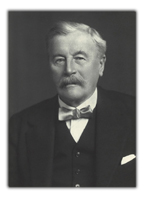
Acworth, Sir William Mitchell (1850–1925), railway economist, was born at Rothley, Leicestershire, on 22 November 1850, the third son of the Revd William Acworth, vicar of Rothley, and his wife, Margaret Dundas, daughter of Andrew Mitchell of Maulside, Beath, and Blythswood Place, Glasgow. He was educated at Uppingham and at Christ Church, Oxford, where he matriculated on 13 May 1871. After taking a degree in history in 1872, for eighteen months he tutored the two sons of Crown Prince Frederick of Germany, William (afterwards Kaiser Wilhelm II) and Henry. On returning to Britain he was appointed in 1875 an assistant master at Dulwich College, where he remained until 1885. In 1878 he married Elizabeth Louisa Oswald (d. 1904), eldest daughter of James Brown, of Orangefield, Ayrshire. In 1886 he was elected a member, later chairman, of the Metropolitan Asylums Board. He served on the London county council from 1889 to 1892, and in 1890 was called to the bar at the Inner Temple.
Having begun to specialize in railway affairs, in 1889 and 1890 Acworth published his first books, descriptive accounts of the railways in England and Scotland respectively. In 1891 he turned his attention to the economic and statistical aspects of his topic, and the principles that governed the fixing of railway rates. After visiting the United States to learn about statistical methods used in American railroads, he severely criticized British railway accounts in The Railways and the Traders, published that year. These criticisms led to accounting procedures being overhauled by the UK railways in 1911.
Soon after its foundation in 1895, Acworth began lectures for railway students at the London School of Economics. In 1905 he published his best work, The Elements of Railway Economics, a pioneer textbook that was widely translated. A revised edition, co-authored by W. Tetley Stephenson, appeared in 1925. He wrote many articles on railway economics for technical and other periodicals in Britain, and also in the United States, where his work was highly esteemed. His knowledge of such matters earned him membership of the royal commission on railway accidents in 1899, on the viceregal commission on Irish railways in 1906, and on the Board of Trade committee on railway accounts and statistics the same year. He became a director of the Underground Electric Railways of London Ltd and of the Midland and South-Western Junction Railway.
Acworth gained political experience as a Unionist candidate for the Yorkshire constituency of Keighley in the general elections of 1906, 1910, and 1911. In the First World War he served for a time in the Red Cross, until in 1916 he was made a member of the royal commission of inquiry into the Canadian railways. A year later he gave evidence in the US congress before the joint committee on inter-state and foreign commerce; his testimony was revised and published in 1920 as A Historical Sketch of State Railway Ownership, in which Acworth gave his reasons for preferring private enterprise. During that year the British authorities required railway accounts to be expressed in terms of ton-miles and passenger miles.
In 1921 Acworth received a knighthood and was appointed chairman of the committee on Indian railway policy and administration. After the committee had concluded its work a year later, he was created KCSI. In 1923 he married Elizabeth Learmonth, younger daughter of Thomas Wotherspoon, of Hundleshope, Peeblesshire. There were no children of either marriage. That year the council of the League of Nations invited him to undertake an investigation of the Austrian railways. In 1924 the reparations commission, set up to implement the Dawes plan, asked him to draw up a scheme for reorganizing the German railways. Fluent in French and German, and with a barrister's training in addition to his unparalleled railway expertise, he dominated the inquiry, which recommended a public corporation to supersede the former government department. That task proved so exacting for a man in his seventies that Acworth suffered a breakdown and died at A8 the Albany, Piccadilly, London, on 2 April 1925, shortly before he was due to depart for a similar investigation in Romania. His unique collection of transport literature was bequeathed to the London School of Economics.
A supporter of private enterprise, Acworth was, in some instances, led to recommend measures of state control owing to chaotic post-war conditions; but he always strongly emphasized the necessity of separate railway budgets and of adequate safeguards against political interference. A man of concentrated energy, he undertook much journalistic work for The Times. He served on the councils of the Royal Economic Society and the Royal Statistical Society, having presided over the economics section of the British Association in 1908. Not surprisingly, his entry in Who's Who listed no recreations. He was noted for his moral courage, fair-mindedness, hospitality, and sense of humour. Widely read, he often lamented (as did some economists) that he knew so little economic theory, although he had great skill in unravelling quantitative data. Although practical railway officers often charged him with being too theoretical, they turned up in droves to his lectures, and some helped to supervise the teaching curriculum. No recognition gave him so much satisfaction as this acceptance by his own country's railway industry..
Courtesy of Oxford Dictionary of National Biography.
There is an interesting account of his Indian work heading what came to be known as the Acworth Committee here. This committee's work helped establish the Indian Railway's Administration and oversaw its consolidation and expansion.
Charles Orr's Memoirs Volume 6

