

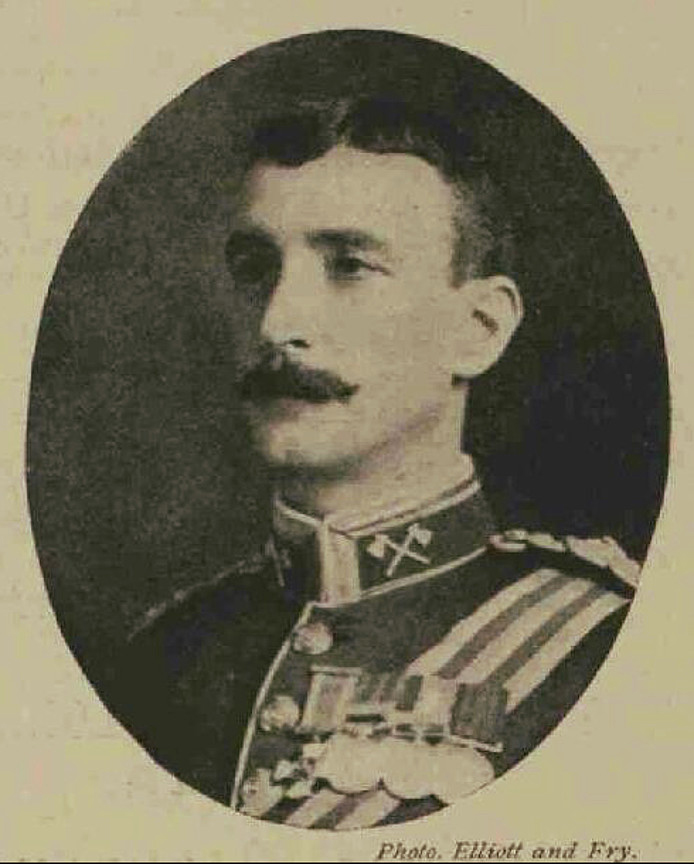
Alexander Stanhope Cobbe was born on 5 June 1870 at Naini Tal, Bengal. He was the son of Lieutenant-General Sir Alexander Hugh Cobbe and Emily Barbara née Jones. He was educated in Wimbledon and at Wellington College. He passed out of RMC Sandhurst in 1889 and was commissioned into the South Wales Borderers. Three years later he transferred to the Indian Army and served in the 32nd Sikh Pioneers as a lieutenant, his rank dating from 4 March 1892. In 1895 he played a prominent part in Colonel Kelly’s famous march over steep and snow-covered mountains, fighting at least two serious actions, particularly at Nisa Gol where the regiment lost 2 men killed and 4 wounded, and relieving the besieged fort at Chitral on 20 April.
In 1896 he was seconded into the Central African Regiment to take part in the Southern Angoniland operations (Nyasaland). He was promoted to captain and appointed second-in-command of the King’s African Rifles in May 1896 to take part in the expedition to Kwamba in 1899. He was awarded the DSO for his service in Ashanti when he took a detachment there in 1900.
In 1901 he commanded a battalion of the King’s African Rifles and took them to Somaliland. In the action at Erego on 6 Oct 1902, Captain Cobbe was isolated when his men retired, and he took charge of the Maxim gun and brought it to bear at a critical point in the battle. He then noticed a wounded man about 20 yards in front of him and succeeded in carrying him to safety under fire. For his bravery he was awarded the Victoria Cross, gazetted on 20 Jan 1903.
He was posted to the Staff College at Camberley in 1905 and then appointed GSO3 at the War Office. He was promoted to Brevet Lieutenant-Colonel in 1910 and returned to India as GSO1 to Army HQ. In 1911 he was appointed ADC to the King.
When the First World War broke out he went to France as a staff officer in the Lahore Division. In 1916 he was recalled to India as Director of Training and at the same time was commanding officer of the 31st Sikh Pioneers, but the war in Mesopotamia needed senior active officers and he was put in command of the 7th Division in June 1916. When Sir Stanley Maude succeeded to the command of the army in Mesopotamia, Cobbe was given command of III Tigris Corps and later I Tigris Corps until the end of the war. He was prominent in the crossing of the Tigris, the march to Baghdad and finally the Turkish surrender at Qilat Shergat.
He remained in command in Mesopotamia after the war, but returned to Britain in 1919 to work as Military Secretary in the India Office, and later returned to India for four years in Northern Command. He reached the rank of General in 1924 and came back to England for the last time to work at the India Office. He lived at Sharnbrook, Bedfordshire, where his father-in-law was lord of the manor of Colworth.
General Sir Alexander Cobbe VC, GCB, KCSI, DSO, died on 29 June 1931. He was buried in St Peter’s Churchyard in Sharnbrook. He was married in 1910 to Winifred Ada Bowen and they had a son, Flying Officer A. W. L. Cobbe, who was killed in the Battle of Britain.
