

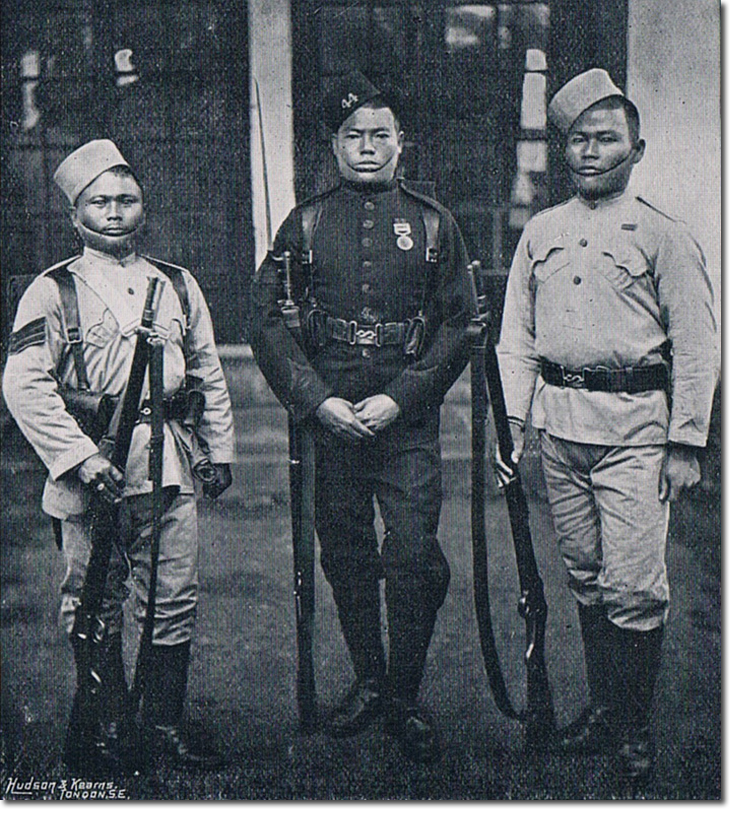
The Navy & Army Illustrated published this photo on 24 July 1896. The caption explains that the Gurkha in the middle is a Havildar in dark green drill order; the shorter Havildar on the left of the photo, is in heavy marching order, and the man on the right is a sepoy in khaki drill order. The dark green dress uniform is different from that worn in the earlier 1885 and 1890 photos. The jacket has a black collar and the black cuffs are now pointed. There is no longer a black panel down the front. The eight buttons are black plastic. This Havildar has a black leather waist-belt and shoulder braces with pouches at the front and a folded greatcoat on his back. The kukri and bayonet frog are on the back of the belt. A bronze 44 badge on his green Kilmarnock cap is clearly visible but there are no badges on the green cloth shoulder straps. He has an India Medal with a clasp for either BURMA 1885-89 or LUSHAI 1889-92.
The khaki service dress worn by the sepoy and the other Havildar is also worn with black equipment and black puttees. The khaki top is a smock that has to be pulled over the head and fastened with three black buttons. There are two breast pockets that hold 5 rounds each. No cap badges were worn in this order of dress and no shoulder titles. The 1888 Mackenzie equipment has a valise or folded greatcoat on the back. The kukri is attached to the waistbelt on the right and the bayonet on the left. The pantaloons are a much closer fit than previously for both the khaki and the dress uniform. The Gurkhas are armed with Martini Henri rifles, issued in 1888 to replace the Snider Enfields. The Havildar in the centre has a bayonet attached to his rifle. This is the slim bladed socket bayonet. They were initially issued with sword bayonets, as was normal for rifle regiments, but gave them up for the type seen here. They were still referred to as ‘swords’, the term used by riflemen for bayonets.

