|
Colours
|
|
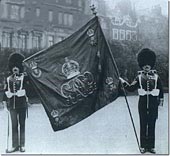
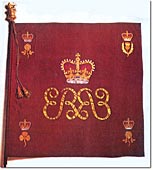
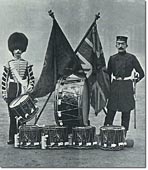
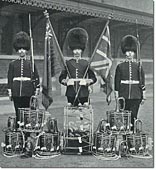
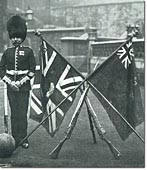
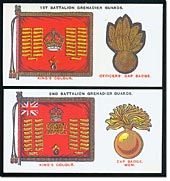
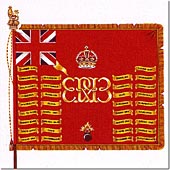
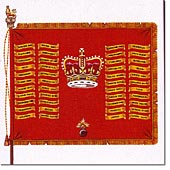
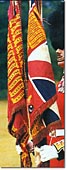
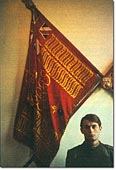
'Colours' is the name given to the flags carried by a regiment into battle to indicate the position of the regimental HQ. In battle, the Commander-in-Chief directing operations could tell, at a distance, where his regiments were; they also provided a rallying point for men who had strayed from their commanders. In the early regiments, each company had it's own Colour. The Captain of each company put his device in the centre of the Colour. The Captains could be of any rank including the Colonel who commanded the senior company. In the 1st Guards, the senior company was the King's company whose Colour was plain crimson with the crown and cypher in the middle in gold. King Charles II presented Royal badges for each of the other companies. This did not happen in the other two Guards regiments until 1750.
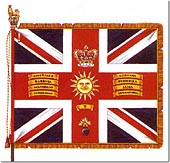
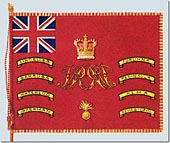
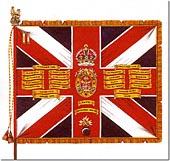
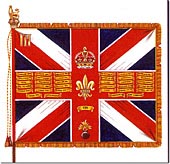
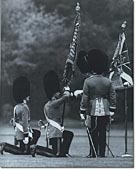
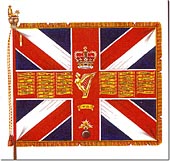
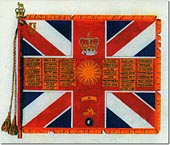
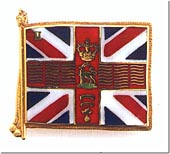
In 1747, infantry colours were regulated and in the line regiments the First or King's Colour was the Union Flag, and the Second, or Regimental Colour was the colour of their facings with a small Union Flag in the canton. But the Guards regiments kept to the old system and have continued to this day. Their King's/Queen's Colour is crimson while the Regimental Colour is the Union Flag. At first the Regimental Colours were based on the Union Flag with the device in the middle and the company number in the 'canton' (upper corner nearest the pole or pike). By mid 19th century, there were 30 companies in all. The Company number was then placed under the device and the Battalion number was put in the canton. The colours were carried by ensigns, the most junior officers, and guarded by two colour sergeants.
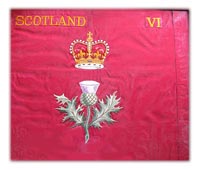
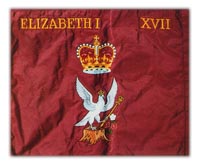
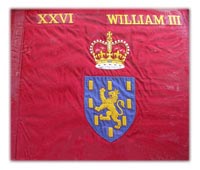
The company badges, or devices, are also used on small crimson flags used as markers on the parade ground, carried by a Colour Sergeant. They are known as Camp Flags or Camp Colours having been used in the old days as signs to indicate the different companies when camp had been set up. The list below gives the description of each company badge. They are illustrated in some cases by an example. These are made of crimson French silk, 21 inches by 17 inches (53cm x 43cm). They are embroidered on both sides with gold and silver wire and coloured silks. In the centre is a king's or queen's personal armorial device surmounted by the current Royal Crown. Across the top of the flag are the name of the king or queen and the Company number in Roman numerals. These Colours are unfringed except for the Colonel's which is fringed in gold. The Lieutenant-Colonel has No.27 Company Colour, and the Regimental Adjutant has No.28. The first 8 Company Colours are used by the 1st Battalion. The Colours from 9 to 16 were used by the 2nd Battalion, since 1994 by Nijmegen Company, and the numbers 17 to 24 were used by the 3rd battalion, since 1961 by Inkerman Comany. The last three Colours of each battalion were used by the CO, the 2nd in command, and the Adjutant respectively. The Camp Colours are fixed to poles 8ft 4in tall with a solid brass finial of the Royal Crest.
|
|
Royal Standards and Battalion Colours
|
|
|
|
| 1st or King's/Queen's Company |
The Royal Crest of England |
|
2nd |
Red & white rose incorporated, seeded gold, barbed green |
|
3rd |
Golden fleur-de-lys |
|
4th |
Golden portcullis |
|
|
|
|
|
|
|
|
|
|
8th |
Red dragon of Cadwallader on green mount |
|
9th |
White greyhound on green mount, with gold collar |
|
10th |
Golden sun with sunbeams and human face |
|
11th |
Silver unicorn statant on green mount, with gold collar, chain, horn, mane & hoofs |
|
12th |
Silver antelope statant with gold collar, chain, horns and hoofs on green mount |
|
13th |
Kneeling White hart with gold crown,chain, horns etc on green mount |
|
14th |
Silver falcon within gold fetterlock |
|
15th |
Red rose of Lancaster |
|
|
|
|
|
|
|
|
|
|
19th |
Sword and sceptre crossed |
|
|
|
|
21st |
Sun rising out of clouds |
|
22nd |
Burning beacon |
|
23rd |
Two crossed ostrich feathers |
|
24th |
Royal crest of Ireland |
|
25th |
St George's cross on silver shield |
|
|
|
|
27th |
Badge of the Order of the Bath |
|
28th |
Crest of Brunswick or Hanover |
|
29th |
Shamrock leaf |
|
30th |
Crest of the Prince Consort |
|