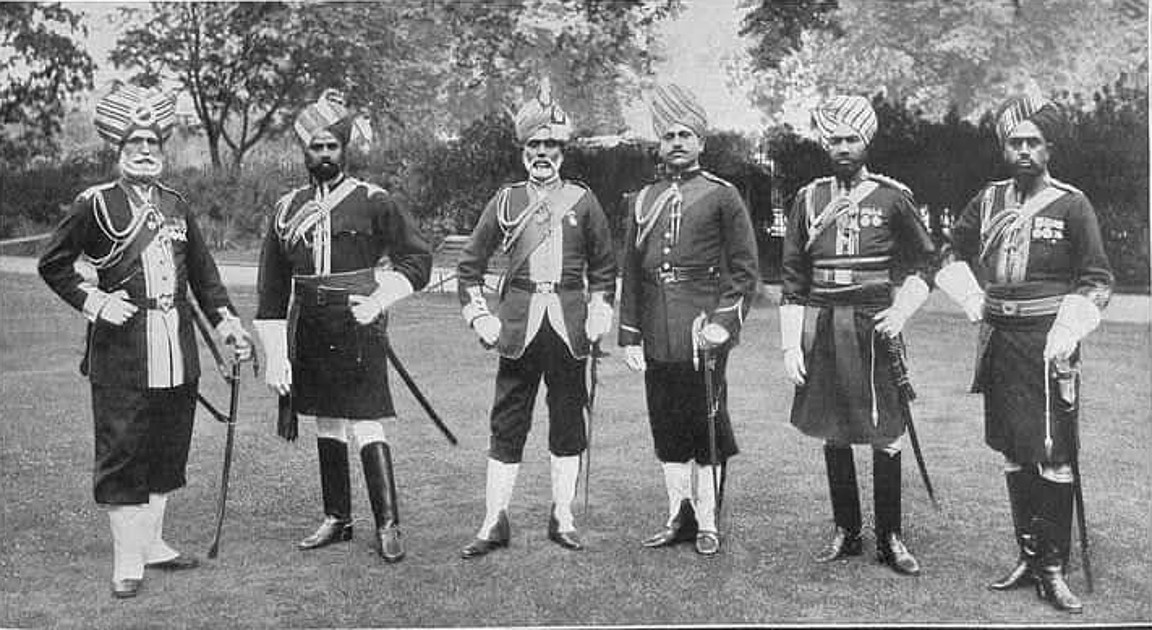
Seated, from the left: Subadar-Major Jiwand Singh Bahadur, 45th (Rattray’s) Sikh Infantry (red tunic, white facings). He was a highly respected officer who, in 1903, had served 30 years in the regiment. He was awarded the Royal Victorian Order by Edward VII and reached the rank of Honorary Captain.
Seated, centre: Ressaidar Ahmed Khan, 2nd Lancers Hyderabad Contingent. In 1903 this became the 29th Lancers (Deccan Horse). His uniform is a green kurta, white facings with gold lace edging.
Seated, right: Risaldar-Major Ali Muhammad Khan, Sardar Bahadur, 2nd Bengal Lancers. After 1903 the regiment was 2nd Lancers (Gardner’s Horse). His uniform is a dark blue kurta with light blue facings and gold lace.
Standing, left: Subadar-Major Mir Abba, Bahadur, 4th Madras Infantry (Pioneers). The uniform is a red tunic with white facings. The khaki turban has a red end and white fringe. The regiment became the 64th Pioneers in 1903.
Standing, centre: Risaldar-Major Umdah Singh, Bahadur, 2nd Punjab Cavalry. The officer wears a dark blue kurta with red facings and gold lace. In 1903 the regiment was numbered 22nd, and in 1904 was named 22nd Sam Browne’s Cavalry (Frontier Force).
Standing, right: Subadar Ram Chandar Rao Mohitay, 3rd Bombay Light Infantry. He wears a red tunic with black facings. The regiment was named 103rd Mahratta Light Infantry in 1903.
The British officer in charge of the Orderlies was named as Captain Brevet Major Hon. C. G. Bruce of the 1st Battalion, 5th Gurkha Rifles.