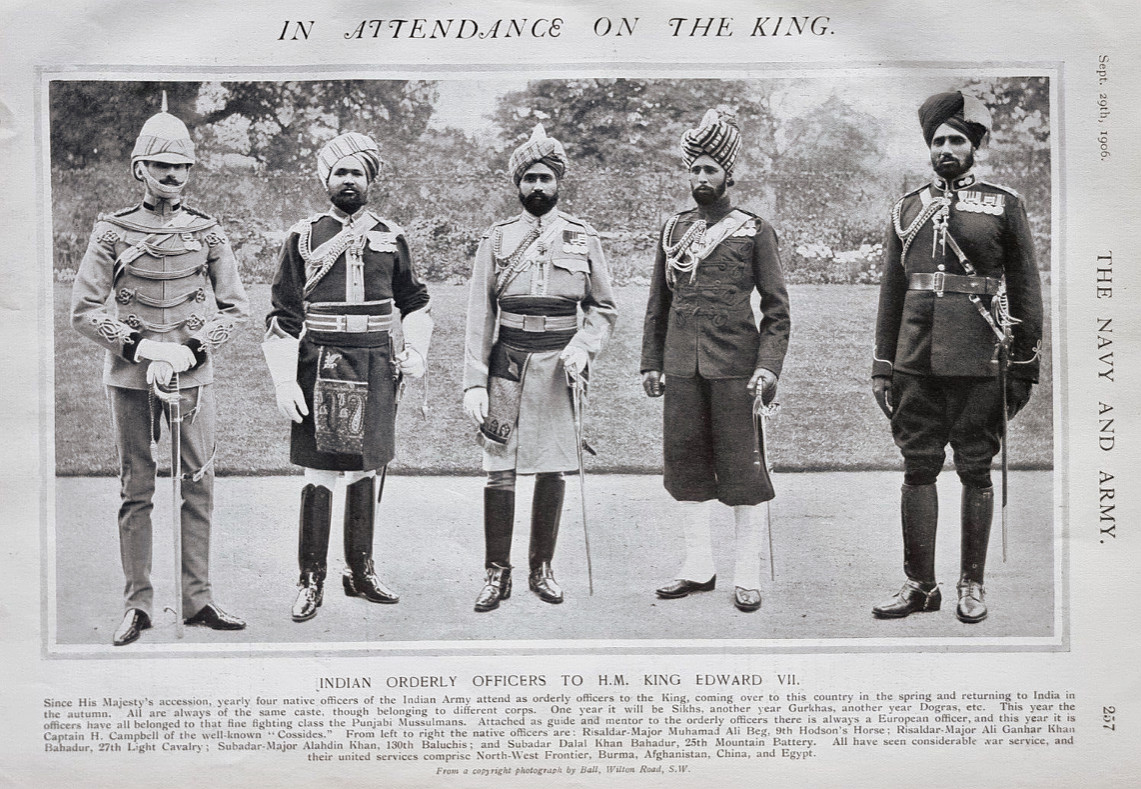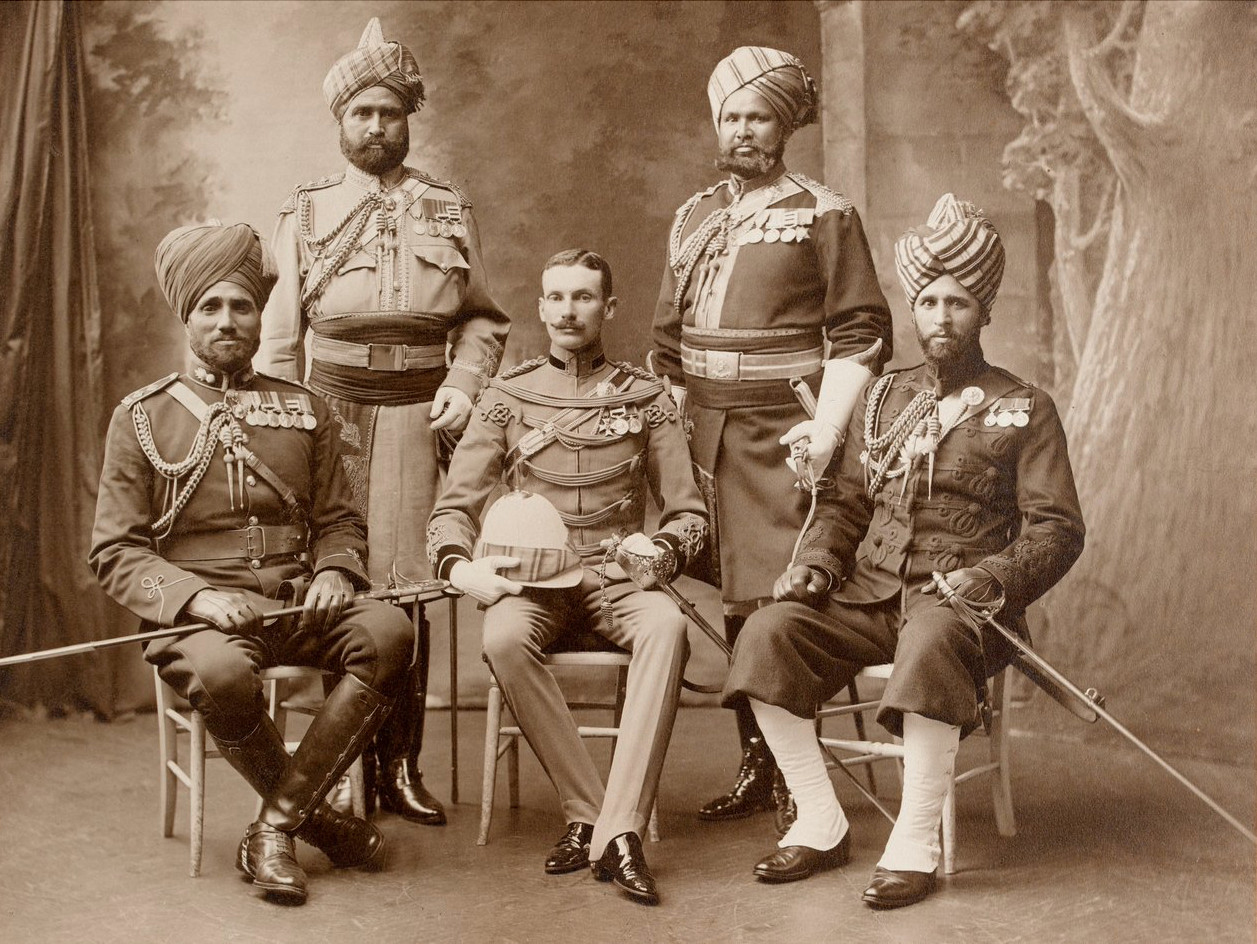
Seated, left: Subadar-Major Dalel Khan OBI, 25th Mountain Battery (Frontier Force). His uniform consists of a red turban, a blue tunic with a red collar edged with gold. There is gold braid on his cuffs, and his shoulder straps bear two pips and a gilt shoulder title. On his collar is an embroidered gold flaming grenade, the badge of the Artillery. He has a brown leather Sam Browne belt which supports his sword. The blue breeches are worn with laced boots, spurs, and leather gaiters. Around his neck is the decoration for the Order of British India.
Seated, centre: Captain Hector Campbell, Queen’s Own Corps of Guides (Frontier Force) (Lumsden’s), which was based at Mardan. His uniform is described as drab with a scarlet collar and cuffs, and drab cords and lace. The Guides were a corps of cavalry and infantry, so the fact that he has spurs (not seen in this photo) indicates that he was a cavalry officer. His three medals include the insignia of the Royal Victorian Order.
Hector Campbell was born in 1877. He was educated at Haileybury, and entered RMC Sandhurst in 1895. He was commissioned in January 1897 as a 2nd Lieutenant into the Queen’s Own Corps of Guides and promoted to Captain in 1906, to Major in March 1915. He was awarded the DSO in World War One and retired with the rank of Brigadier. The London Gazette of 25 June 1926 stated that he was placed on the unemployed list on 1 February 1926. Brigadier Hector Campbell DSO MVO died in 1972.
Seated, right: Subadar-Major Alahdin, 130th Baluchis. This officer wears a rifle green tunic with black lace and braid and a scarlet collar and cuffs. The trousers are red. The regiment was formerly the 30th Bombay Infantry. In 1906 they were honoured with the title Prince of Wales’s Own and (Jacob’s Rifles), their title when they were raised in 1858.
Standing, left: Risaldar-Major Ali Ganhar Khan OBI, 27th Light Cavalry. The regiment was formerly the 2nd Madras Lancers. His uniform is a pale blue (French grey) kurta with buff facings and silver lace and braid. The kummerbund is dark blue, as are his breeches. He wears the decoration for the Order of British India at his neck.
Standing, right: Risaldar-Major Muhammed Ali Beg, 9th Hodson’s Horse, formerly 9th Bengal Lancers. His blue kurta has white facings and gold lace, and he wears the Order of British India. His medals include the Khedive’s Star for service in Egypt in 1882.
Amongst a collection of papers belonging to Brigadier Hector Campbell, handled by Richard Ford Manuscripts, is a printed notice dated 6 June 1906, Dunmore:
‘Re ENTERTAINMENT to King’s Indian Orderlies. It is proposed to invite Captain Hector Campbell (Queen’s Own Corps of Guides), and the four King’s Indian Orderly Officers accompanied by their four Orderlies, to Eastbourne, on Tuesday, June 26th’.