

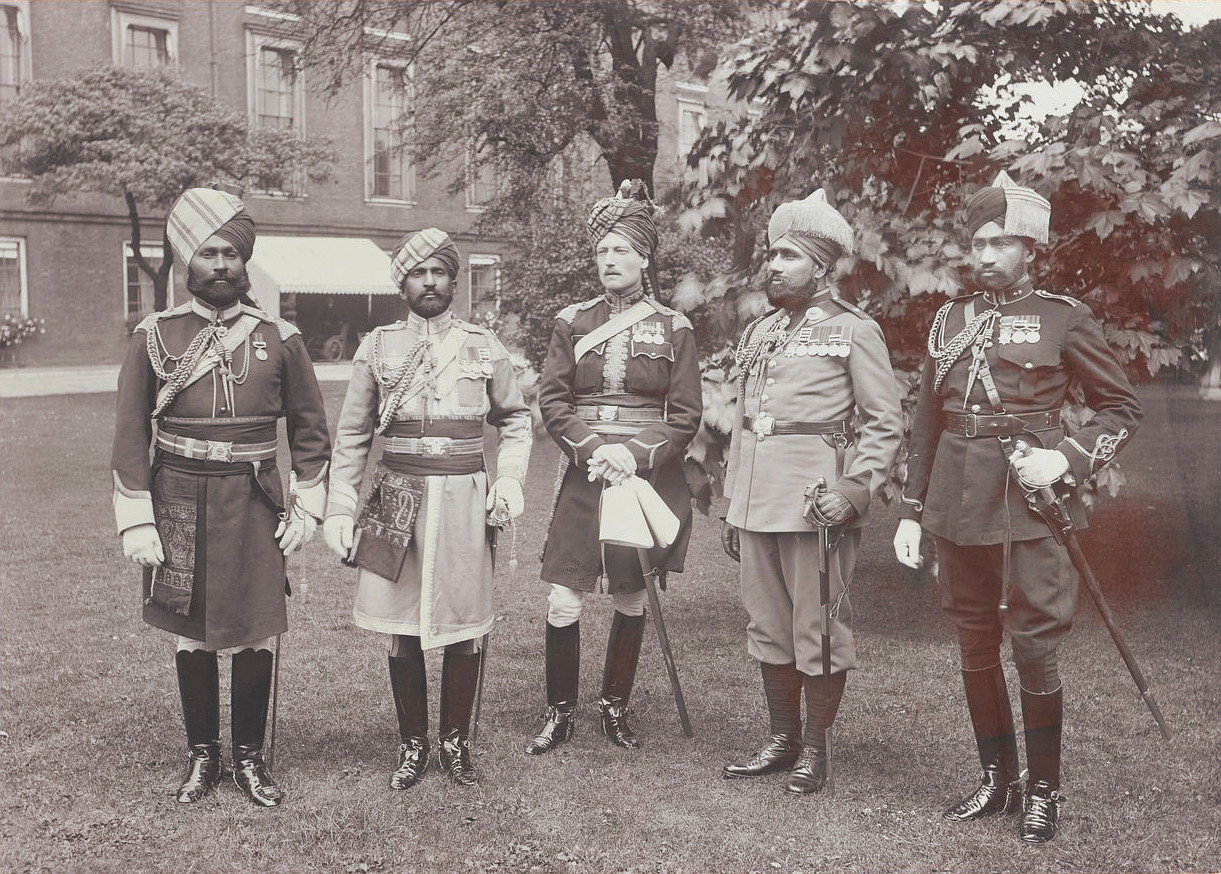
The Coronation of King George V took place on 22 June 1911 which meant that the King’s Indian Orderly Officers for that year had unusual duties, most notably taking part in the processions which took place over two days, the 22nd and 23rd. There were many troop detachments from different parts of the British Empire, including a cavalry contingent from India. This comprised 27 officers from different regiments. They rode alongside the Canadian Mounted Police, but they did not include the King’s Orderly officers who rode behind the British cavalry and artillery detachments. This of course was where the two cavalry officers and the Mountain Artillery officer were placed. Subadar-Major Bahadur Ali Khan, the only infantry officer in the quartet, was on foot, elsewhere in the procession.
Left: Risaldar-Major Abdul Karim Khan, Bahadur OBI, 30th Lancers (Gordon’s Horse). Prior to 1903 this regiment was the 4th Lancers Hyderabad Contingent. The 30th Lancers consisted of two squadrons of Sikhs, one squadron of Jats and one of Hindustani Muslims. This officer commanded the Hindustani Muslims. His uniform is a green kurta with white facings and gold lace. The kummerband is red. He has the gilt decoration for the Order of British India 2nd Class at his neck.
Second from left: Risaldar-Major Malik Sher Khan Bahadur, 26th King George’s Own Light Cavalry. Since 1788 this regiment was the 1st Regiment of Madras Cavalry, becoming Lancers in 1886. The reorganisation of 1903 re-numbered them as 26th and the title Prince of Wales’s Own was conferred on them in 1906. But when Prince George became King George V in 1910 their title reflected this. The Risaldar-Major is a Punjabi Muslim. His uniform is a French grey kurta with buff facings. His kummerband is blue.
Centre: The British officer in charge of the detail stands in the centre of the group, Major L. C. Jones, 5th Cavalry. This regiment was raised in 1841 as the 7th Regiment of Bengal Irregular Cavalry but was elevated to 5th in 1861. The regiment had an establishment of four squadrons, two of Hindustani Muslims, one of Rajputs and one of Jats. The uniform is distinctive in being scarlet. Major Jones’s kurta is decorated with gold lace and braid, including breast pockets. The kummerband is blue. The National Army Museum possesses his mess kit (1959-07-93) dated 1896, and says that he reached the rank of major-general.
Second from right: Subadar-Major Bahadur Ali Khan, Sardar Bahadur IOM OBI, 51st Sikhs (Frontier Force). This distinguished officer is a Punjabi Muslim who had been decorated with the Order of the Brilliant Star of Zanzibar 3rd Class for his services in Uganda in 1898. The regiment was raised in 1846 as the 1st Regiment of Infantry of the Frontier Brigade, and in 1847 was the 1st Sikh Local Infantry, one of four Sikh infantry regiments dating from that time, a remarkable thing considering that the British fought the first war against the Sikhs from 1845 to 46 and the second war from 1848 to 49. The Subadar-Major wears a drab coloured uniform with yellow facings. The regiment was based at Bannu, consisting of four companies of Sikhs, one company of Dogras, one of Punjabi Muslims and two of Pathans. They had served in China in 1900 and this officer has a medal for that campaign.
Right: Subadar Muhammed Ismail IOM, 32nd Mountain Battery. He wears a blue uniform with scarlet facings. His Indian Order of Merit 3rd Class is a silver star next to his campaign medals. The 32nd Mountain Battery was raised in 1907, based at Dera Ismail Khan.
