

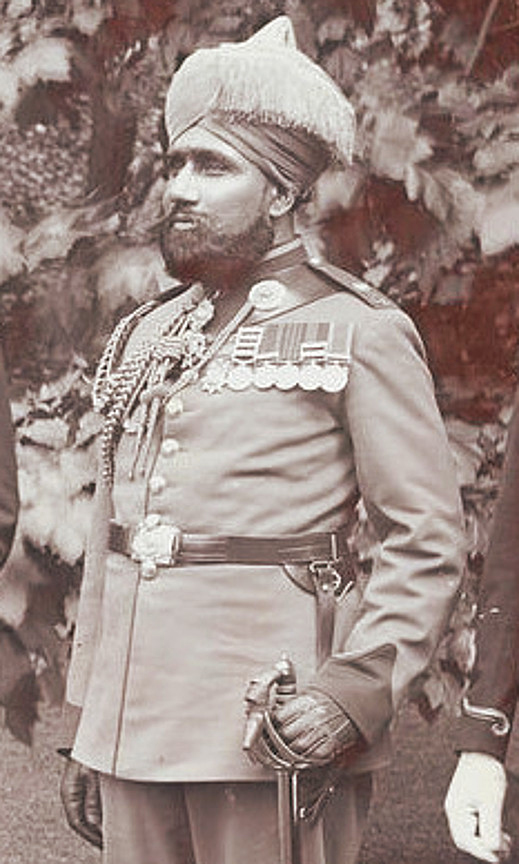
Ali Khan enlisted in the Army on 24 June 1876 and was commissioned as a jemadar on 1 May 1895, promoted to subadar on 27 November 1895 and Subadar-Major on 1 March 1909. He had a fine array of medals which included the India Medal 1849–95, with its red and blue striped riband, for which he had four clasps including Jowaki 1877–78, Burma 1887–89, and Waziristan 1894–95. He also held the Afghanistan Medal 1878–80, with a green riband edged in crimson, bearing the clasp for Ali Musjid. He served on the Northwest Frontier during the Mahsud-Waziri campaign of 1881. The medal on the right of his row was the China Medal 1900, crimson riband with yellow edges, with clasp for Relief of Pekin. He also fought on the Northwest Frontier in 1902 in operations against the Darwesh Khel Wazirs.
The Order of British India was worn as a gold and enamel decoration suspended on a ribbon beneath his collar. The larger multicoloured decoration below was the Order of the Brilliant Star of Zanzibar, awarded by the Sultan, a rare non-British honour.
He served in East Africa in 1895–96 in operations against Mazarin rebels. The East and Central Africa Medal 1897–99, with riband half yellow and half red, bore two clasps. During this campaign he was awarded the Indian Order of Merit, 3rd Class. His citation read:
“For conspicuous gallantry in East Africa (Uganda) during the fight at Jass camp on the 26th April 1898 on which occasion he, with No.1 Section and the Maxim Section, formed up on the left of the firing line, which was wavering, and by a steady conduct of fire, enabled the centre to rally and the flank sections of the contingent to cope successfully with the enemy’s counter-attack. He also distinguished himself as a leader in the defence of Mruli Post on the 30th May 1898 and was specially mentioned for his gallantry.”
Bahadur Ali Khan was admitted to the Order of British India, First Class, on 26 December 1906. In 1910 he travelled to London as one of the King’s Indian Orderly Officers and took part in the Coronation of King George V. He served as ADC to the Commander-in-Chief and ended his long and distinguished career sometime in 1912–13. This information was provided by a Facebook post (29 June 2016) by the Centre for Military History and Conflict Studies (CMHCS, USI).

