

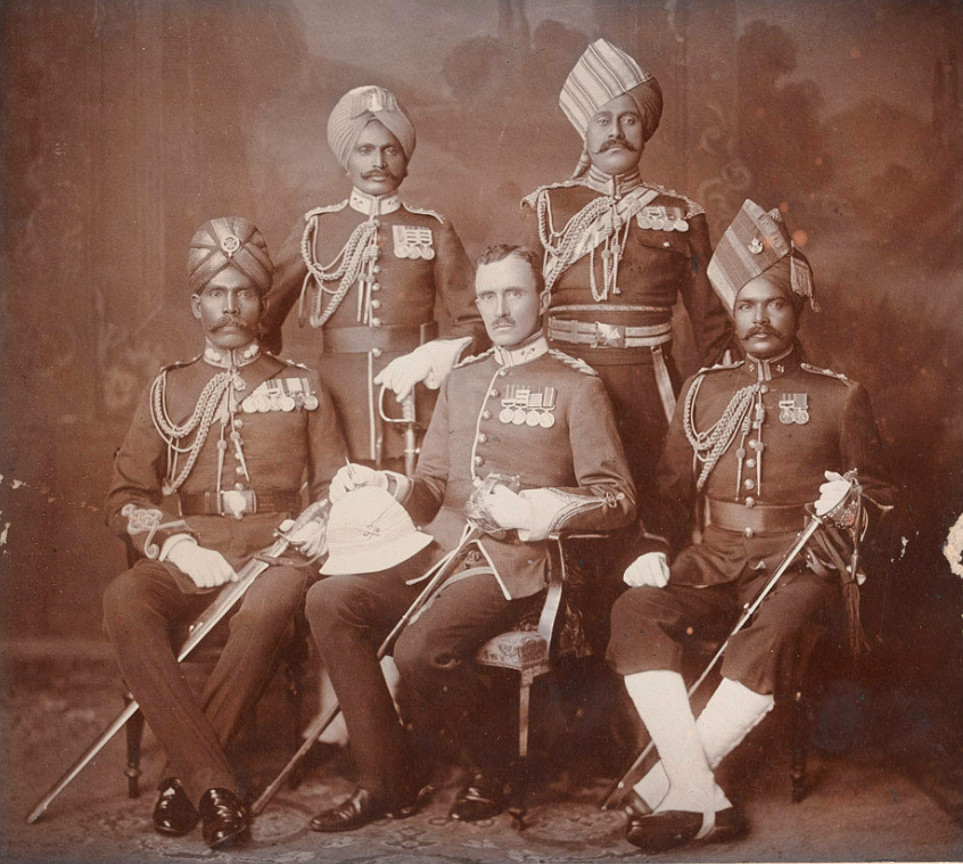
Seated left: Subadar Alexander, Sardar Bahadur OBI, 2nd Queen Victoria’s Own Sappers and Miners. This corps was raised in Madras as pioneers in 1780. By 1803 they were two battalions of pioneers. Sappers were military engineers and the miners dug tunnels in a siege. In 1831 the corps were titled The Corps of Madras Sappers and Miners. The Bengal Sappers and Miners became the 1st Corps in 1903, the Madras Corps became the 2nd, and the Bombay Sappers and Miners became the 3rd.
Subadar Alexander was a Madrasi Christian. He wears a scarlet tunic with blue velvet collar and cuffs, edged with gold. The collar badges are silver embroidered flaming bombs. His distinctive turban is gold and blue striped. Belts are brown leather and his trousers are blue with a red stripe. The gilt Order of British India hangs at his neck. His long row of medals include those for service in the Afghan War of 1879–80 and the Kabul to Kandahar bronze star.
Seated centre: Major J. A. Bliss, 64th Pioneers. Prior to 1903 the 64th was the 4th Regiment of Madras Infantry (Pioneers), a very old corps, raised in 1759 as the 5th Battalion Coast Sepoys. They were converted from Infantry to pioneers in 1883. Major Bliss wears a scarlet tunic with white collar and cuffs, and gold lace and braid. His white helmet has a regimental badge of crossed axes and crown, and a badge of crossed axes on his collar. He has a medal for service in Burma with a clasp and a medal for service on the NW Frontier in 1897–98, two clasps, and a clasp for the Bazar Valley operation. Also a Queen’s South Africa medal with five clasps.
Seated right: Subadar Pandu Rao, 63rd Palamcottah Light Infantry, formerly the 3rd Madras Light Infantry. Subadar Rao was a Mahratta Hindu. The regiment was stationed at Kamptee, comprising four companies of Madrasi Muslims, two of Tamils and two of Paraiyans (Pariahs) and Christians. The uniform is a scarlet tunic with emerald green facings and gold lace. He has a bugle horn badge of the regiment on his turban.
Standing left: Subadar Somayya, 81st Pioneers, formerly the 21st Madras Infantry. Raised in 1786 from the Ganjam Sebundy Corps and drafts from the 11th and 18th Madras Battalions. The uniform is a scarlet tunic with white facings and gold lace. The turban is drab or khaki with a white fringe. Subadar Somayya was a Madrasi Hindu. The regiment, stationed in Belgaum, consisted of four companies of Tamils, two companies of Madrasi Muslims and two of Paraiyans and Christians. Paraiyans were considered to be untouchable, the name derived from parai, meaning drum in Tamil, as they were employed as drummers. The 1912 Army list refers to them as Pariahs.
Standing right: Risaldar Lakshiman Rao Jadhu, 31st Duke of Connaught’s Own Lancers, formerly the 1st Bombay Lancers. His uniform is a blue kurta with scarlet facings and gold lace. The Risaldar was a Mahratta Hindu, the only cavalry officer in the group. The regiment was based at Kohat in 1912. The composition was one squadron of Deccani Mahrattas, one of Jats from West Rajputana, one squadron of Sikhs and one of Pathans (Pashtuns).
