

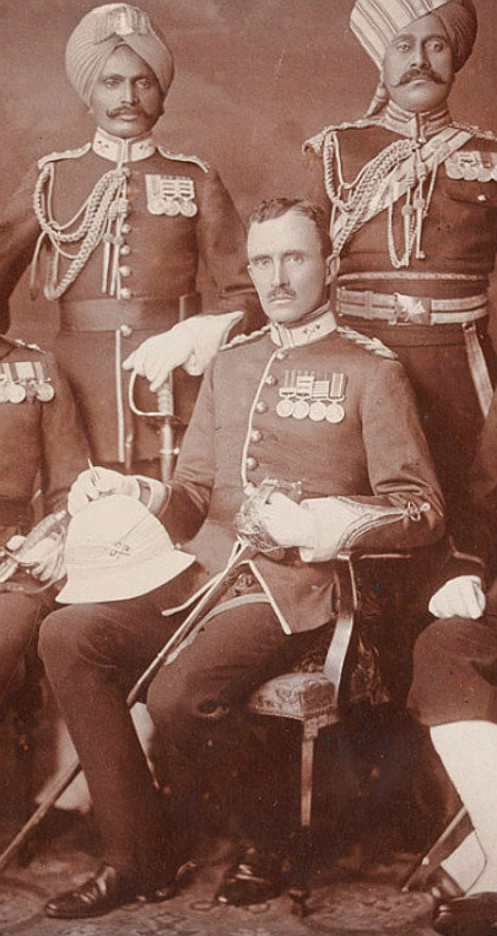
The photo is a detail from the group of King’s Indian Orderly Officers 1912. Major J A Bliss wears the British officers’ pattern uniform of scarlet tunic with white facings and gold lace and braid. His plaited gold shoulder cords have an embroidered crown to show his rank, and the white collar has crossed axes, the badge of pioneer regiments. His Wolesley foreign service white helmet also has a crossed axes badge with a crown above. The Indian officer standing behind Major Bliss’s right shoulder is Subadar Somayya, 81st Pioneers. It is interesting to compare the uniforms of British and Indian officers of Madras Pioneers. Major Bliss served in the 81st Pioneers from c1890 to 1906, for most of that time the regiment was the 21st Madras Infantry, so he would have known the Subadar well.
J A Bliss was promoted to lieutenant on 4 December 1891 in the 21st Madras Infantry. He served in Burma in 1892–93, the Chin Hill campaign. He was on the Northwest Frontier in 1897–98, present on the Samana and in the Kurram Valley in August–September 1897. He was in the Tirah, present at the actions of Chagru, Kotal and Dargai. Lieutenant Bliss was in the operations in the Bazar Valley in December 1897. The 1895 and 1900 Army lists show him serving as a lieutenant in the 21st Madras Infantry. He was promoted to captain on 3 May 1901 but had entered the Indian Staff College a year before, in July 1900.
He served in the Boer War, volunteering to serve away from his regiment. He was appointed adjutant in the 22nd Battalion, Imperial Yeomanry from March 1901. He took part in operations in the Orange River Colony and Cape Colony from May 1901 and in the Transvaal from November 1901 to January 1902. His Queen’s South Africa medal has five clasps. After the war he returned to India in 1902 and in 1903 took part in the expedition to Tibet.
The 1905 Army list shows him still as a captain in the 81st Pioneers (formerly 21st Madras Infantry). But in 1906 he had transferred to the 64th Pioneers, still with the rank of captain. He was promoted to Major on 3 May 1908, second in command of the 64th Pioneers. The regiment was stationed at Belgaum and comprised two companies of Madrasi Muslims, four companies of Tamils and two companies of Paraiyans and Christians.
In 1912 Major Bliss was awarded the MVO (Member of the Royal Victorian Order, 4th Class), as was customary, while in England, in charge of the King’s Indian Orderly Officers. During World War One he served in Burma and was mentioned in Despatches for the operations in Kachin Hills in 1914–15. The Imperial War Museum website says he was a lieutenant-colonel in command of Indian Artillery.

