

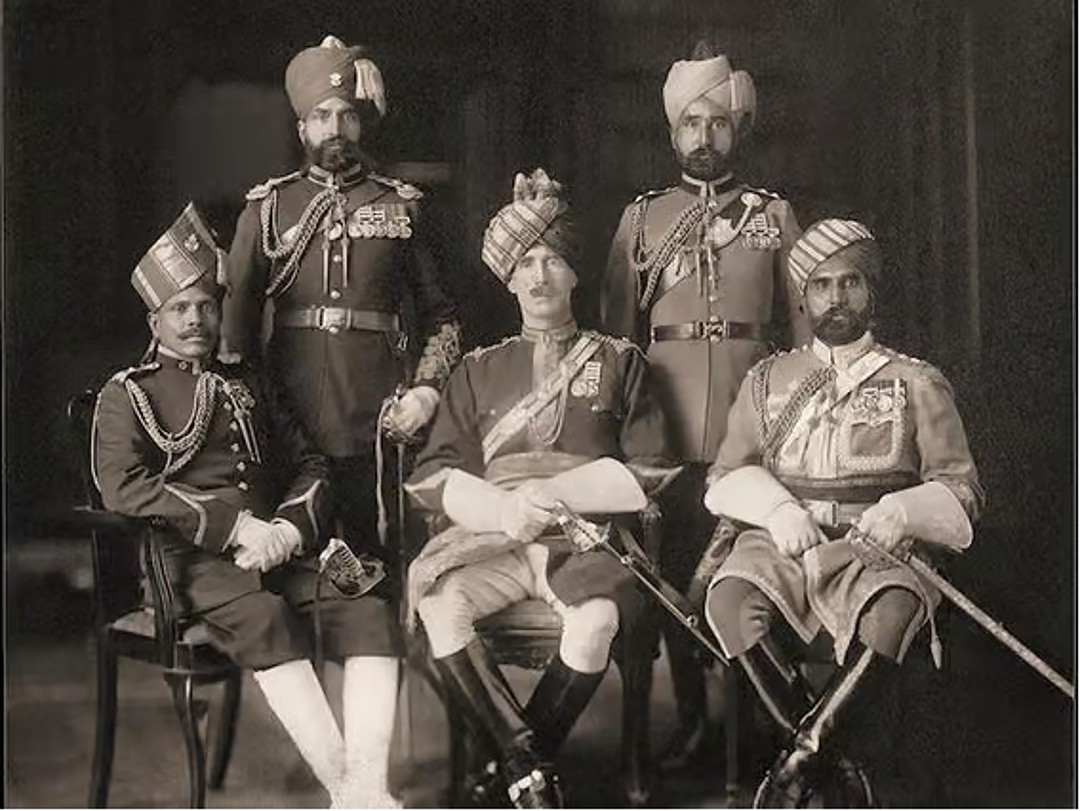
Seated left: Subadar Abdur Razzak, 63rd Palamcottah Light Infantry, formerly the 3rd Madras Light Infantry which originated in 1759. The subadar was a Madrasi Muslim. It was the second time that this regiment had been represented in the King’s Indian Orderlies — in 1912 Subadar Pandu Rao came to London. The uniform is a scarlet tunic with emerald green collar and cuffs edged with gold lace. During the First World War the Palamcottah Light Infantry raised a second battalion, but the regiment was practically destroyed at the Battle of Tanga in East Africa in November 1914. Both battalions were disbanded after the war.
Seated centre: Major Percy Edward Ricketts, 18th King George’s Own Lancers. This regiment was raised during the Indian Mutiny as the 2nd Regiment of Mahratta Horse and was briefly known as the 18th Tiwana Lancers from 1903. Prince George of Wales conferred his title on them in 1906. Their distinctive uniform was a scarlet kurta with white facings and gold lace. The regiment was stationed in Meerut in 1914, consisting of three squadrons of Punjabi Muslims and one squadron of Sikhs. Percy Ricketts was promoted to major on 3 April 1908 and appointed second‑in‑command on 1 February 1911.
Seated right: Risaldar Zaman Khan, 26th King George’s Own Light Cavalry, formerly the 1st Madras Lancers, an old regiment raised in 1787. The Madras cavalry wore French grey uniforms, and this officer has a kurta of that colour with buff facings, laced and braided in silver. The regiment, stationed in Bangalore in 1914, comprised one squadron of Madras and Dekhani Muslims, one of Rajputana Rajputs, one of Jats, and one squadron of Punjabi Muslims which Risaldar Zaman Khan commanded. King George was the Colonel‑in‑Chief of the regiment and the Honorary Colonel was the Maharaja of Mysore.
Standing left: Subadar Mihr Din, Bahadur OBI, 1st King George’s Own Sappers and Miners. Raised in Bengal in 1803, they were originally designated pioneers. The Subadar’s uniform consists of a scarlet tunic with blue facings and gold lace. His rank is indicated by two stars on his gold shoulder cords and circular gold braid around the Austrian knots on his cuffs. The belts are brown leather. His blue turban has a red end with a yellow fringe.
In the British Army the Corps of Sappers and Miners became the Corps of Royal Engineers in 1856, but the Indian Army retained the title Sappers and Miners. In 1914 the headquarters was at Rurki, consisting of six field companies, a depot company with a mounted detachment, two electric light sections, a printing section, and a photo‑litho section. The British officers came from the Corps of Royal Engineers while the Native officers and rank‑and‑file comprised Sikhs, Hindustanis, Punjabi Muslims and Pashtuns. Subadar Mihr Din was a Punjabi Muslim and was awarded the Order of British India, 2nd Class.
Standing right: Subadar Bostan Khan, 53rd Sikhs (Frontier Force), formerly the 3rd Sikh Infantry. The uniform is a drab or khaki tunic with black facings and drab lace. The turban is khaki with a black kullah and gold fringe. The uniform can be seen at Subadar 1909. The regiment was stationed at Kohat in 1914, comprising four companies of Sikhs, two of Khattak Pashtuns, one of Dogras, and one company of Punjabi Muslims which was commanded by this officer.
