

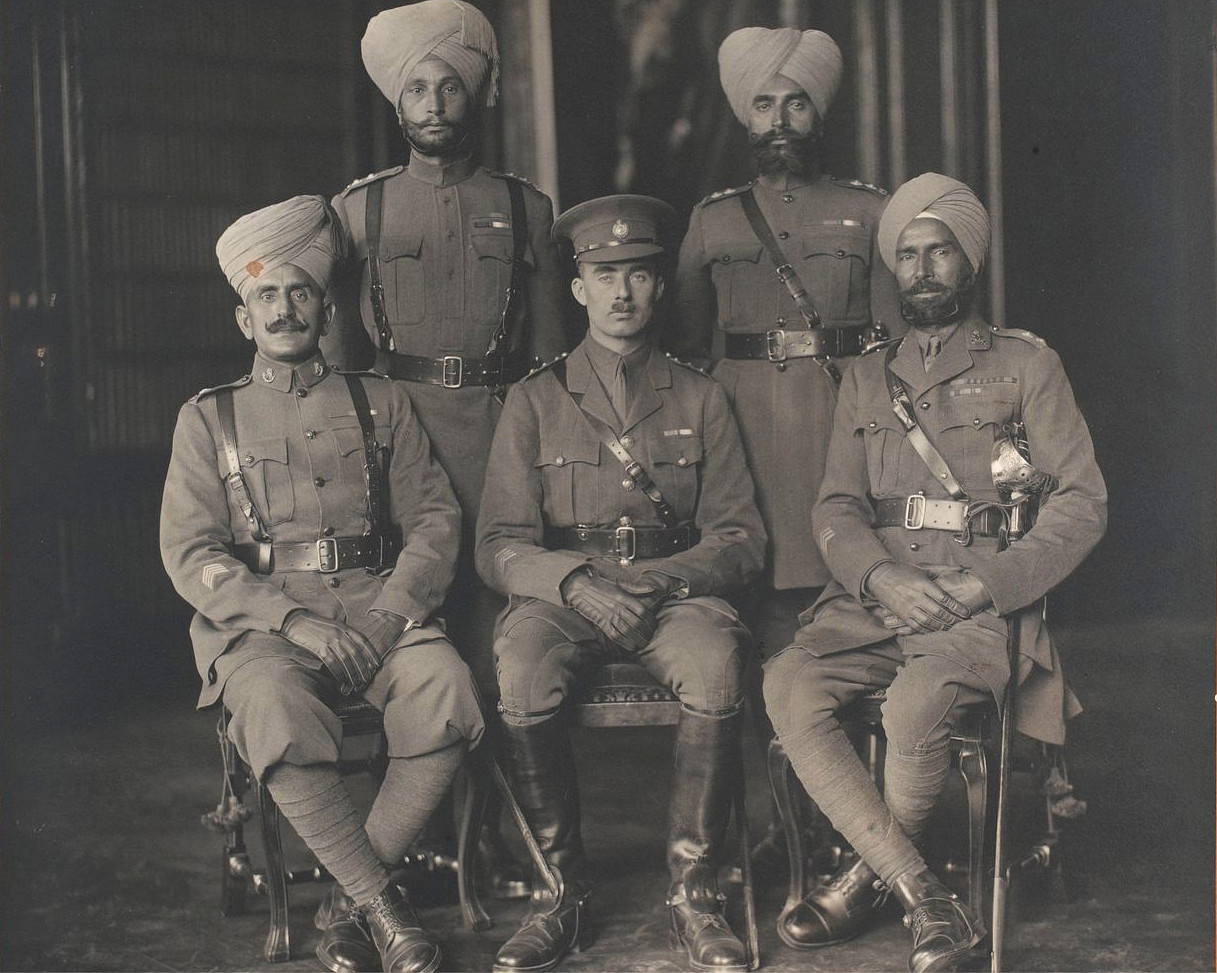
The First World War meant that the tradition of sending Indian Orderlies to attend the King in England had to be put on hold from 1915 to 1918. The Indian Army was employed on active service either in France and Flanders, the Middle East or Far East. Full dress uniforms were put into store and everyone wore khaki from 1914 to 1919, even the King himself. The three seated officers have small chevrons on their right sleeve. These were authorised in December 1917 and worn by all ranks to show service overseas. They were light blue but the lower stripe was red if the wearer had served overseas in 1914. Two of these officers, Captain Reyne and Subadar Fateh Singh, spent many months in captivity in Turkey.
Seated left: Subadar-Major Dalpat Singh IOM OBI, 6th Jat Light Infantry. This regiment was raised in Bengal in 1803, and in 1922 became the 1st Royal Battalion 9th Jat Regiment. The subadar-major is a Jat, decorated with the Indian Order of Merit and the Order of British India 2nd Class. He wears khaki service dress with regimental badges on his collar. The brown leather Sam Browne belt has two shoulder straps which crossed over at the back, a style worn by Indian infantry officers. The 6th Jats were based at Secunderabad before the war and comprised eight companies of Jats. A second battalion was raised in 1917 but this officer served in the 1st Battalion. They served throughout the war in India, France, Egypt and Mesopotamia.
Seated centre: Captain Gerard Van Rossum Reyne DSO, 1st Battalion 76th Punjabis, prior to 1903 the 16th Madras Infantry, dating back to 1776. During the First World War the regiment served on the Suez Canal and in Mesopotamia. At Kut-al-Amara the regiment was forced to surrender and spent the rest of the war as captives of the Turks. Captain Reyne survived the death march to Turkey and many months in captivity. His medals are shown below. The 1st/76th Punjabis became the 3rd Battalion 1st Punjabis in 1922.
Seated right: Risaldar Kunda Singh IOM IDSM, 21st Prince Albert Victor’s Own Cavalry (Frontier Force) (Daly’s Horse), formerly the 1st Punjab Cavalry. In 1921 they amalgamated with the 23rd Cavalry and the following year became the 11th PAVO Cavalry (Frontier Force).
Standing left: Subadar Fateh Singh, Bahadur IOM OBI, 24th Punjabis. In the First World War they were one of the unfortunate regiments that defended Kut-al-Amara and ended up as prisoners of the Turks until 1917. In 1922 they became the 4th Battalion 14th Punjab Regiment.
Standing right: Risaldar Hargyan Singh IOM ISDM, 14th Murray’s Jat Lancers. At the start of the First World War they served on the Northwest Frontier but were sent to Mesopotamia in 1916. In 1922 they amalgamated with the 15th Lancers to become the 20th Lancers.
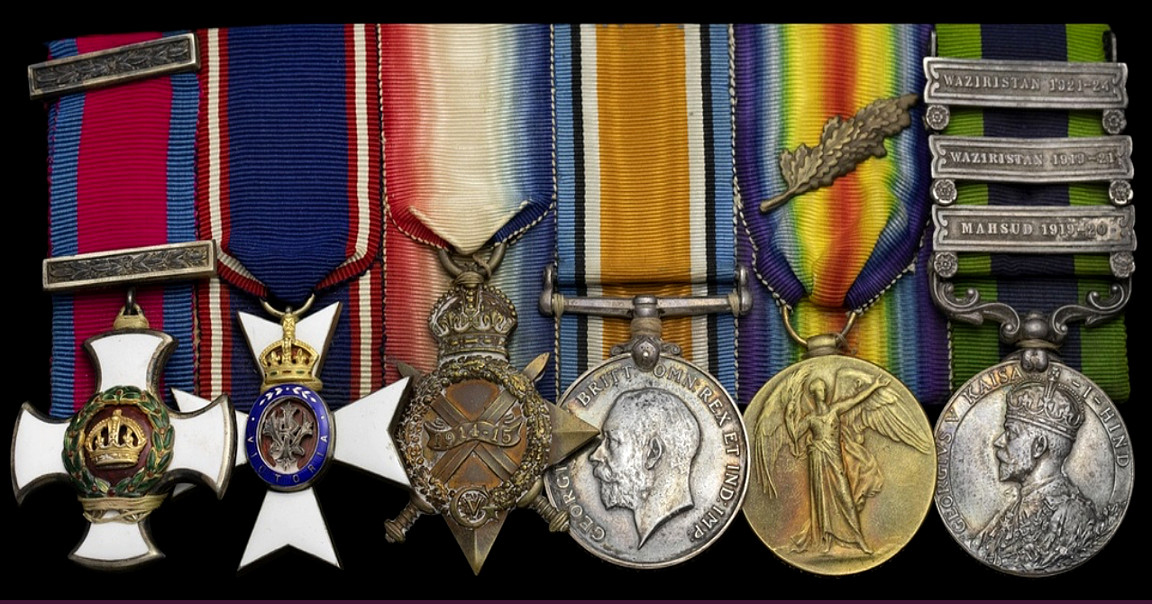
Medals: Distinguished Service Order (DSO); Member of the Royal Victorian Order (MVO); 1914–15 Star; British War Medal; Victory Medal (with oak leaves for Mention in Despatches); India General Service Medal 1908–24 (3 clasps).
Gerard van Rossum Reyne was born in Gosport, Hampshire on 29 March 1886, the son of Major J. F. Reyne who had served in the 37th (North Hampshire) Regiment. He was educated at Wellington College and trained at the Royal Military College Sandhurst. Reyne was posted to the 76th Punjabis on 7 December 1906 and promoted to lieutenant on 5 November 1907.
When the First World War broke out, the 76th were sent to the Middle East in November 1914. They defended the Suez Canal and took part in the repulse of Djemal Pasha’s attack on 3 February 1915. The regiment then advanced with the British/Indian force into Mesopotamia, but the campaign stalled at the battle of Ctesiphon in November 1915.
At Ctesiphon the regiment suffered heavy casualties, including the commanding officer who was killed. Captain Reyne was awarded the Distinguished Service Order (Gazetted 19 October 1916). General Townsend ordered a withdrawal to Kut-al-Amara, which they reached on 3 December. There they were surrounded by the Turkish army. Reyne distinguished himself during the desperate defence of Kut, receiving mentions in despatches and being wounded. The garrison surrendered on 29 April 1916.
The Turks marched the whole force into captivity on an infamous death march to Turkey. Of the 227 officers and 12,000 other ranks taken prisoner, 70% died from cruelty, starvation and disease. Reyne survived and was held in several locations: Kastamuni in July 1916, then Changri and Afion Kara Hissar, which he left on 21 December 1917. He was later held at Kedos, leaving in September 1918, and finally at Smyrna.
The photograph of him with the King’s Indian Orderly Officers was taken in London in the summer of 1919 when he was appointed a Member of the Royal Victorian Order. Later that year he returned to active service in operations in Waziristan against the Mahsud tribesmen, a campaign that continued for several years as reflected in his medal clasps. He was promoted to major in August 1920 and lieutenant-colonel in 1930, retiring in 1933.
During the Second World War he served in the Hampshire Home Guard. He died on 24 July 1940 and was buried in Yateley (St Peter) Churchyard.
The medals were sold at Spink (24003) for £4,000. The information and photograph come from their website.
