

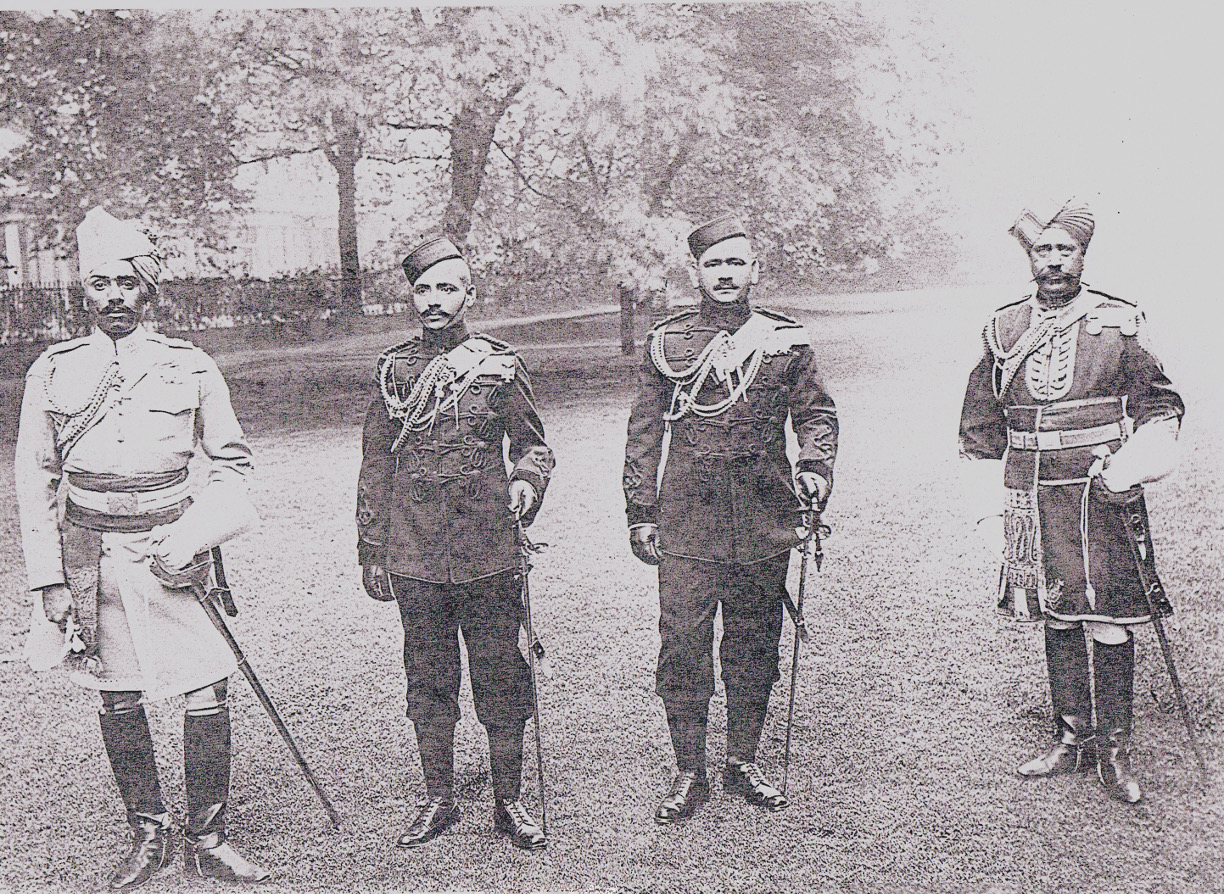
Standing left: Risaldar Balwant Singh IOM IDSM, 27th Light Cavalry. The 27th had formerly been the 2nd Madras Lancers, the oldest of all the cavalry regiments, and in 1922 was renumbered 16th Light Cavalry, retaining this title up to 1947 and after Partition when it became part of the Indian Army. Risaldar Balwant Singh was a Rathore Rajput; he wears a French grey kurta with buff facings and silver lace. He was decorated with the India Distinguished Service Medal which had a blue riband with a broad crimson central stripe. The regiment spent most of the war in India with detachments to Persia; however, they gained distinction in Afghanistan in 1919. In 1923 they were chosen, along with the 7th Light Cavalry, for Indianisation.
Second from left: Subadar-Major Padan Singh Rewat, 4th Battalion 39th Garhwal Rifles. His uniform is rifle green with black facings. Rank is indicated by an embroidered crown on each black plaited shoulder cord. His medals are not clear but include a cross which is hard to identify. The 4th Battalion was raised at Dehra Dun in October 1918 and sent to the Frontier for the Third Afghan War.
Third from left: Subadar Tilok Singh Sauntiyal IOM, 2nd Battalion 39th Garhwal Rifles. The 39th existed as a distinct Garhwali regiment from 1890, and raised the 2nd Battalion in 1901. During the First World War they suffered heavy casualties in Flanders in the autumn of 1914. This officer wears the 1914–15 Star. Both Garhwali officers in this poor reproduction appear to have a pale ‘panel’ for their medals.
Right: Risaldar-Major Sukhdyal Singh, Bahadur OBI, 12th Cavalry. This regiment was raised as Sikh irregular cavalry during the Indian Mutiny. In 1914 they comprised two squadrons of Sikhs, one of Punjabi Muslims and one of Dogras, in which Sukhdyal Singh served. He wears the full dress blue kurta which, shortly before the war, adopted a more ornate gold-embroidered front. This pattern was adopted by the amalgamated 11th King George’s Own Lancers and 12th Cavalry when they became the 5th King Edward’s Own Probyn’s Horse in 1922. The 12th went to the Middle East in the First World War but did not see active service.
The British officer commanding the King’s Indian Orderlies for 1920 was Brevet Lieutenant-Colonel J. G. McConaghy DSO, 25th Cavalry (Frontier Force). This regiment was raised in 1849 as the 5th Regiment of Punjab Cavalry. In the First World War the 25th Cavalry served in German East Africa in 1915 and joined in the pursuit of von Lettow Vorbeck to the Mozambique border before being withdrawn because tsetse flies were decimating the horses. They served in Afghanistan in 1919, in the Third Afghan War. In 1921 they amalgamated with the 22nd Cavalry to become, in 1927, Sam Browne’s Cavalry (12th Frontier Force). The London Gazette of 9 December 1927 lists him: “Colonel J. G. McConaghy DSO MVO is transferred to the unemployed list 17th Oct 1927.”
