

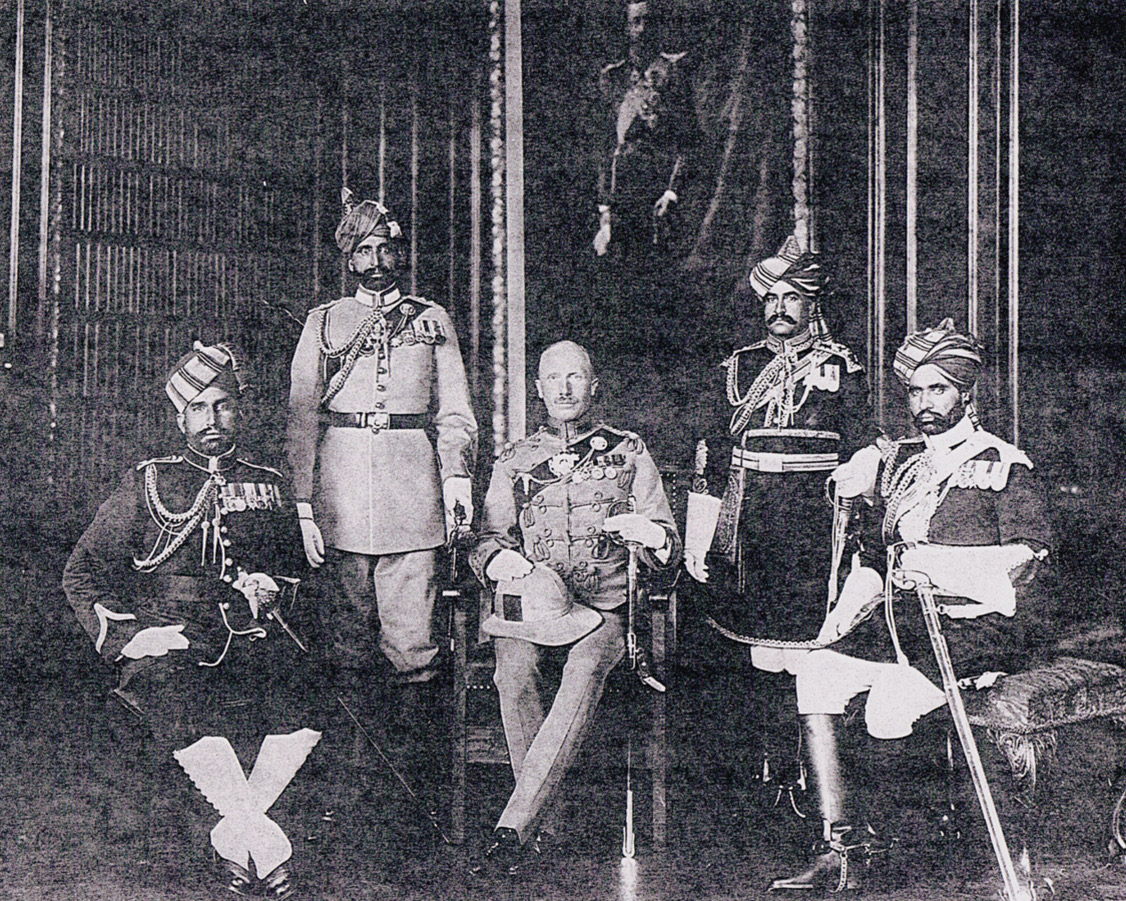
Seated left: Subadar-Major Ghulam Muhiyuddin, Bahadur OBI IDSM, 82nd Punjabis. Before 1903 this regiment was the 22nd Madras Infantry. In 1922 they became the 5th Battalion 1st Punjab Regiment. Before WW1 the 82nd comprised 4 companies of Punjabi Muslims, two of Sikhs and two companies of Jats. They served in Mesopotamia but were not captured by the Turks. The Subadar-Major wears a scarlet tunic with emerald green facings and gold lace. He has the Order of British India 2nd Class hanging at his neck and was also awarded the India Distinguished Service Medal.
Seated centre: Major W F C Gilchrist CIE, 52nd Sikhs (Frontier Force). The 52nd were the 2nd (or Hill) Sikh Infantry before 1903. In 1922 they were the 2nd Battalion 12th Frontier Force Regiment. The 52nd wore a drab or khaki uniform with scarlet facings and drab lace and cords. Major Gilchrist was awarded the Companion to the Order of the Indian Empire. It was a rose shaped decoration with red enamelled petals and gold centre bearing the head of Queen Victoria. He wears it suspended from a ribbon under his collar. Before the war the 52nd Sikhs comprised only two companies of Sikhs. Three companies were Dogras, two were Punjabi Muslims and one was Pashtuns.
Seated right: Risaldar-Major Ghulam Hussain IDSM, 19th Lancers (Fane’s Horse). This officer wears a blue kurta with French grey facings and silver lace. Fane’s Horse served in France and Flanders from late 1914, in the 2nd (Sialkot) Cavalry Brigade, First Indian Division. They were in all the actions of the Indian Cavalry Corps. At the start of 1918 they went to Palestine where they set a record riding 250 miles in less than a week, to Damascus. They returned to India in 1921 and on 23 August 1921 they amalgamated with the 18th KGO Lancers to form the 19th King George’s Own Lancers.
Standing left: Subadar Muhammad Azim, Bahadur IOM OBI, 92nd Punjabis. The 92nd were raised in 1800 as a Madras regiment but from 1890 to 1903 they were Burma Infantry. In 1914 they were stationed at Benares, comprising 4 companies of Sikhs and 4 of Punjabi Muslims. In WW1 they served in Mesopotamia and Egypt. In 1922 they became the 4th Battalion 8th Punjab Regiment. The Subadar wears a khaki long-skirted tunic with white facings.
Standing right: Risaldar Laurasib Khan MC, 10th Duke of Cambridge’s Own Lancers (Hodson’s Horse). This was the second cavalry regiment raised by Major Hodson during the Indian Mutiny. The Risaldar wears a blue kurta with scarlet facings and gold lace. The regiment fought in Mesopotamia and took part in the capture of Baghdad. Risaldar Laurasib Khan was the only recipient of the Military Cross in his regiment, for his bravery in Mesopotamia, holding the rank of Ressaider at the time. The Army awarded only 106 MCs to Indian officers in WW1.
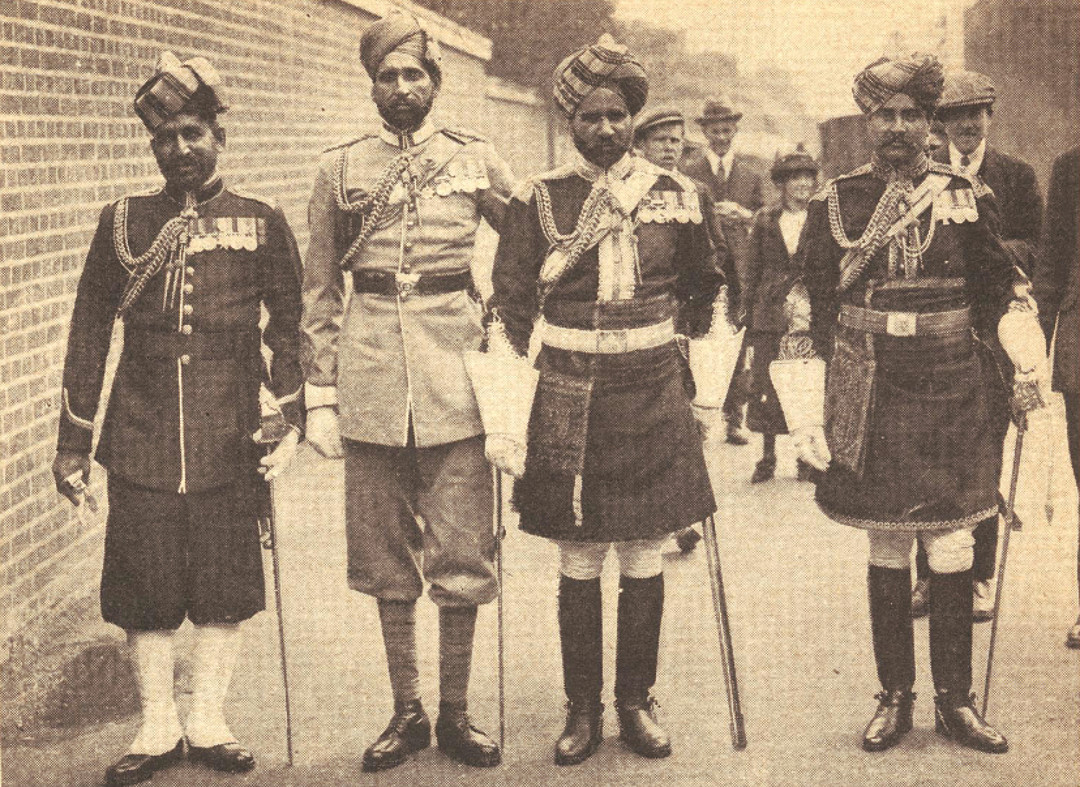
The Indian officers pose in a street, in the summer of 1921. From left:
Left: Subadar-Major Ghulam Muhiyuddin, Bahadur, 82nd Punjabis.
Second: Subadar Muhammad Azim, Bahadur, 92nd Punjabis.
Third: Risaldar Ghulam Hussain, 19th Lancers.
Right: Risaldar Laurasib Khan MC, 10th Lancers.
