

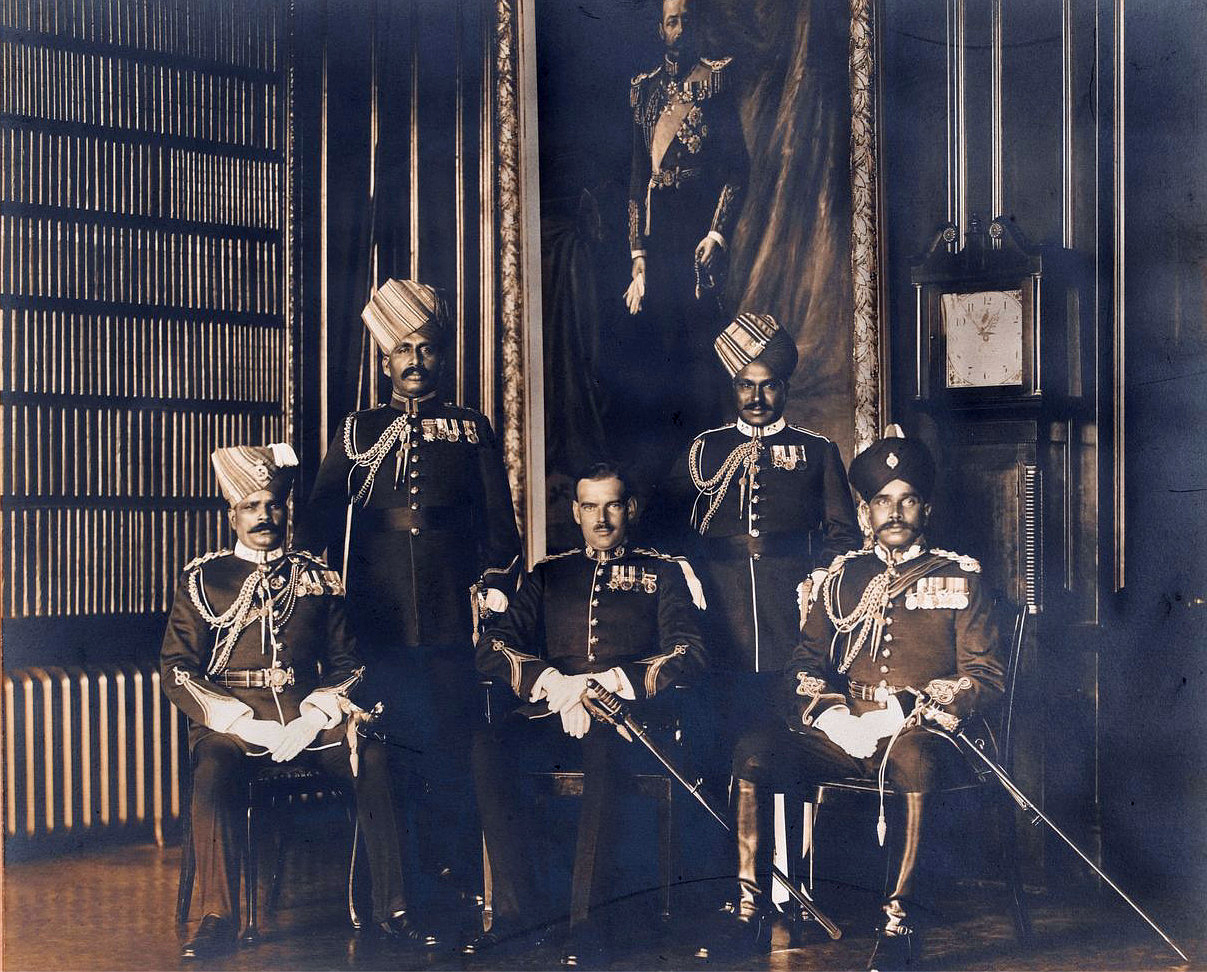
Seated left: Honorary Lieutenant Krishna Bhosle OBI IDSM, 128th Pioneers. Formerly the 28th Bombay Pioneers before 1903, the regiment became the 3rd Battalion of the 2nd Corps of Bombay Pioneers in 1922. By 1933 the Corps had been reduced so much that it was struck off the strength of the Indian Army. Lieutenant Krishna Bhosle was a Dekhani Mahratta. The regiment had two companies of Dekhani Mahrattas, with the remaining companies comprising two of Yusufzais, two of Rajputana Muslims and two of Sikhs. He wears a scarlet tunic with white facings. The Order of British India 2nd Class is on a ribbon at his collar. His turban bears the circular badge of the 128th Pioneers and he has crossed axe badges on each side of his gold-laced collar. One of his medals shows his service in Sudan in 1896–98.
Seated centre: Major W G Strover, 50 Kumaon Rifles. This regiment was raised during World War One, in 1917, and therefore did not have a dress uniform. Major Strover, the British officer in command of the detachment, wears the uniform of his previous regiment, the 5th Light Infantry: a scarlet tunic with yellow facings. His war service was in the Middle East, most notably in Palestine.
Seated right: Honorary Lieutenant Joseph, Bahadur OBI IDSM, 2nd Queen Victoria’s Own Sappers and Miners. This Madras Corps comprised 50% Indian Christians and ‘Pariahs’, 21% Tamil Hindus, 12.5% Telagu Hindus, 12.5% Muslims and 4% other castes. Lieutenant Joseph was a Christian and attended church every Sunday while in England. His first attendance was on 16 April, two days after landing at Tilbury, when he went to mass at Westminster Cathedral.
Standing left: Subadar-Major Vishram Rao Chowan IOM, 116th Mahrattas. Formerly the 16th Bombay Infantry, the regiment comprised four companies of Konkani Mahrattas, two of Dekhani Mahrattas and two of Dekhani Muslims. In 1922 they became the 4th Battalion 5th Mahratta Light Infantry. Subadar-Major Vishram Rao wears a scarlet tunic with yellow facings. His Indian Order of Merit is the medal on the left of his row. At the beginning of June he required medical treatment at Millbank Hospital for rheumatism and missed several engagements due to illness.
Standing right: Subadar-Major Nanjappa, Bahadur OBI, 64th Pioneers. Formerly the 4th Madras Pioneers, the regiment comprised four companies of Tamils, two of Madrasi Muslims, and two of Pariahs and Christians. Subadar-Major Nanjappa was a Madrasi Hindu. He wears a scarlet tunic with white facings and crossed axe badges on his collar. The badge on his turban is crossed axes with the number 64 superimposed. He held the Order of British India 2nd Class, although it is not visible in this photograph.
The officers were selected at short notice. Subadar-Major Vishram Rao Chowan was notified in March 1922. He and the three other Indian officers sailed on the SS China from Bombay, arriving at Tilbury Docks on 13 April. They had no full dress uniforms, having worn khaki since at least 1914, and were fitted out by London tailors for both full dress and new khaki service dress. They were quartered at 49 St George’s Road, Pimlico, each with his own batman.
They were expected to attend the King at court and at any reviews or ceremonies during the London season. Full dress was worn for formal occasions; knee-length grey coats for garden parties. They were presented to the King on 6 May. Major Strover recorded the ceremony in his diary, describing the formal sword movements and the King’s questions about the officers.
On 29 May they attended a levée at St James’s Palace, standing in ranks on the left of the Throne Guard of the Gentlemen at Arms. Their next parade was the Trooping of the Colour on 3 June, where they stood near the saluting base with their batmen. Subadar-Major Vishram Rao was unable to attend due to illness. Lieutenant Joseph and Major Strover were provided with horses by the Household Cavalry to ride in the procession.
On 8 June they attended court at Buckingham Palace, standing once more to the left of the Throne Guard. They were introduced to the Agha Khan and the Duke of Atholl. The next day they rested, feeling tired after the exertions of the season.
On 19 June they attended the Horse Show at Olympia, wearing full dress and seated in a box next to the Royal Box. The 21st and 22nd were duty days at court, being presented to the Prince of Wales. On 24 June they attempted to reach the unveiling of the King Edward VII Memorial at Shadwell Park, but their hired car broke down repeatedly and the driver became lost several times. They were forced to salute the King from the roadside as he was driven home.
On 12 July they visited RMA Sandhurst for the ‘breaking up parade’, meeting Indian cadets. On 17 July they were on duty at the opening of the New London County Hall. On 19 July Lieutenant Joseph visited Chatham for the unveiling of the Royal Engineers War Memorial by the Duke of Connaught, meeting RE officers he knew, while the others went shopping.
On 21 July the Indian Officers were each presented with the Royal Victorian Medal, and Major Strover received the MVO 4th Class, at a garden party attended by the King, Queen Mary, the Prince of Wales and the Duke of Connaught.
Their final visit was to Brighton, where they met the Mayor and Town Clerk and toured the Royal Pavilion. Strover recommended that the visit be made an annual event.
On 3 August they packed their kits. The next day they embarked on the SS Macedonia at Tilbury. Major Strover remained in England. They were accompanied home by Captain Chapman, 62nd Punjabis.
This account is summarised from Major Strover’s diary. Further details: Vishram Rao Chowan – London Diaries.
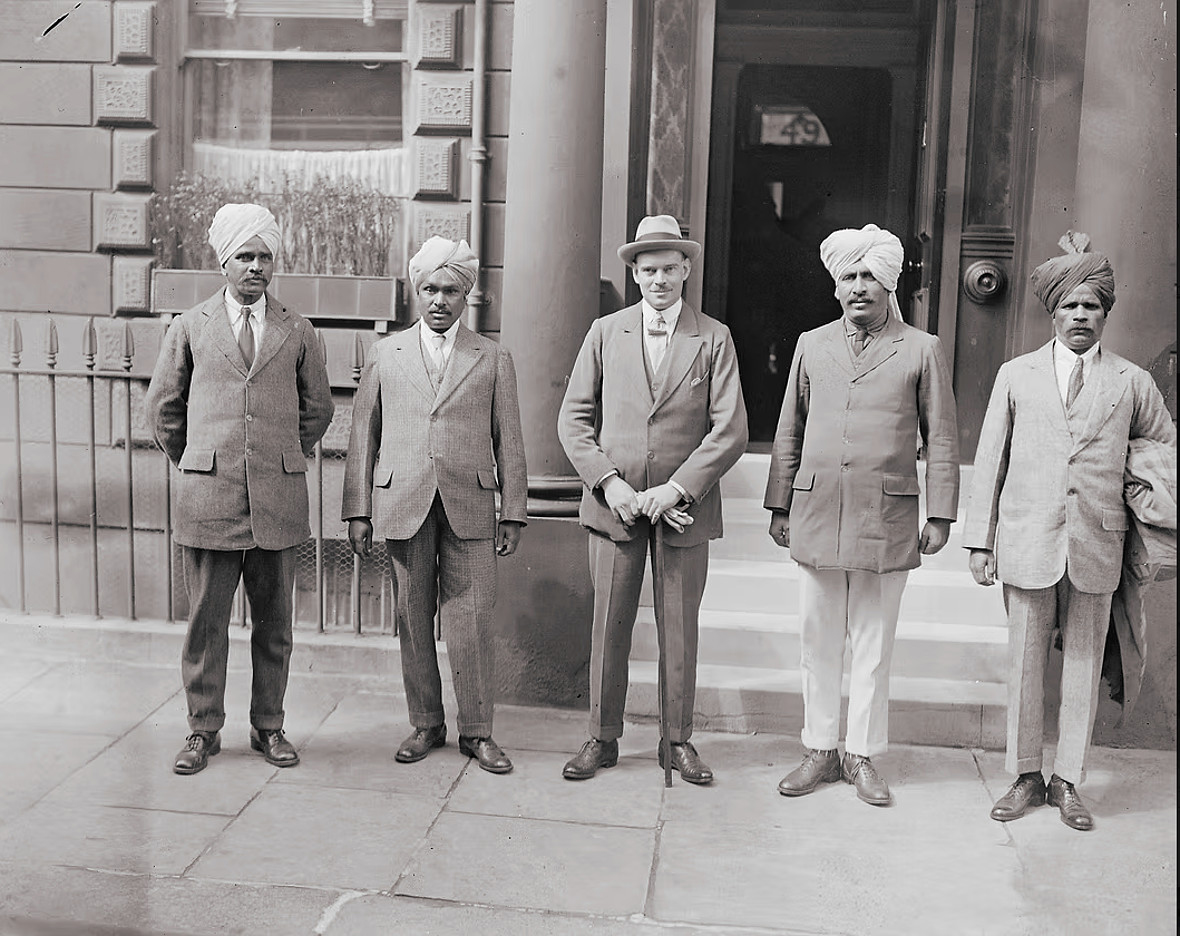
This photograph was taken outside 49 St George’s Road, Pimlico, where the Indian Orderly Officers were quartered during their stay in London in 1922. The house stood on what is now the junction of St George’s Drive and Clarendon Street, SW1. The officers had arrived the previous day on the SS China and were settling into their London accommodation before beginning their ceremonial duties.
The men are, from left to right:
Hon. Lieutenant Joseph, Bahadur
2nd Queen Victoria’s Own Sappers and Miners. A Christian officer from the Madras Sappers, he was noted for attending church every Sunday during his stay in England.
Subadar-Major Nanjappa, Bahadur
64th Pioneers. A Madrasi Hindu from the former 4th Madras Pioneers, wearing civilian dress here rather than his scarlet tunic and white facings.
Major W G Strover
50 Kumaon Rifles. The British officer commanding the detachment. He had previously served with the 5th Light Infantry and saw wartime service in Palestine.
Subadar-Major Vishram Rao Chowan
116th Mahrattas. Later the 4th Battalion 5th Mahratta Light Infantry. He suffered bouts of rheumatism during the London season and required treatment at Millbank Hospital.
Hon. Lieutenant Krishna Bhosle
128th Pioneers. A Dekhani Mahratta and veteran of the Sudan campaign of 1896–98.
The photograph was taken by a reporter from the Central Press Agency on 14 April 1922, the day after their arrival at Tilbury Docks. It is one of the few images showing the Orderly Officers in civilian clothing rather than their newly tailored full dress uniforms.
