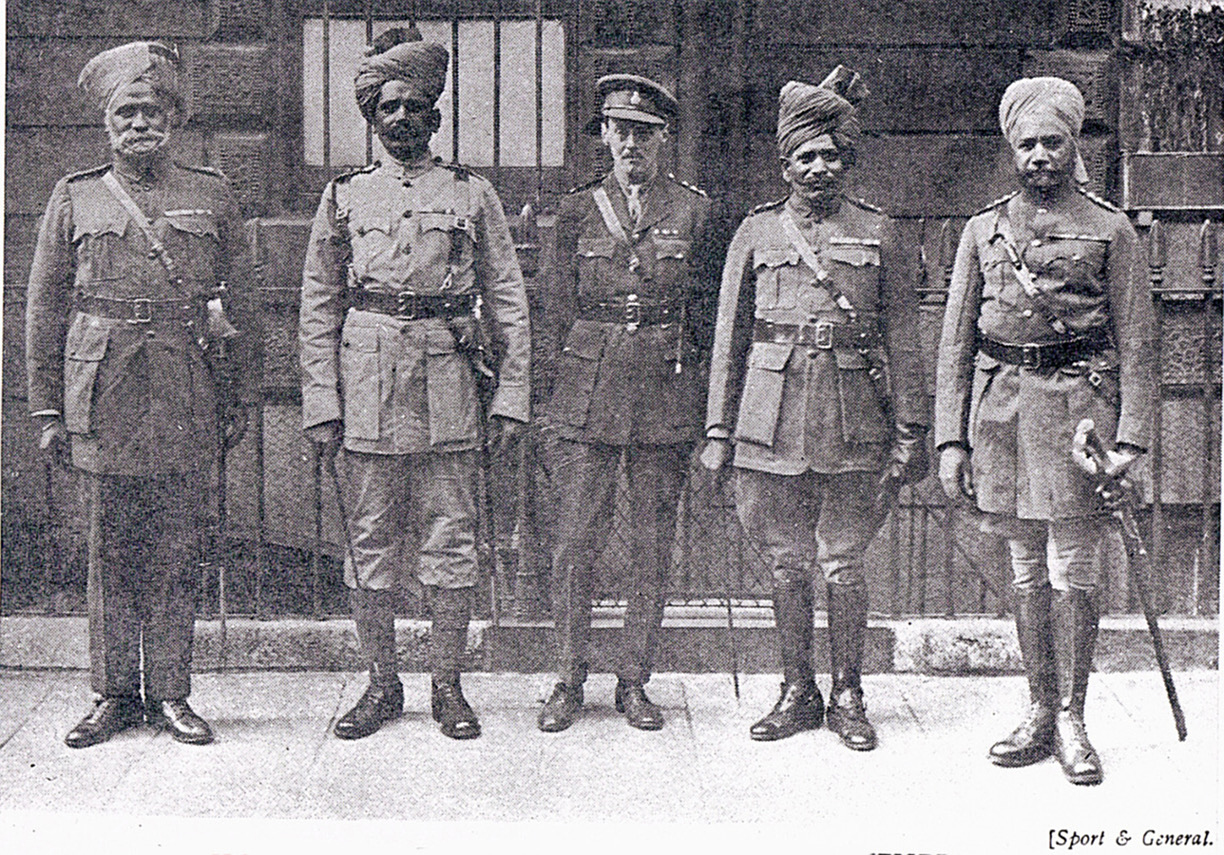
Left: Subadar-Major Bir Singh MC, 2nd Battalion 8th Punjab Regiment. Prior to 1922 this was the 90th Punjabis, and before 1903 the 30th Madras Infantry (5th Burma Battalion). They served in Mesopotamia in the First World War where Bir Singh, then a Subadar, was awarded the Military Cross for bravery. The regiment comprised four companies of Sikhs, of which he was one. The remaining companies were two of Punjabi Muslims, one of Rajputs and one of Brahmans. He wears khaki service dress and a khaki turban with a black end and red fringe.
Second from left: Subadar Harnath Singh MC IOM, 4/6th Rajputana Rifles (Outram’s). For many years this was the 23rd Bombay Light Infantry, renumbered 123rd Outram’s Rifles in 1903, and in 1922 becoming the 2nd Battalion of the 6th Rajputana Rifles. In 1914 the 123rd Rifles were stationed at Manipur with a detachment at Kohima, comprising four companies of Rajputana Jats, two of Rajputana Rajputs and two of Punjabi Muslims. They fought mainly in Mesopotamia and Persia. Two additional battalions were raised during the war. Subadar Harnath Singh was awarded the Military Cross for his action in Egypt while serving with the 2nd Battalion 123rd Outram’s Rifles. He was a Rajput. His uniform is pale khaki with small black buttons, and his Sam Browne belt is black leather, a distinction of rifle regiments.
Third from left: Major Richard Hassall Sheepshanks DSO, 5th King Edward’s Own Probyn’s Horse. In 1922 this regiment was formed from the amalgamation of the 11th King Edward’s Own Lancers (Probyn’s Horse) and the 12th Cavalry. Major Sheepshanks (1885–1951) served in the 12th Cavalry during the First World War, having begun his career in the 33rd Queen Victoria’s Own Light Cavalry. He transferred to the 12th Cavalry on 1 September 1915 and was appointed ADC on the personal staff of the Viceroy and Governor-General, Lord Chelmsford, on 13 October 1916. He was awarded the DSO in June 1917 and promoted to Major on 19 January 1922. As officer in command of the King’s Indian Orderly Officers in 1923 he was appointed a Member of the Royal Victorian Order (MVO).
Major Sheepshanks received the Distinguished Service Order for his actions against Turkish and Arab forces in Southern Persia. Leading a cavalry troop against a vastly superior enemy, he repeatedly charged the foremost lines and inflicted heavy losses. He was mentioned in despatches by Lieutenant-General Sir Arthur Barrett, who wrote that Sheepshanks had been “conspicuous for his gallantry and skilful handling of a small body of cavalry.”
Fourth from left: Risaldar Rewat Singh MC, 18th King Edward’s Own Cavalry. The 18th Cavalry was formed in 1922 from the amalgamation of the 6th King Edward’s Own Cavalry and the 7th Hariana Lancers. Ressaidar Rewat Singh had served in the 32nd Lancers in Mesopotamia and was awarded the Military Cross. He was a Rajput.
Right: Risaldar Jiwan Singh IDSM, 7th Light Cavalry. This regiment retained its independence after the amalgamations of 1922. Formerly the 28th Light Cavalry, and before 1903 the 3rd Madras Lancers, it had the unique distinction of being the only Indian cavalry regiment to fight against Bolshevik forces in Eastern Persia during the First World War. Jiwan Singh was a Sikh, awarded the India Distinguished Service Medal for his service in Transcaspia, Russia. His khaki service dress buttons up to the neck, as did all the Indian officers’ tunics. His Sam Browne belt has a whistle on the shoulder strap, and he holds the 1908 cavalry pattern sword with its distinctive hilt.
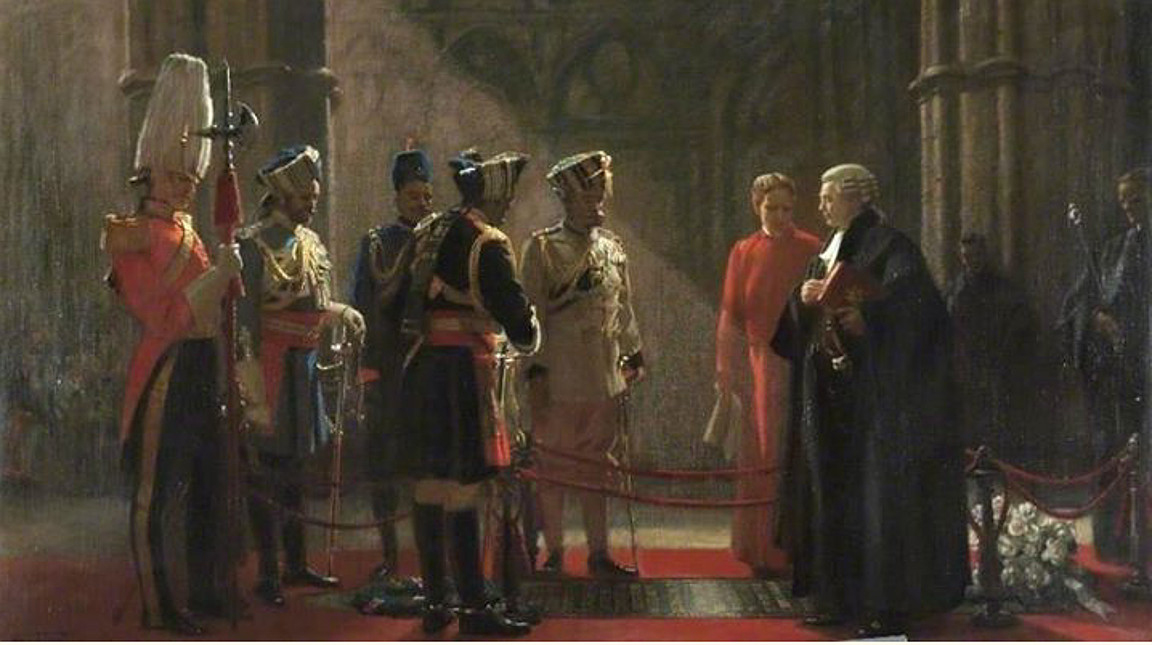
The King’s Indian Orderly Officers paid homage at the Tomb of the Unknown Warrior, situated in the nave of Westminster Abbey. The body of an unknown soldier who died in the First World War was ceremonially interred in the floor of the Abbey on Armistice Day 1920. The officers depicted in this painting by Frank O Salisbury are:
Next to the Gentleman-at-Arms: Risaldar Jiwan Singh IDSM, 7th Cavalry. He is identifiable by his pale blue dress kurta.
Next to Jiwan Singh, at the back: Subadar Harnath Singh MC IOM, 6th Rajputana Rifles. His dress uniform is a rifle green tunic with scarlet collar and cuffs, and a green turban.
Standing with his back to us: Risaldar Rewat Singh MC, 18th King Edward’s Own Cavalry. He wears a blue kurta with French grey facings.
Standing on the right: Subadar-Major Bir Singh MC, 2nd/8th Punjab Regiment. He wears a drab-coloured tunic with blue facings and drab lace, braid and cords.
This painting was sourced from the Rare Books Society of India, which dates the work by Frank O Salisbury to 1923. The artist produced at least one additional version, with some differences, which was exhibited at the British Empire Exhibition at Wembley in 1924 and later donated by Salisbury to the British Library. This version can be viewed on the Art UK website.
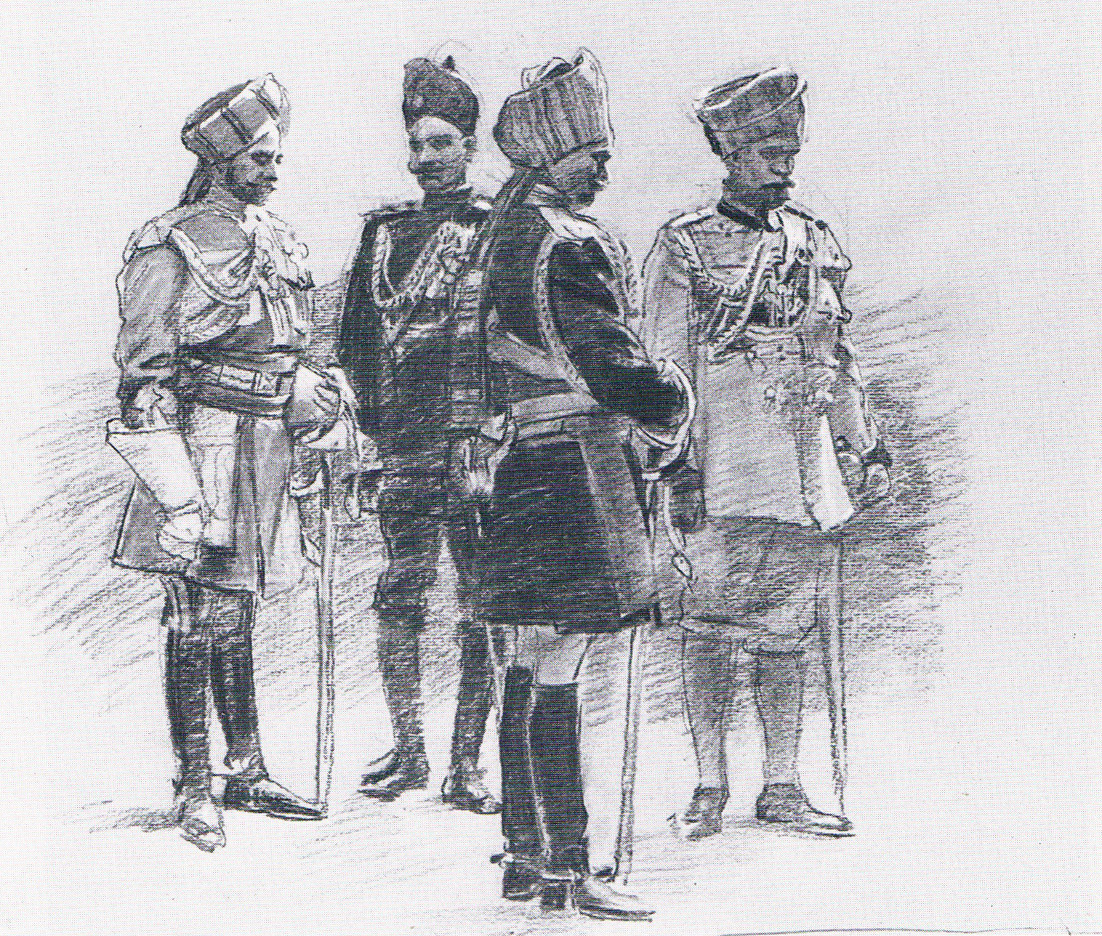
The accompanying charcoal sketch by Salisbury appeared in a Christie’s catalogue dated 25 September 1985, which auctioned works by the artist (1874–1962). The catalogue also listed four charcoal portraits of each of the Indian officers, naming their regiments, although these were not illustrated. The sketch clarifies several details of the dress uniforms, including the metal quoit worn around the turban of Subadar-Major Bir Singh on the right.