

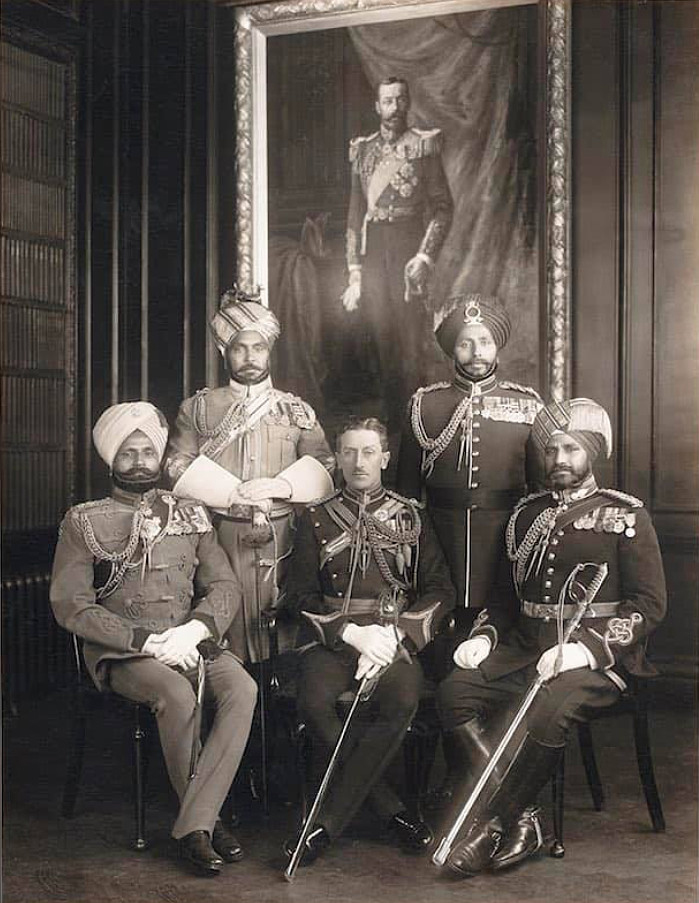
Seated left: Subadar-Major and Honorary Lieutenant Chanda Singh, Bahadur IOM OBI, 1st Battalion 12th Frontier Force Regiment (Prince of Wales’s Own) (Sikhs). Until the 1922 reorganisation this battalion was the 51st Sikhs (Frontier Force). During the First World War they served in Aden, Egypt and Mesopotamia, earning the title Prince of Wales’s Own for their distinguished service in the Middle East. Subadar Chanda Singh received the Indian Order of Merit for gallantry in Mesopotamia. The 12th Frontier Force Regiment comprised the 51st, 52nd, 53rd and 54th Sikhs, along with two battalions of the QVO Corps of Guides Infantry. All six battalions wore drab uniforms with red facings.
Seated centre: Major Charles Alfred Lowry Howard DSO MVO MC, 13th Duke of Connaught’s Own Bombay Lancers. The 13th DCO Lancers were formed in 1923 by amalgamating the 31st and 32nd Lancers, which before 1903 had been the 1st and 2nd Bombay Lancers. Charles Howard was promoted lieutenant on 7 February 1909 in the 32nd Lancers. In 1919, as a major attached to the Somaliland Camel Corps, he took part in operations against the Dervishes. He and Captain Lousada of the Norfolk Regiment, accompanied by two illaloes (northern Somalis), entered Fort Jid Ali through a hidden goat passage, discovering that the defenders had evacuated during the night. Although the fort was empty, the action demonstrated considerable personal bravery. The London Gazette of 8 August 1924 announced his appointment as Deputy Assistant Quartermaster General (DAQMG): ‘A.H.Q., Q.M.G. Bch.— Maj. C.A.L. Howard, M.C., 13th Lancers, 18th May 1924.’ His DSO was awarded later. Major Howard wears the dress uniform of the 13th Lancers: blue with a scarlet plastron front, scarlet collar and cuffs. Unusually, he wears his gold cord aiguillettes on the left shoulder (concealing his medals), whereas the Sikh officers wear theirs correctly on the right.
Seated right: Subadar-Major and Honorary Lieutenant Kishen Singh, Bahadur IDSM OBI, Royal Artillery, Survey Section (India). As a Subadar in the 25th Mountain Battery, Kishen Singh earned the Indian Distinguished Service Medal for gallantry in Mesopotamia during the First World War. In 1925 Captain E. B. Culverwell assembled the ‘Nine Originals’ at the School of Artillery at Kakul, forming the nucleus of the Royal Indian Artillery and marking the beginning of specialised Surveillance and Target Acquisition (SATA). Although there is no firm evidence that Lieutenant Kishen Singh was one of the Nine Originals, his service record makes it likely. In this photograph he wears the dress uniform of the Survey Section: dark blue with red facings and gold lace, silver embroidered bomb badges on the collar, and boots and spurs for mounted duty.
Standing left: Risaldar-Major Udkam Singh, Bahadur OBI, 7th Light Cavalry. Unlike most cavalry regiments, the 7th Light Cavalry was not amalgamated in 1922. They had previously been the 28th Light Cavalry, and before 1903 the 3rd Madras Lancers. In 1914 the regiment was stationed at Quetta, with squadrons of Rajputana Rajputs, Jats and Muslims, although Risaldar-Major Udkam Singh himself was a Sikh. The regiment served in East Persia fighting Bolshevik Russian forces, earning battle honours for Merv and Persia 1915–19. His uniform is the distinctive French grey kurta with silver lace and braid; unfortunately his elaborately braided cuffs are hidden beneath white leather gauntlets.
Standing right: Subadar-Major Sant Singh IOM IDSM, 2nd Battalion 3rd Sikh Pioneers. This battalion was formed from the amalgamation of the 23rd, 32nd and 34th Sikh Pioneers, all composed of Mazbi and Ramdasia Sikhs. Subadar-Major Sant Singh, formerly of the 32nd Sikh Pioneers, was later promoted Honorary Captain and appointed to the Order of British India. He wears a long-skirted scarlet tunic with blue facings, and his red turban carries the old regimental badge of the 32nd Sikh Pioneers.

