

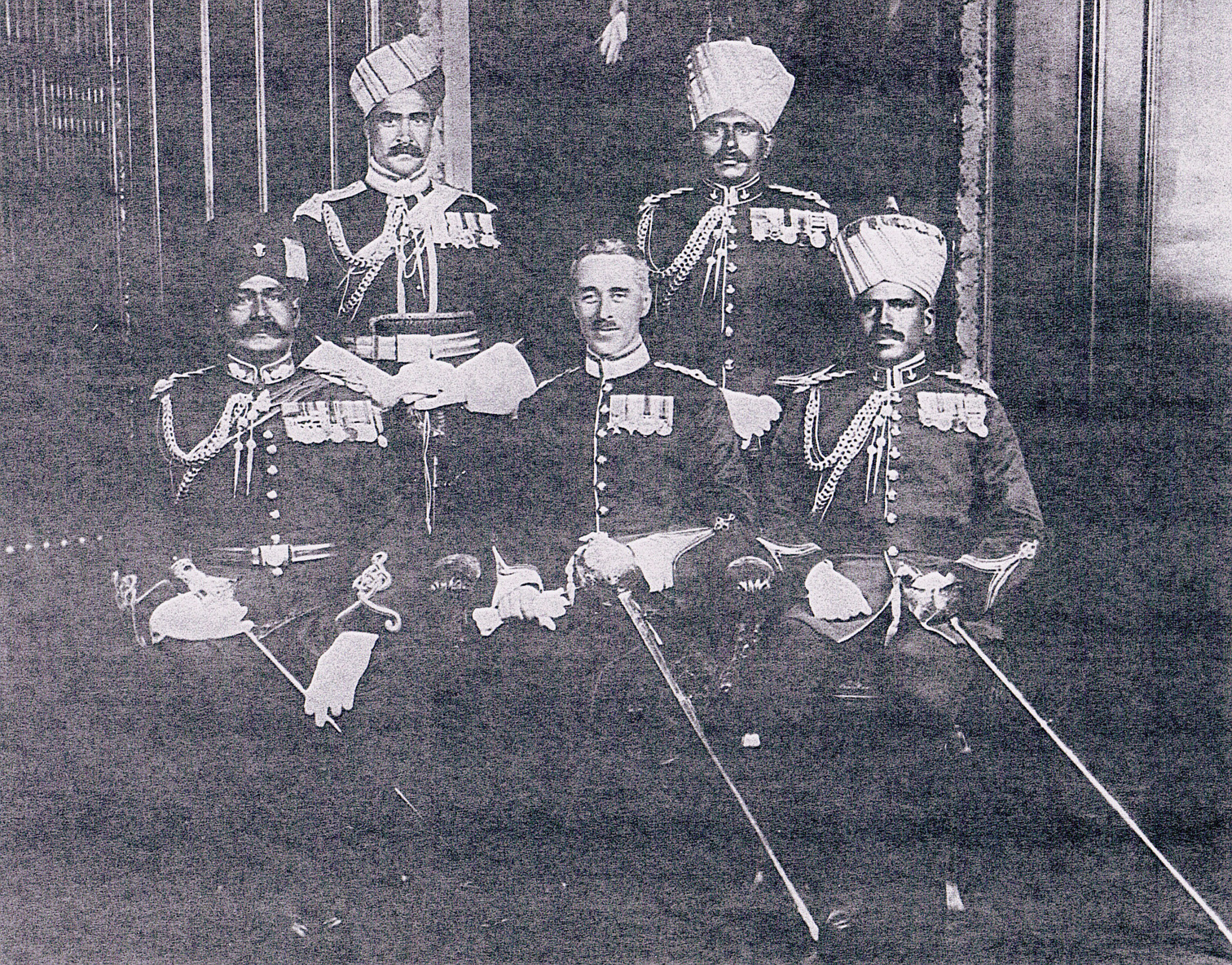
Seated left: Subadar-Major and Honorary Lieutenant Ram Rup Singh, Sardar Bahadur IOM OBI, King George’s Own Bengal Sappers and Miners. In the British Army, sappers and miners had been incorporated into the Royal Engineers since 1856, but the Indian Army retained the title Sappers and Miners up to WW2. Sappers were soldiers who built fortifications and dug out ‘saps’, trenches that allowed assault teams to approach enemy fortifications under cover. Miners dug underground so that explosives could be placed to undermine the enemy. There were Sappers and Miners in all three Presidencies which became the 1st, 2nd and 3rd Sappers and Miners. The 1st (Bengal) was honoured in 1906 with the title Prince of Wales’s Own, then when the Prince became King, was called King George’s Own Sappers and Miners.
Subadar-Major Ram Rup Singh has a Prince of Wales badge on his blue turban. The rest of his uniform conforms to the RE pattern; scarlet tunic with blue facings and gold lace. The red Morocco leather pouch-belt has the Engineers distinctive gold wavy line. Whilst serving in WW1 he was a jemadar, awarded the Indian Order of Merit in France, and the 1st Class Order of British India in Mesopotamia.
Seated centre: Major Alexander Kilgour Macpherson MVO, 10th Battalion 2nd Bombay Pioneers. The 10th Battalion was formed from the 121st Pioneers, which prior to 1903 was the 21st Bombay Infantry (The Marine Battalion). The battalion comprised one and a half companies of Lobana Sikhs, one and half companies of Mahrattas and one and half companies of Rajputana Muslims and Meos from Gurgaon District. Major Macpherson wears a scarlet tunic with white facings and gold lace. He had been an officer in the 12th Pioneers (which had black facings) that after WW1 became the 2nd Bn Bombay Pioneers. He served in France and was wounded at Festubert in Nov 1914.
Seated right: Subadar-Major Manajirao Palande, 2nd Battalion 5th Mahratta Light Infantry. The 2nd Battalion was the 105th Mahratta Light Infantry, formerly, before 1903, the 5th Bombay Light Infantry. In 1914 the 105th had been stationed in Poona, comprising 4 companies of Dekhani Mahrattas, 2 of Konkani Mahrattas and 2 companies of Dekhani Muslims. The 5th Mahratta LI, based at Belgaum, was formed after WW1 from the 103rd, 105th, 110th, 114th, 116th and 117th Mahrattas, all Bombay Regiments. The uniform was scarlet with black facings and gold lace.
Standing left: Risaldar Jai Lal Singh MC, The Royal Deccan Horse (9th Horse). This cavalry officer was awarded the Military Cross for his bravery while serving as a jemadar in the 29th Lancers in Egypt during WW1. The 9th Deccan Horse was the amalgamation in 1921 of the 20th Deccan Horse and the 29th Lancers (Deccan Horse). Before the reorganisation of 1903 these were the 1st and 2nd Lancers Hyderabad Contingent. The uniform he wears is a green kurta with white facings and gold lace.
Standing right: Subadar-Major Atmaram Chatge (or Ghadge), IOM, 1st Battalion 5th Mahratta Light Infantry. He was awarded the Indian Order of Merit during WW1 whilst he was a Colour Havildar serving in Mesopotamia in the 103rd Mahratta Light Infantry. In 1914 the 103rd was stationed at Ahmednagar and in WW1 they served in Mesopotamia where they were part of the defence of Kut and became prisoners of the Turks after the surrender.
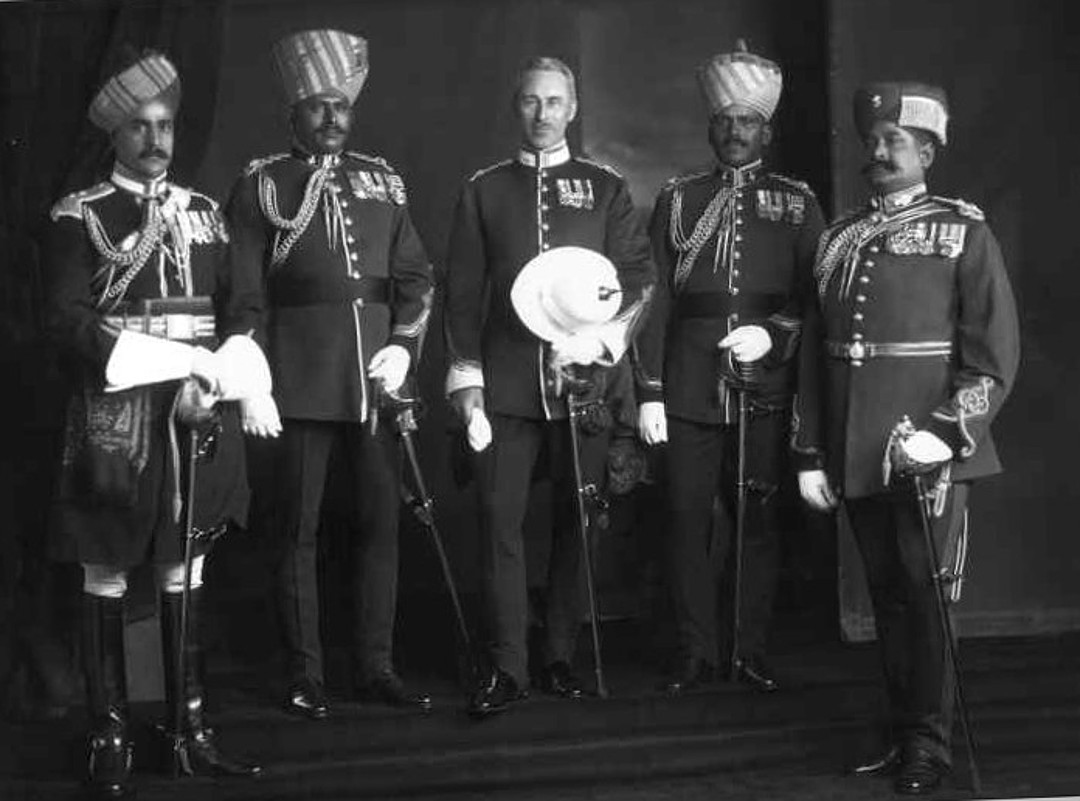
The group portrait of the King’s Indian Orderly Officers was taken in the Lafayette Studiol, 160 New Bond Street, London on 1 June 1928. The officers are, from left:
