

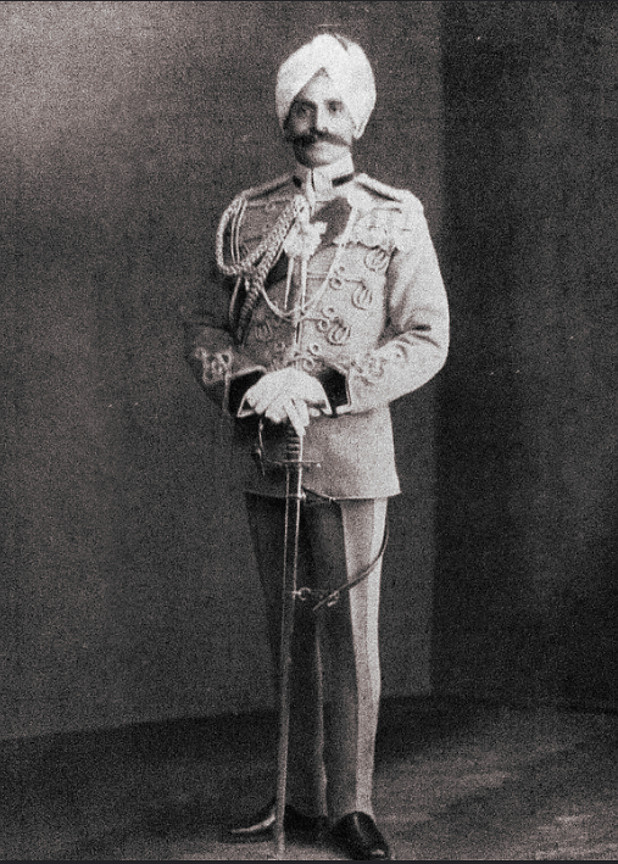
Subadar-Major Sansar Chand IDSM, 2nd Battalion 12th Frontier Force Regiment. The 2nd Battalion was formerly the 52nd Sikhs that served in Mesopotamia in the First World War. Sansar Chand was awarded the Indian Distinguished Service Medal for his outstanding conduct in the war against the Turks in Mesopotamia, holding the rank of subadar at the time. The 52nd Sikhs was raised in 1846 as the 2nd Sikh Infantry, and in 1914 was stationed at Bannu, comprising 3 companies of Dogras, 2 of Sikhs and one of Pashtuns. The Subadar-Major was a Dogra. He was photographed in 1932 wearing his dress uniform of drab with red facings and drab cords and lace. He has gold cord aiguillettes on his right shoulder to indicate his appointment as King’s Indian Orderly.
Lieutenant-Colonel Alexander Wyndham Malet MVO, 1st Battalion 17th Prince of Wales’s Own Dogras. There were three regiments of Dogras in the First World War: the 37th, 38th and 41st. The oldest was the 38th, raised as the Agra Levy in 1858 during the final year of the Indian Mutiny. In 1914 the regiment was stationed at Malakand, consisting of 8 companies of Dogras.
Alexander Wyndham Malet was born in Kensington on 28 Feb 1886, the son of Captain Guilbert Edward Wyndham Malet and Gertrude Agnes Cunliffe-Owen. He was commissioned as a 2nd Lieutenant in the 38th Dogras on 5 Aug 1905, promoted to lieutenant on 5 Nov 1907 and to captain on 5 Aug 1914. He was seconded to the Burma Military Police during the First World War. He served in both World Wars and on the Northwest Frontier from 1922–23, where he was mentioned in despatches. He fought in the Burma campaign from 1930–32, again mentioned in despatches.
He married Kathleen Betty Cadell on 27 May 1921 in Kensington. They had a son, Richard (born 7 Jan 1923), and two daughters, Sylvia (born 7 Sep 1925) and Kathleen (born 4 Feb 1934). In 1939 the family lived in Oxford St Giles, Oxfordshire. He died on 20 July 1956 in Cheltenham, aged 70, and was buried in Bishop’s Cleeve, Gloucestershire.
Risaldar-Major and Honorary Captain Bharat Singh, Sardar Bahadur IOM OBI, 16th Light Cavalry. Prior to 1922 this regiment was the 27th Light Cavalry, and before 1903 the 2nd Madras Lancers. Detachments served in Persia and France in the First World War while the rest remained in India. They distinguished themselves in Afghanistan in 1919. Bharat Singh, a Rajput, was a Ressaidar when he was awarded the Indian Order of Merit for courage in Waziristan. After the war he was appointed to the Order of British India, 1st Class.
Risaldar-Major and Honorary Lieutenant Ratan Singh IDSM, 18th King Edward’s Own Cavalry. The 18th was an amalgamation of the 6th King Edward’s Own Cavalry and the 7th Hariana Lancers. Lieutenant Ratan Singh was a Rajput.
Subadar-Major and Honorary Lieutenant Kuldip Singh, 4th Battalion 15th Punjab Regiment. The regiment was formed from five Punjabi regiments—the 25th, 26th, 27th, 28th and 29th—raised in 1857 during the Indian Mutiny. The 4th Battalion was formerly the 28th Punjabis, stationed in Ceylon in 1914 and comprising 3 companies of Sikhs, 3 of Pashtuns, one of Dogras and one of Punjabi Muslims. Lieutenant Kuldip Singh was a Dogra. The uniform of the 15th Punjab Regiment was a scarlet tunic with buff facings.