

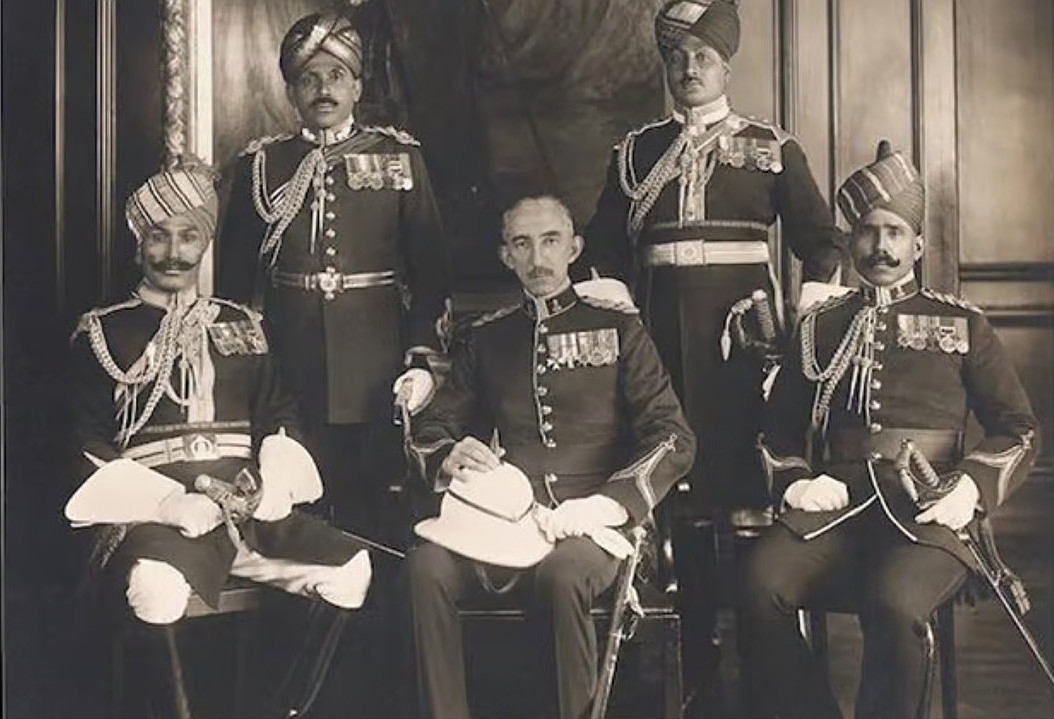
Seated left: Risaldar-Major Anno Khan IDSM, The Poona Horse (17th Queen Victoria’s Own Cavalry). The 17th was the amalgamation of the 33rd Queen Victoria’s Own Light Cavalry (prior to 1903, the 3rd (Queen’s Own) Bombay Light Cavalry) with the 34th Prince Albert Victor’s Own Poona Horse, also a Bombay regiment. This officer, a Hindustani Muslim (Kaimkhani), served in the 34th and was awarded the Indian Distinguished Service Medal for his service in France. The regiment was then sent to Palestine. The uniform of the combined regiments was a blue kurta with French grey facings, the same as the 34th. The gold laced belts have red silk stripes down the middle, indicating the red facings of the 33rd.
Seated centre: Lieutenant-Colonel Alan Bruce McPherson MVO MC, Commanding Officer of the 2nd (Mooltan) Battalion 9th Jat Regiment. This was the 119th Infantry (The Mooltan Regiment) up until 1922, based at Secunderabad. But Colonel McPherson had been an officer in the 1st Battalion, which was the 6th Jat Light Infantry, also based at Secunderabad.
Alan Bruce McPherson was born on 6 Jan 1887 in Ghadechi, India. His father was Donald William McPherson, his mother was Hermione May Hoff.
1907 2nd Lieutenant, Double company officer 6th Jat LI, 27 Mar
1908 Lieutenant 6th Jat LI
1913 Lieut. Quartermaster 2 Mar 6th Jat LI
1933 Lieutenant-Colonel in charge of King’s Indian Orderlies
1935 Assistant Adjutant General Northern Command India
1937 Colonel in command of 11th Infantry Brigade
1940 Deputy Director of Recruiting & Mobilisation, War Office
1944 London Gazette of 8 June lists ‘Colonel (temporary Brigadier) Alan Bruce McPherson MVO MC Indian Army’ under Additional Commanders of the Military Division
1957 Retired
1978 Died in Ealing, Middlesex on 14 December
Seated right: Subadar Wali Muhammad Khan, 2nd (Mooltan) Battalion 9th Jat Regiment. The 9th Jat Regiment, based at Bareilly, was made up of the 6th, 10th, 18th and 119th Regiments. The 2nd Battalion retained the name Mooltan from the 119th (The Mooltan Regiment) raised in Bombay in 1817. The regiment served in Mesopotamia in WW1. The Subadar was a Muslim Rajput (Ranghar). All four battalions of the 9th Jats wore scarlet uniforms with blue facings.
Standing left: Subadar Abdul Subhan IDSM, 1st (King George’s Own) Battalion Madras Pioneers. The Madras Pioneers were disbanded in February 1933 and he transferred to the Queen Victoria’s Own Madras Sappers and Miners, whose uniform he wears for the occasion (scarlet tunic, blue facings). The Corps of Madras Pioneers was formed in 1922 from the 61st King George’s Own Pioneers (formerly 1st Madras Pioneers), 64th Pioneers (formerly 4th Madras Infantry) and the 81st (formerly the 21st Madras Pioneers).
Standing right: Risaldar Muhammed Qadir Khan, 8th King George’s Own Light Cavalry. The 8th was an unusual combination of Madras and Hyderabad cavalry regiments. The 26th King George’s Own Light Cavalry was, prior to the reorganisation of 1903, the 1st Madras Lancers. The 30th Lancers (Gordon’s Horse), before 1903, was the 4th Lancers Hyderabad Contingent. Before amalgamation the uniform of the 26th was French grey with buff facings, while the 30th had a green uniform with white facings. The uniform of the 8th KGO Light Cavalry, worn by this Subadar, was ordered to be dark blue with French grey facings. He was a Dekhani Muslim.
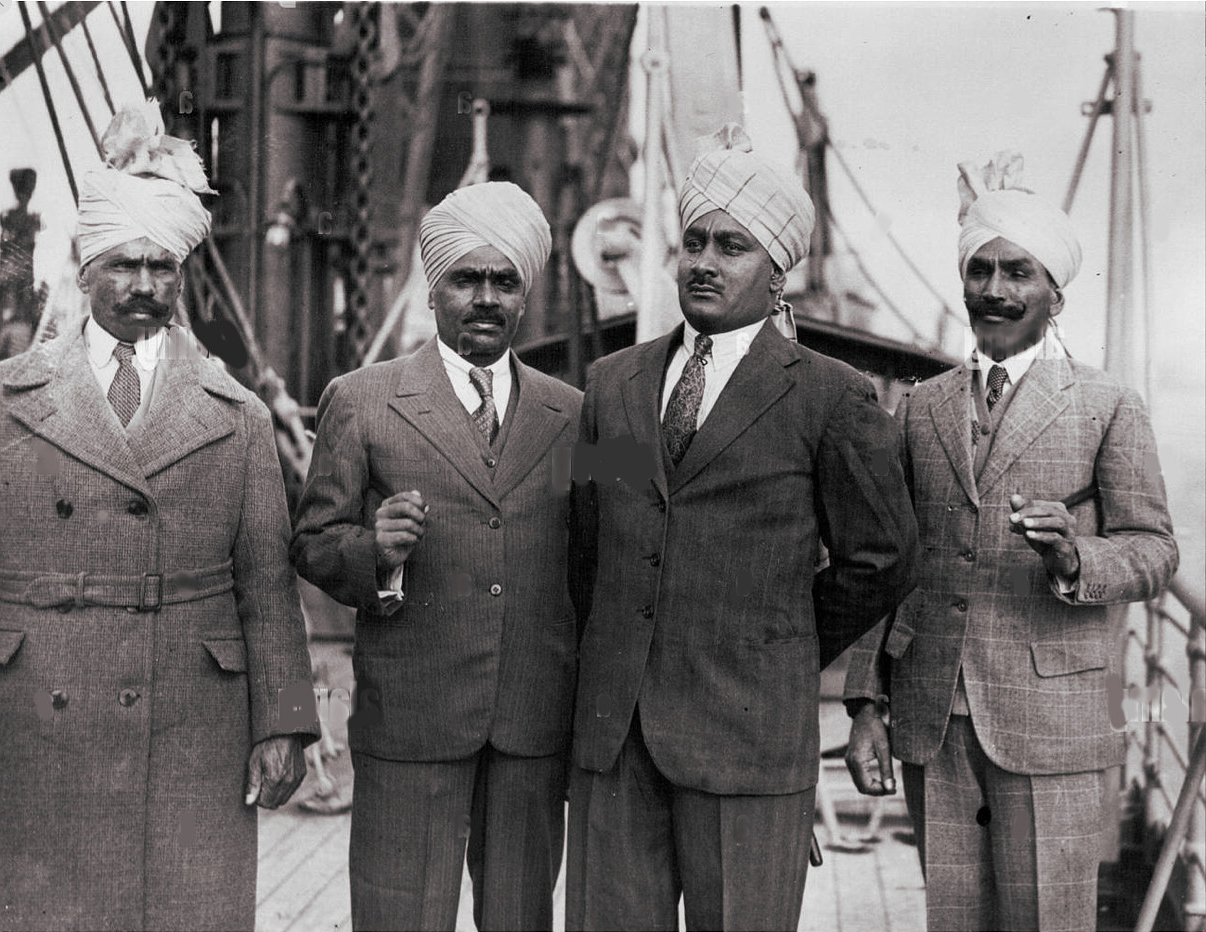
Right: Risaldar-Major Anno Khan IDSM, 17th QVO Cavalry
Third left: Risaldar Muhammed Qadir Khan, 8th KGO Light Cavalry
Second left: Subadar Abdul Subhan IDSM, Madras Sappers & Miners
Left: Subadar Wali Muhammad Khan, 2nd/9th Jat Regiment

Right: Risaldar Muhammed Qadir Khan, 8th KGO Light Cavalry
Fourth left: Subadar Abdul Subhan IDSM, Madras Sappers & Miners
Third left: Lt-Col A B McPherson MVO MC, 9th Jat Regiment
Second left: Subadar Wali Muhammad Khan, 2nd/9th Jat Regiment
Left: Risaldar-Major Anno Khan IDSM, 17th QVO Cavalry