

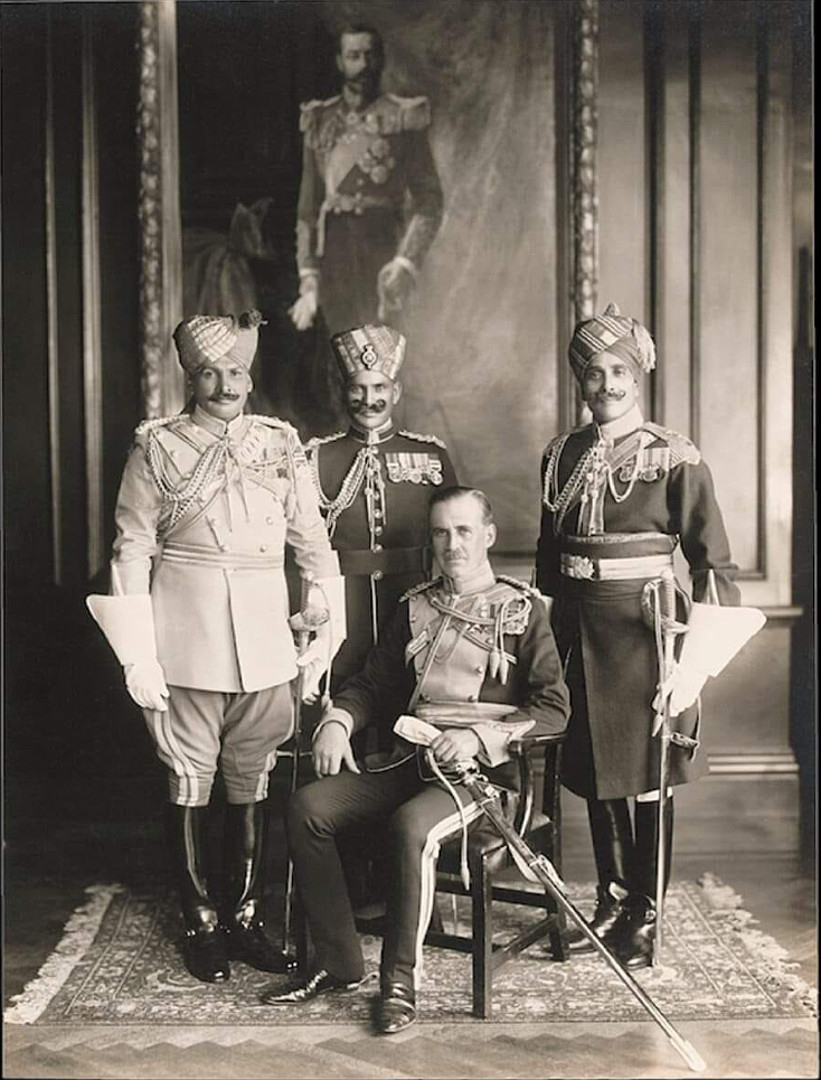
Seated: Lieutenant-Colonel Eric Garnett Atkinson MVO, 15th Lancers. In 1922 the 15th Lancers was formed from the amalgamation of the 17th Cavalry (formerly Bengal Lancers) and the 37th Lancers (Baluch Horse), previously the 7th Bombay Lancers. Atkinson had served with the 17th Cavalry from 1908, at which time his father commanded the regiment. Although the 17th did not serve on the front line during the Great War, Captain Atkinson himself was in France and Flanders throughout. He assumed command of the 15th Lancers in 1934 and was well known on the polo field, representing both his regiment and England in the sport.
Standing left: Risaldar Khairati Singh, Bahadur OBI, 16th Light Cavalry. The regiment originated around 1776 as part of the army of the Nawab of Arcot and entered the service of the East India Company in 1784 as the 3rd Regiment of Madras Native Cavalry. Its designation changed several times before becoming the 2nd Madras Lancers in 1886 and the 27th Light Cavalry in 1903. Traditionally, the Madras cavalry regiments (26th, 27th, and 28th) wore French grey uniforms with buff facings and silver lace, but after the 1922 reorganisation they were ordered to adopt dark blue kurtas with French grey facings. Photographic evidence, however, shows that they continued to wear their old Madras colours. In this 1934 photograph the Risaldar wears the lancer-pattern uniform formerly reserved for British officers, explained by the fact that the 16th Light Cavalry was one of only two Indian cavalry regiments selected for Indianisation in 1923, resulting in the replacement of all British officers by Indians.
Standing centre: Subadar-Major Badan Singh IDSM, 1st Battalion 7th Rajput Regiment (Queen Victoria’s Own Light Infantry). During the Great War the battalion served as the 2nd Queen Victoria’s Own Rajput Light Infantry in India, Egypt, Mesopotamia, Salonika, and the Black Sea. The 1922 reorganisation linked it with five other Rajput regiments to form the 7th Rajput Regiment. The 2nd was a class regiment, stationed in Bombay in 1914, with its headquarters at Secunderabad in 1910. Its uniform consisted of a scarlet tunic with dark blue facings and gold lace. This battalion was one of six Indian infantry units selected for Indianisation in 1923, meaning that all its officers were Indian. Badan Singh earned the Indian Distinguished Service Medal in Egypt during the Great War while serving as a lance naik in the 2nd QVO Rajput Light Infantry.
Standing right: Risaldar Krishna Chandra Singh IDSM, 2nd Lancers (Gardner’s Horse). The regiment was created in 1922 by amalgamating the 2nd Lancers (Gardner’s Horse) with the 4th Cavalry. The 2nd, being the more distinguished of the two, retained its title as well as its dark blue uniform with French grey facings and gold lace, while the 4th’s distinctive scarlet dress disappeared. Gardner’s Horse served with great distinction on the Western Front for three years before joining the cavalry advance that drove the Turks from Palestine. The 4th also served in France but transferred to Mesopotamia in the winter of 1915. Krishna Chandra Singh earned the Indian Distinguished Service Medal in France while serving as a Ressaidar in the 2nd Lancers.
Although absent from this group photograph, the official list of King’s Indian Orderly Officers for 1934 includes Subadar-Major & Honorary Lieutenant Hem Raj Sardar Bahadur OBI IDSM, 1st Royal Battalion 9th Jat Regiment (Light Infantry). In 1922 the four battalions of the 9th Jat Regiment were formed from the 6th Jat Light Infantry, the 119th Infantry (The Mooltan Regiment), the 10th Jats, and the 18th Infantry. The dress uniform of the 9th Jat Regiment was a scarlet tunic with blue facings and gold lace, similar to that worn by Subadar-Major Badan Singh. This raises the question of whether the officer in the photograph has been correctly identified; however, the absence of the Order of British India at the neck of the tunic strongly suggests that the figure is indeed Badan Singh of the 7th Rajput Regiment.
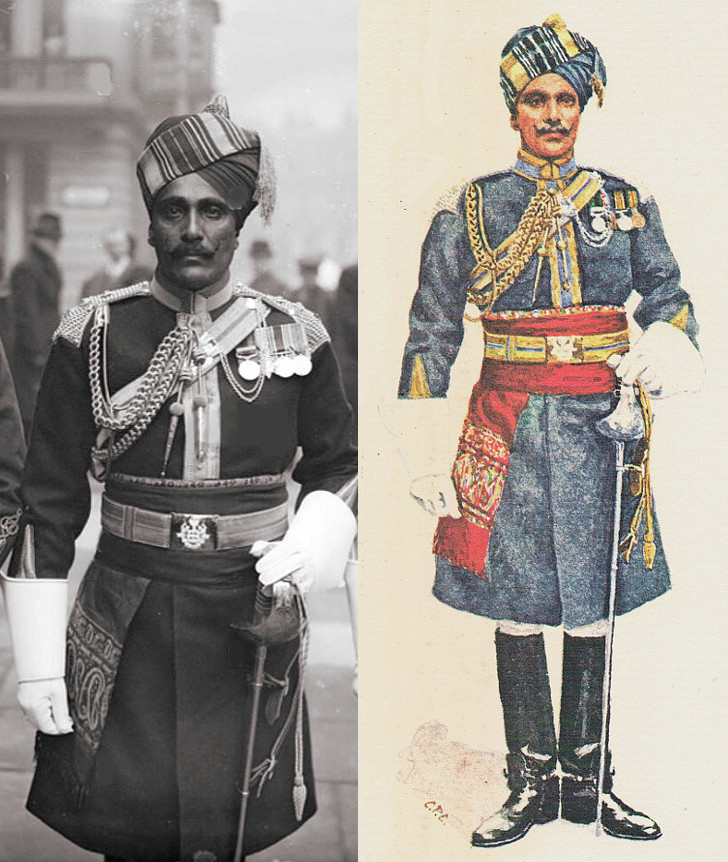
Risaldar Krishna Chandra Singh IDSM: The coloured rendition of this officer is by Chater Paul Chater, reproduced in An Assemblage of Indian Army Soldiers and Uniforms by Michael Glover (Perpetua Press, 1973). Chater based his painting on a monochrome photograph taken in May 1934, at around the same time as the group portrait shown above. The kurta is dark blue, with French grey facings clearly visible on the collar and along the central line of the belts.

Risaldar Khairati Singh, Bahadur OBI: On the right is Chater Paul Chater’s painting of Risaldar Khairati Singh, copied from the photograph on the left taken in London in May 1934. Chater has slimmed the officer and altered several elements of his uniform. The turban bears a different pattern, and the silver‑laced pouch‑belt has been incorrectly depicted with a central dark blue stripe. The artist has also omitted the Order of British India, which should be suspended at the collar. Nevertheless, the painting is valuable in showing the buff‑coloured plastron front of the tunic and the gold and crimson girdle.

