

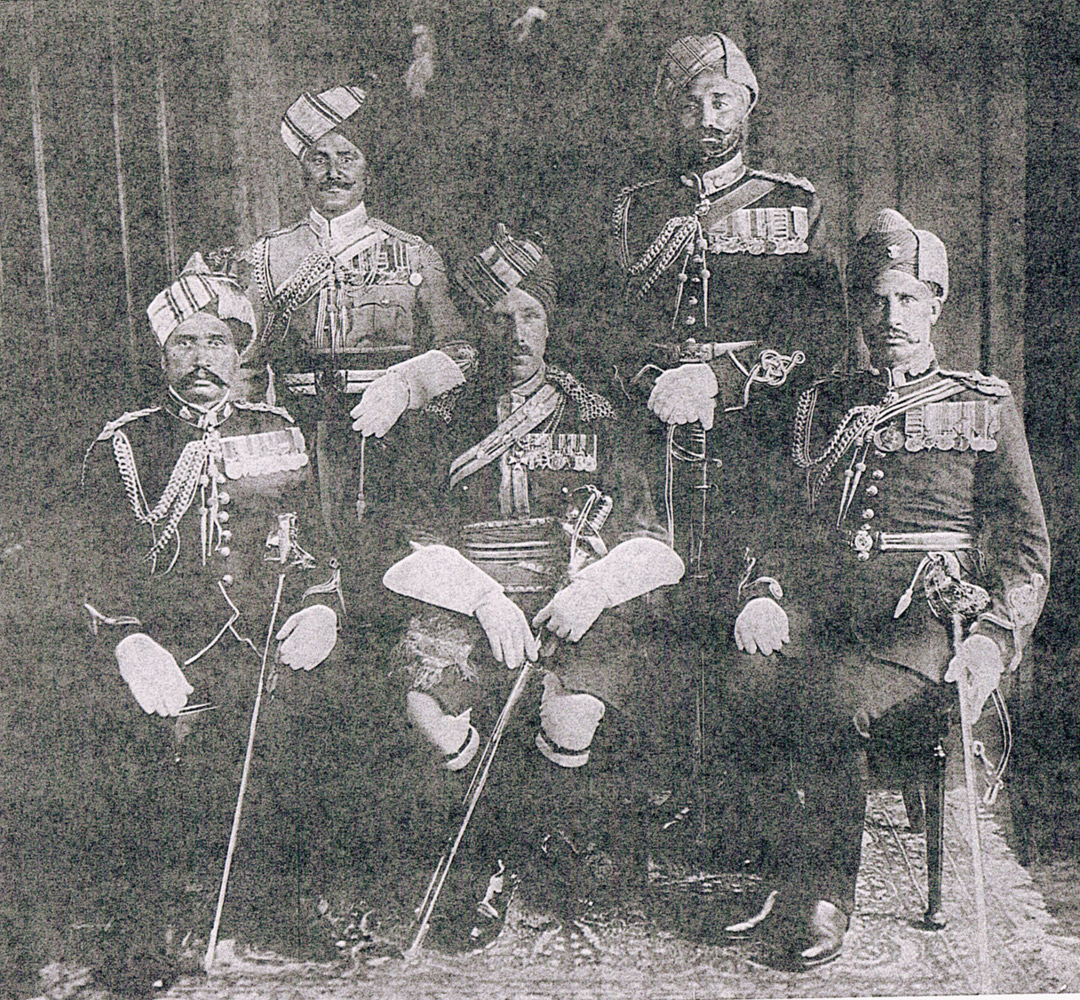
Seated left: Subadar-Major & Honorary Lieutenant Itbar Khan, Sardar Bahadur IDSM, 5th Battalion 2nd Punjab Regiment. The 5th Battalion, prior to 1922, was the 87th Punjabis, raised in Madras in 1798 and known from 1824 to 1901 as the 27th Madras Infantry. They served in Mesopotamia in the Great War, the 87th comprising four companies of Punjabi Muslims, of which Itbar Khan was one. Sikhs and Jats made up the other four companies. The Subadar-Major wears a scarlet tunic with green facings and gold lace. Normally a subadar-major would have a crown rank badge on each gold shoulder cord, but he has two stars to denote the rank of lieutenant. The 5th/2nd Punjab Regiment was one of seven infantry battalions selected for Indianisation in 1933, so that all British officers were replaced by Indians.
Seated centre: Lieutenant-Colonel Roland Dening MVO MC, 19th King George’s Own Lancers. Two cavalry regiments, the 18th King George’s Own Lancers and the 19th Lancers (Fane’s Horse), were joined together in 1921 and the next year were named 19th King George’s Own Lancers. Lt-Col Dening was CO of the 19th Lancers from June 1934. He joined the 18th KGO Lancers as a lieutenant in 1910 and saw service in France, present at the battle of Neuve Chapelle in March 1915. He also saw service in Palestine and Syria. He reached the rank of major-general and was appointed Colonel of the regiment in 1945. He wears a scarlet kurta with white facings and gold lace.
Seated right: Subadar-Major & Honorary Lieutenant Nawab Sardar Bahadur, King George’s Own Bengal Sappers & Miners. Lieutenant Nawab, a Punjabi Muslim, wears the uniform of the Royal Engineers: a scarlet tunic with blue facings and gold lace. He has a blue turban and two star rank badges on each gold shoulder cord to denote his rank of lieutenant. The corps of Sappers & Miners was organised into six distinct class companies prior to the Great War and in 1931 began to be Indianised. Indian officers attended the Royal Military Academy Woolwich, and during the Second World War the Sappers and Miners were known as the Royal Indian Engineers.
Standing left: Risaldar-Major Tek Chand, 7th Light Cavalry. This regiment dates back to 1781 and became the 3rd Madras Lancers, altered in 1903 to the 28th Light Cavalry. In June 1915 they were deployed to East Persia to form a cordon with the Russians to prevent enemy incursions into Afghanistan. In 1917 the Russians quit the region but the 28th were part of the force that fought the Red Army in several actions in the advance to Merv. They were not required to amalgamate with another regiment, so were simply retitled 7th Light Cavalry. They were one of two Madras cavalry regiments to be the first units selected for Indianisation in 1923, so the regiment consisted entirely of Indian officers and other ranks. Risaldar-Major Tek Chand was a Hindu Jat. He wears a French grey kurta with buff facings and silver lace. His silver waist-belt and pouch-belt have blue central silk stripes.
Standing right: Subadar Natha Singh, Bahadur IOM IDSM, 22nd Mountain Brigade, RA. The Indian Mountain Batteries underwent several changes. The development of mountain artillery became necessary in the mid-19th century when the British gained access to the Northwest Frontier. In 1914 there were 12 Mountain Batteries armed with light 10-pounder, breech-loading, quick-firing guns that could be dismantled and carried on pack mules. They did not serve in France in the Great War. In 1920 there were 50 batteries, still commanded by British RA officers, but in 1935 Indian commissioned officers were introduced. On 1 Aug 1939 mountain artillery ceased to be RA and became Indian Artillery, gaining the title Royal Indian Artillery in 1944. Subadar Natha Singh was a Jat Sikh. He wears a dark blue tunic with red facings and gold lace, including gold-laced belts.
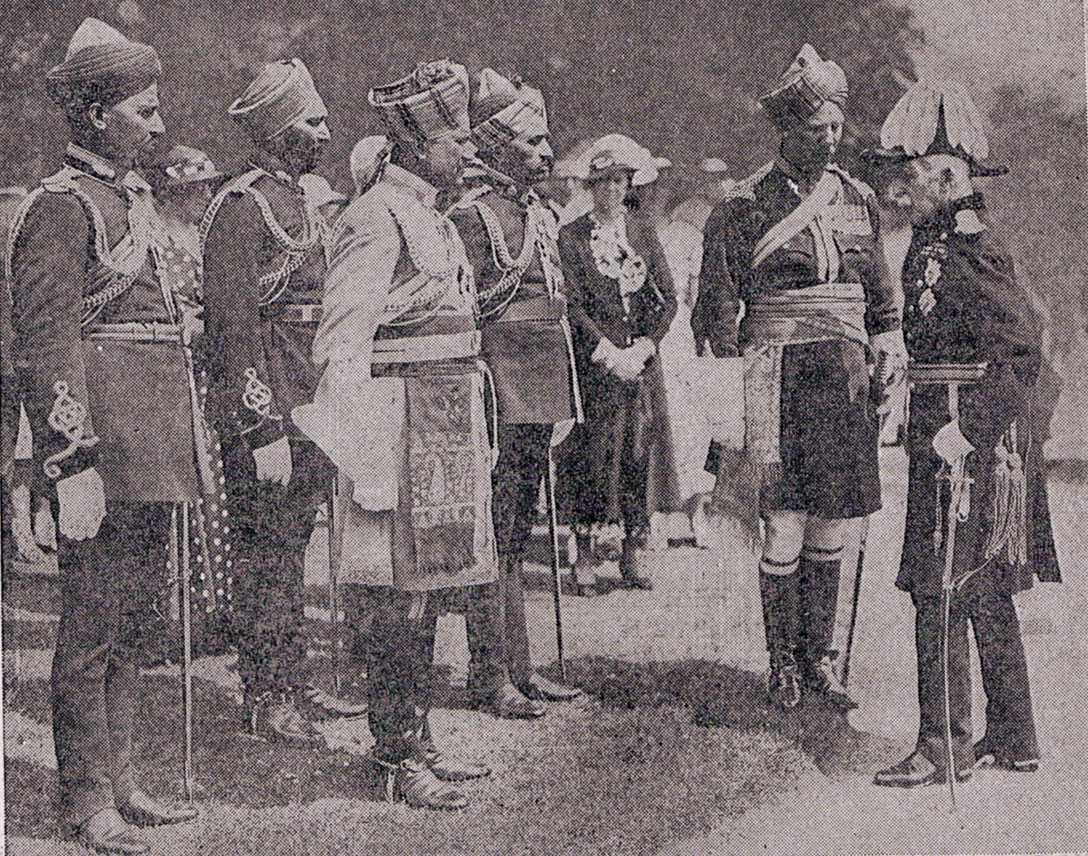
The Duke of Connaught was the seventh child and third son of Queen Victoria, born on 1 May 1850, so this photo was taken when he was 85. The caption to the picture reads: ‘The Duke of Connaught, with the King’s Indian Orderly Officers, after yesterday’s inspection of the King’s Body Guard and the Yeomen of the Guard.’ Lieutenant-Colonel Dening talks to the Duke while the Indian officers stand to attention. From the left:

