

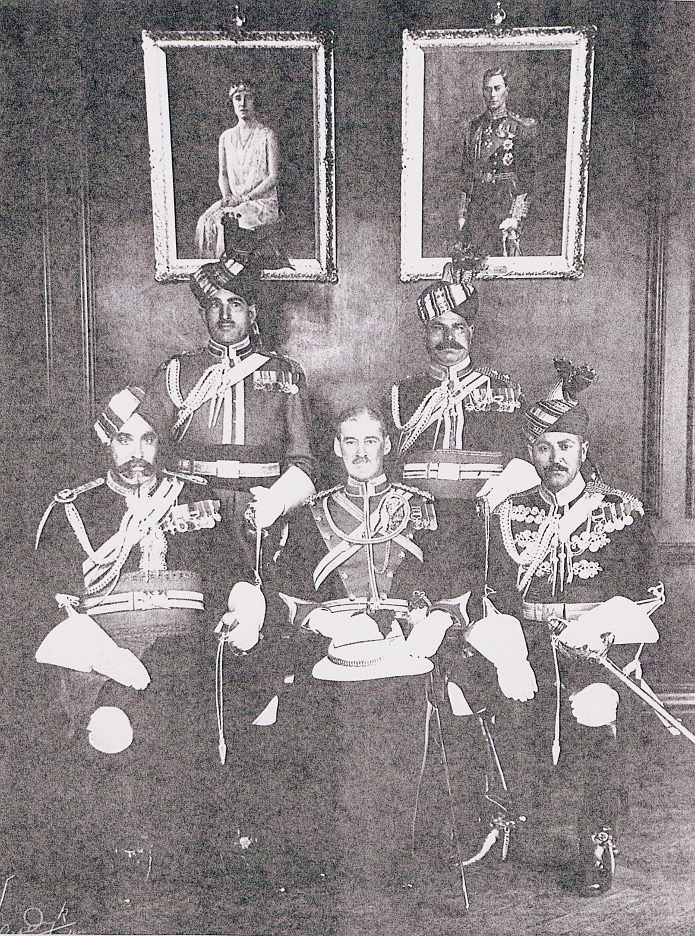
Seated left: Risaldar-Major Lall Singh MBE, Probyn’s Horse (5th King Edward VII’s Own Lancers). The 5th Lancers attained their title in 1922 after the amalgamation of the 11th King Edward’s Own Lancers (Probyn’s Horse) and the 12th Cavalry. Both Bengal cavalry regiments served in the Middle East in the First World War. Risaldar-Major Lall Singh wears a dark blue kurta with scarlet facings and gold lace. His MBE cross can be seen at the end of the row of medals.
Seated centre: Lieutenant-Colonel Edward John Patteson Travis Walker MVO OBE, 13th Duke of Connaught’s Own Lancers. The 13th was the amalgamation, in September 1923, of the 31st DoC Lancers and the 32nd Lancers, both raised in Bombay in 1817. Walker served in the 32nd Lancers from 29 August 1906. He was promoted to lieutenant in the regiment on 29 November 1908 and appointed Adjutant on 25 October 1912. The 32nd fought in Mesopotamia from 1916 and were alleged to be the first British/Indian troops to enter Baghdad, but they suffered heavy casualties in April 1917 at the battle of Istabulat. Captain Walker was a staff officer in the Waziristan Field Force in 1919 with the temporary rank of Major. He was awarded the OBE on 10 June 1921 and appointed MVO in the 1937 Coronation Honours. The London Gazette announced that Lt-Col E J P T Walker was transferred to the Semi-Effective List on 10 April 1938. In the group photo, Lt-Colonel Walker wears a British officer’s uniform of the 13th Lancers: a blue tunic with red facings which included the red plastron covering his chest. The lace and lancer cords are gold but he does not have gold cord aiguillettes on his right shoulder. His white Wolseley helmet has a red plume on the left side.
Seated right: Risaldar-Major Bahadur Sher Khan, 15th Lancers. In 1921 the 17th Cavalry, a Bengal regiment, was linked with the 37th Lancers (Baluch Horse), formerly the 7th Bombay Lancers. Both regiments recruited Pashtuns, so Bahadur Sher Khan could have served in either of them. The uniform he wears is a dark blue kurta with buff facings and gold lace. The elaborate gold braid across his chest was a feature of the uniform of the 17th Cavalry. The 37th Baluchs’ uniform was khaki, so the amalgamated 15th Lancers retained the more impressive dress uniform of the 17th Cavalry.
Standing left: Risaldar Muzzafar Khan, Sam Browne’s Cavalry (12th Frontier Force). This regiment was the amalgamation of two old Punjab units, raised as irregulars in 1849: the 2nd and the 5th Punjab Cavalry, which from 1903 were numbered 22nd and 25th. The 22nd fought in Mesopotamia for four years from 1916 to 1920 while the 25th spent the First World War in East Africa and fought in the Third Afghan War. They were joined together in 1921, numbered 12th in 1922, and had the name of Sam Browne restored in 1927. The uniform worn by Risaldar Muzzafar Khan is a scarlet kurta with blue facings and gold lace.
Standing right: Risaldar Dharam Singh IOM, 20th Lancers. After the First World War two of the best known cavalry regiments were amalgamated: the 14th Murray's Jat Lancers and the 15th Lancers (Cureton’s Multanis). The 14th were a single class regiment of Hindu Jats and it was in this regiment that Dharam Singh had served. He was awarded the Indian Order of Merit 2nd Class for his bravery in France when he held the rank of acting lance-dafadar. This was elevated to 1st Class for further gallantry in Egypt by which time he was a dafadar. The Risaldar wears a dark blue cavalry kurta with red facings and gold lace. His IOM is the star-shaped medal at the end of the row.
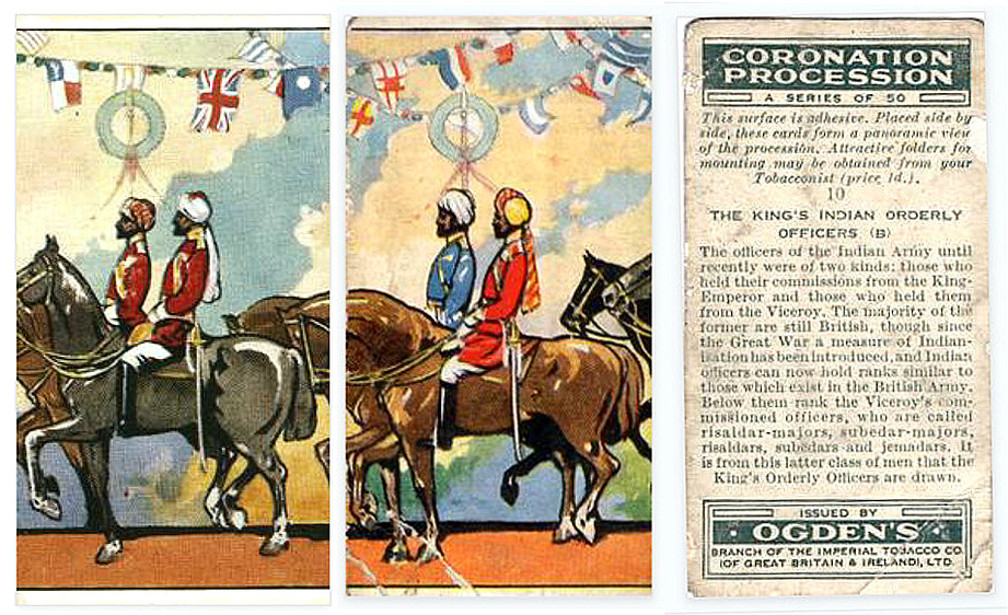
Coronation Cigarette Cards
The Coronation of King George VI took place on 12 May 1937, so the officers chosen to be the King’s Indian Orderlies had an unusual year in attendance for the Court Season. They were all cavalry officers, so that, arrayed in their full dress, mounted on horses borrowed from the Household Cavalry, they took part in the Coronation procession, trotting behind the mounted band of the Royal Scots Greys, following the escort to the carriage carrying Queen Mary and the King’s two daughters, Princess Elizabeth and Princess Margaret Rose.
Ogden’s produced a set of 50 cigarette cards before the Coronation, designed to be butted together to form a panorama of the whole procession. Six of the cards dealt with Indian officers brought over to England for the occasion; two cards, Nos. 29 & 30, show Indian Princes acting as Honorary ADCs to the King-Emperor, and two more cards, Nos. 24 & 25, show Indian cavalry officers representing 21 regiments. The cards in this illustration are Nos. 9 & 10, showing the King’s Indian Orderly Officers. The uniforms are incorrect but the artist was working months before the Coronation, basing the artwork on vague information.
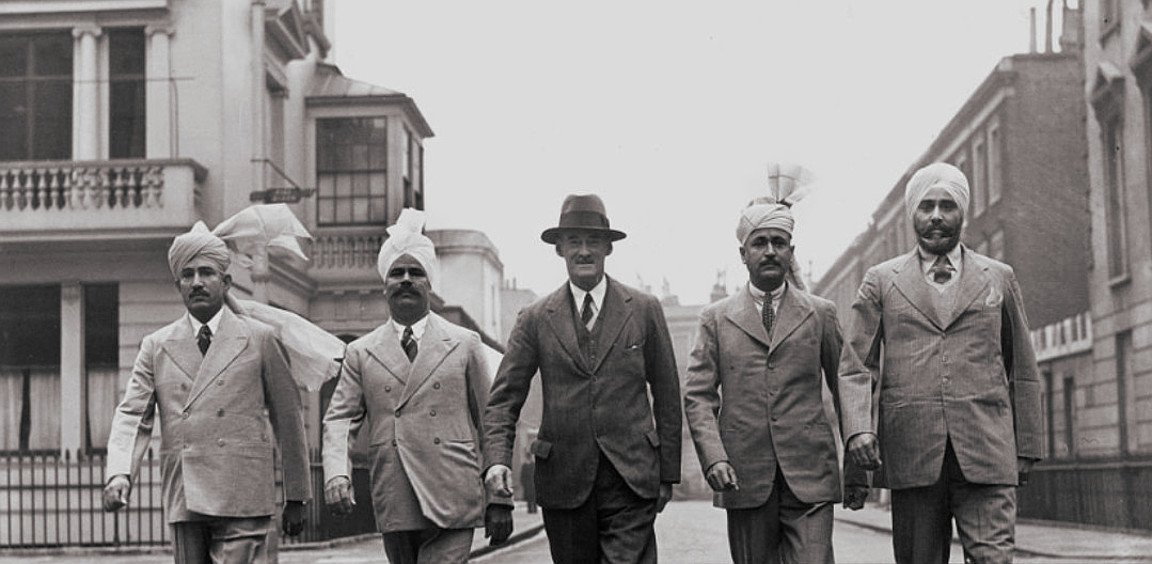
Indian Officers in Pimlico
The King’s Indian Orderly Officers were always quartered at 49 St George’s Road, Pimlico, and this photo shows them walking in the neighbourhood wearing civvies. From left:
Risaldar Muzzafar Khan, Sam Browne’s Cavalry (12th FF)
Risaldar Dharam Singh IOM, 20th Lancers
Lt-Colonel Edward Walker MVO OBE, 13th DCO Lancers
Risaldar-Major Bahadur Sher Khan, 15th Lancers
Risaldar-Major Lall Singh MBE, Probyn’s Horse (5th KEO Lancers)
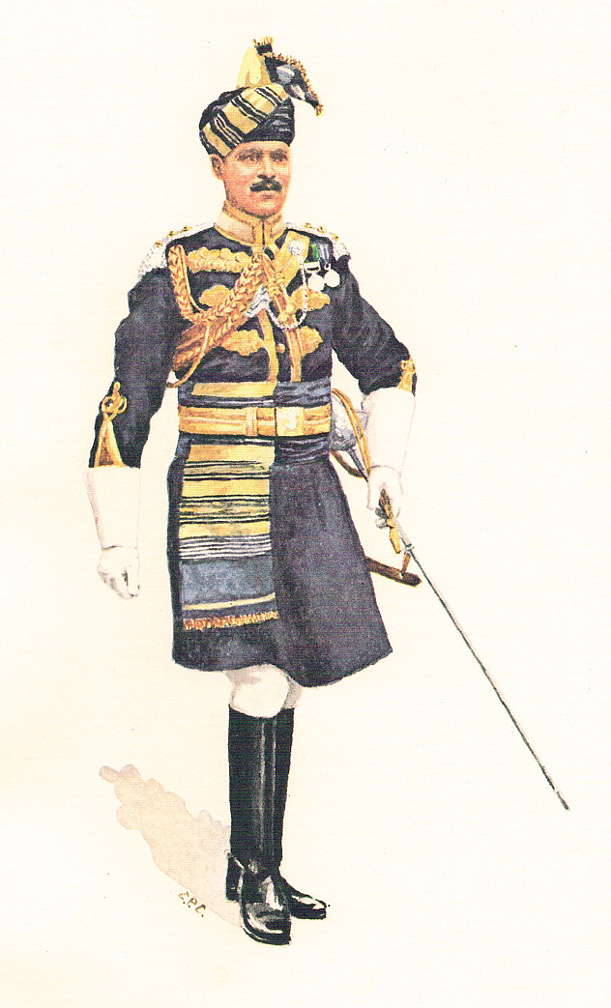
Risaldar-Major Bahadur Sher Khan
This watercolour by Chater Paul Chater shows the dress uniform that impressed spectators at the Coronation of King George VI on 12 May 1937. The buff facings can be seen on his collar and the central silk stripes on his pouch-belt and waist-belt. It was usual for officers wearing a blue kurta to have a red kummerband, but the 17th Cavalry wore a lighter blue kummerband and this was continued in the 15th Lancers. The illustration was published in An Assemblage of Indian Army Soldiers and Uniforms by Michael Glover (Perpetua 1973). The author points out that the end of the officer’s pugri was stiffened and arranged in a fan shape. This practice developed and can be seen in the armies of India and Pakistan today.

