

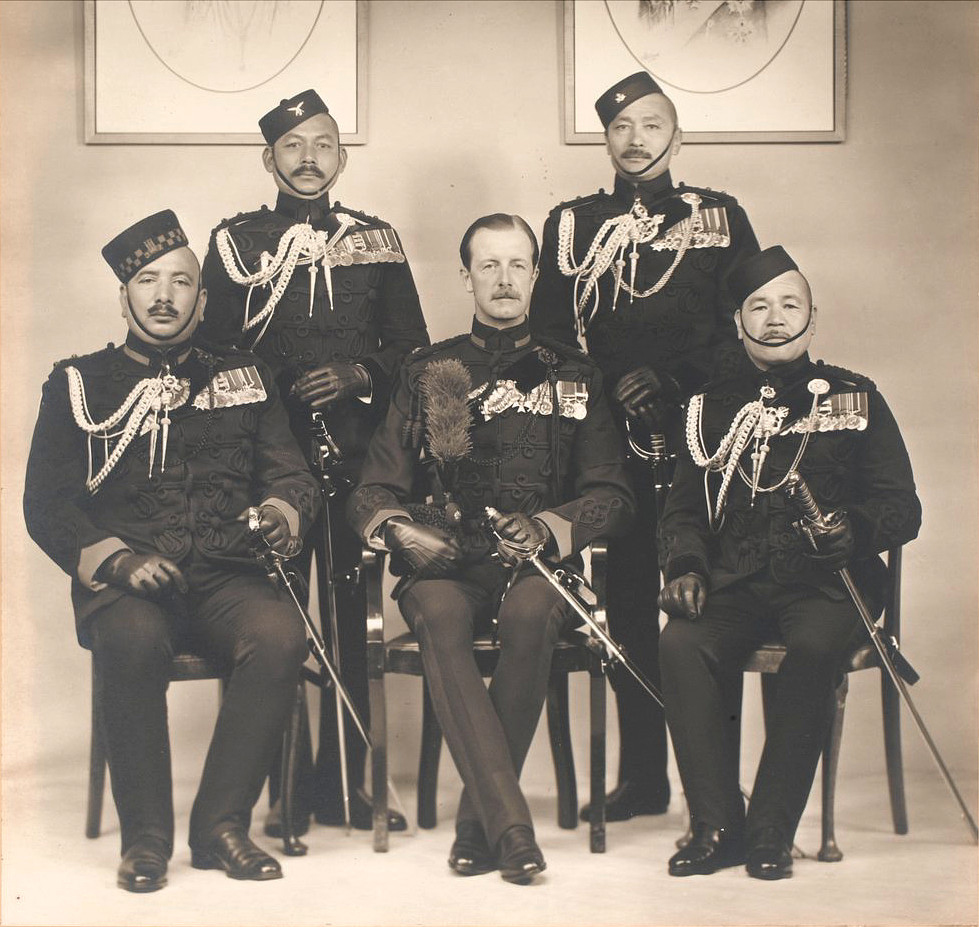
Seated left: Subadar-Major and Honorary Lieutenant Shamsher Singh Bohra, Bahadur OBI, 2nd King Edward VII’s Own Goorkha Rifles. In 1936 this regiment added ‘VII’ to the King Edward title to avoid confusion with Edward VIII who abdicated in that year. Lt Shamsher Singh wears a rifle green uniform with scarlet facings, a tribute to the uniform of the King’s Royal Rifle Corps, who, as the 60th Rifles, fought together with the Sirmoor Rifles, as they were then, at Delhi in 1857. It was there that this regiment distinguished themselves in the defence of the Main Picquet at Hindu Rao’s House, lasting 3 months. The regiment always affected the 19th century spelling, unofficially referring to themselves as the 2nd ‘Goorkhas’. The distinctive red and black diced cap-band was instituted by the CO, Sir Hubert MacPherson (1862–76). They adopted the ‘three feathers’ badge when they were honoured with the title Prince of Wales’s Own in 1876.
Seated centre: Major Charles Mervyn Hunt Wingfield MVO, 1st Battalion 2nd King Edward VII’s Own Goorkha Rifles. Charles Wingfield served throughout the First World War in the 1st Battalion, 2nd Goorkhas. He was promoted to major on 9 June 1938. In the Second World War he was given command of the 3rd Battalion 1st Gurkhas but was killed by a Japanese sniper on 28 May 1944. He was posthumously awarded the DSO for outstanding bravery and leadership when he regained Red Hill, which had been captured by the enemy. This action took place on 9 May 1944.
Seated right: Subadar-Major Dalbir Chand, Bahadur OBI IDSM, 1st Battalion 5th Royal Gurkha Rifles (Frontier Force). The title ‘Royal’ was conferred on the 5th Gurkhas in February 1921 and the Royal Crest added to the badge in 1927. But this officer does not have a badge on his cap like the others. The 1st Battalion served in Egypt and Gallipoli in the First World War, and Dalbir Chand was a havildar when he was awarded the Indian Distinguished Service Medal for service in Gallipoli. The uniform for the Gurkha Rifles was rifle green with black facings, apart from the 1st and 2nd Regiments who had scarlet facings. The 5th served on the Northwest Frontier in the 1930s, earning them two battle honours. After service in the Second World War in the Middle East and Italy (the 2nd Battalion in Burma and Japan), the regiment was one of six Gurkha Rifle regiments transferred to the Indian command.
Standing left: Subadar Balbahadur Khattri IDSM, 2nd Battalion 9th Gurkha Rifles. This officer was a naik when he was awarded the Indian Distinguished Service Medal for his outstanding conduct in Mesopotamia. After the war the battalion was sent to South India as part of a brigade tasked with quelling the Moplah rebellion. He has a clasp added to his India General Service Medal for MALABAR for this campaign. In the Second World War the 2nd Battalion was captured by the Japanese on Singapore Island in February 1941. On Partition the Gurkhas of the 5th were transferred to the Indian Army.
Standing right: Subadar Bhawansing Rai, Bahadur OBI IOM, 1st Battalion 10th Gurkha Rifles. This regiment was raised as the 10th Madras Infantry in 1891, from the Kubo Valley Military Police Battalion. But the Assamese soldiers were replaced by Gurkhas and it finally became the 10th Gurkha Rifles in 1901. In the First World War they served in Mesopotamia. At one point in the Middle East, the battalion was down to two companies strong and they combined with the two surviving companies of the 116th Mahrattas and were known as the 126th Gorattas. They spent four and a half years in the Ottoman Empire and had an unofficial motto: ‘Per arida ad astra’. The 1st Battalion served in Burma in the Second World War.