

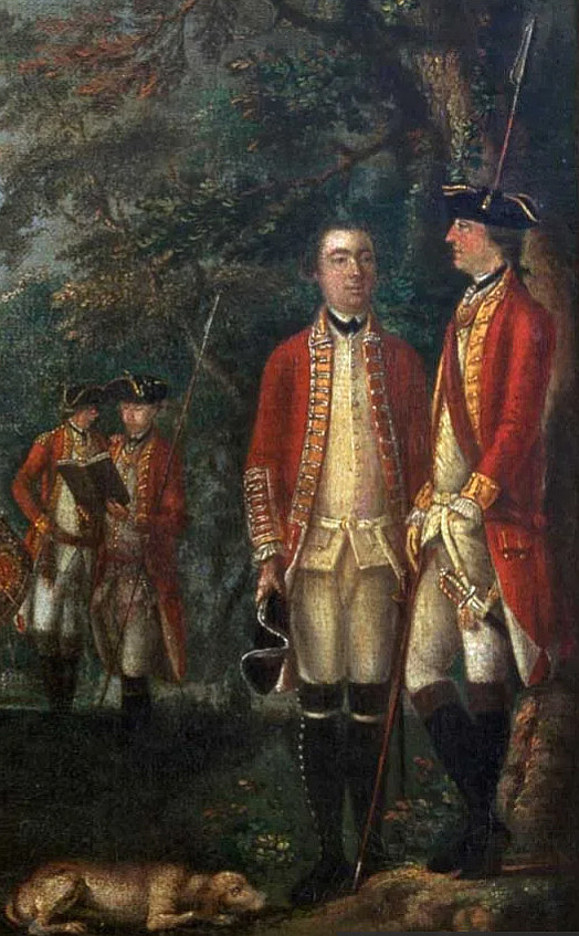
The central figure in this detail from one of Guiseppe Chiesa’s paintings of the 25th Regiment in Minorca is puzzling. The six paintings made by the artist in this period are discussed in detail by Percy Sumner in the Journal of the Society for Army Historical Research vol. XIX no.73 (Spring 1940). He describes the figure:
‘Sergeant-Major, holding hat in hand. Silver laced hat, scarlet coat, yellow collar with two silver laces, lapels edged two silver laces and eleven straight loops of double lace, scarlet slash on cuffs (similar to drum major) with five loops, white waistcoat and breeches.’
But the uniform is very different from that worn by the other soldiers, sergeants, or officers, and I am inclined to think that he is a man of special status. Military bands were quite rare in this period. The Royal Artillery had a band in the mid-18th century, but there are few prints of regimental bands. The ‘drum-major’ referred to in the Sumner quote is another figure in the painting, dealt with in the Drummers and Musicians section. This shows the drummer and fifer wearing reverse colour coats; yellow with red facings. Bandsmen normally wore a similar uniform to the rest of the regiment but with elaborate additions.
The silver lace on this man tells us that he is not a commissioned officer, as they had gold lace, seen on the officer on the right. He does not have a sash as worn by officers and sergeants. Neither does he have an epaulette. The lace on his cuff is very different from that of the rest of the regiment, and resembles the cuff worn by the drum-major, suggesting a musical connection. Sumner says there are five lace loops, but I count six.
Sumner writes that the officer on the right is Lord Lennox but has no convincing reason to make that assumption except that the title on the frame of the picture states: “Lord George Lennox, Colonel of the 25th Regiment of Infantry, in Minorca, 1763.” The date is clearly wrong, which puts the rest of the title into question. He holds a spontoon, carried by officers, but probably only the company officers, not field officers, who mostly paraded on horseback. This officer wears his crimson sash in the style discontinued in the Warrant of 1768. The officers in the background wear theirs correctly, around the waist.

