

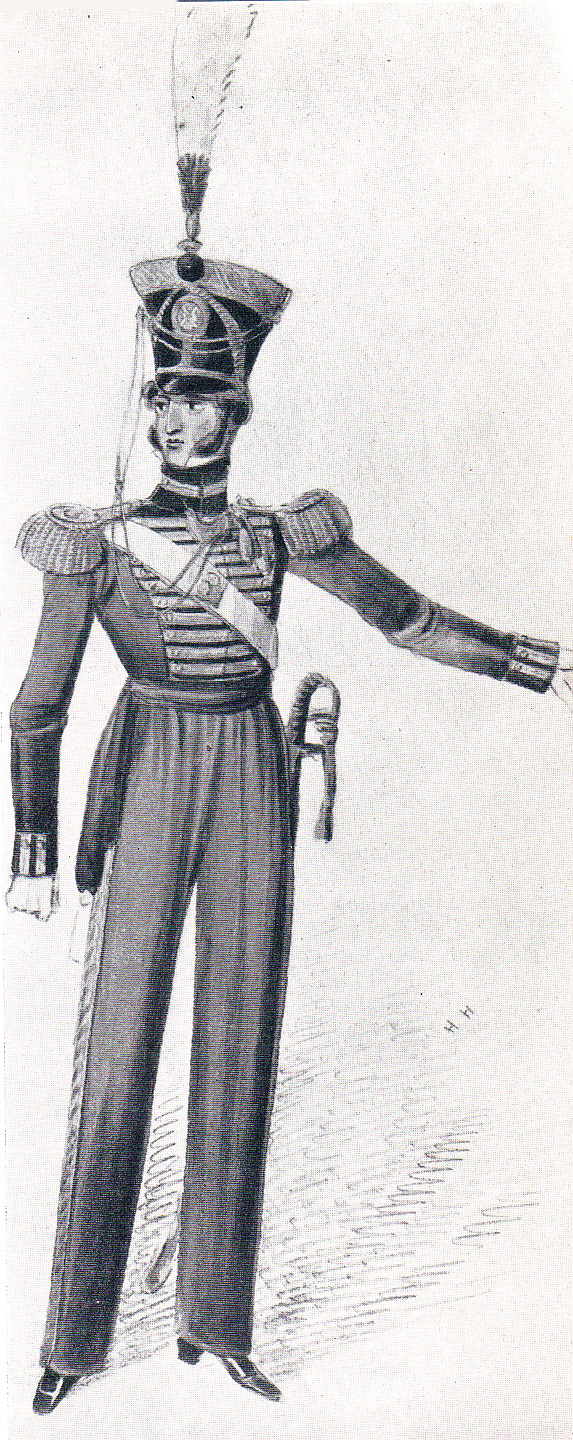
The officer in this painting by William Heath wears a scarlet coat with long tails. The wide lapels on the front of the coat are dark blue, covered in rows of gold lace with ten gilt buttons on each outside edge. The coat is fastened with hooks and eyes. The three-inch blue collar was closed at the front from c1820 onwards, and at this stage had only one loop of gold lace and a gilt button on each side. The blue cuffs have four buttons and gold lace loops. On the back skirts were scarlet pocket flaps with four loops and buttons, in pairs.
The large gold epaulettes indicate that the officer is either a major or lieutenant-colonel (or colonel). Field officers wore an epaulette on each shoulder, but company officers, apart from flank companies, wore only one epaulette on the right shoulder. This poses a problem because the white leather shoulder belt was worn by officers parading on foot. Mounted officers had a waist-belt to support their sword. The officers who paraded on horseback were the commanding officer, the second-in-command and the adjutant. It may well be that the officer shown here is a major, but not holding the office of second-in-command. His shoulder-belt has a gilt plate on the front which appears to correspond with the belt-plate worn from c1810 (see belt-plate).
The tall shako is of black beaver, bell-shaped, 11 inches in diameter at the top and, according to the 1826 Dress Regulations, eight inches tall. The regimental plate on the front was larger and more ornate than previously. But the artist has given the shako a small oval badge showing a Scottish saltire. The lace around the top is gold, and the gilt chin scales are hooked up to the black boss on the front. The white over red plume is taller than the regulation height of 12 inches. The cap-lines are gold and hook up to the left shoulder. The wide trousers were blue-grey with a gold lace outer stripe. The crimson silk sash around his waist has hanging ends on the right side.

