

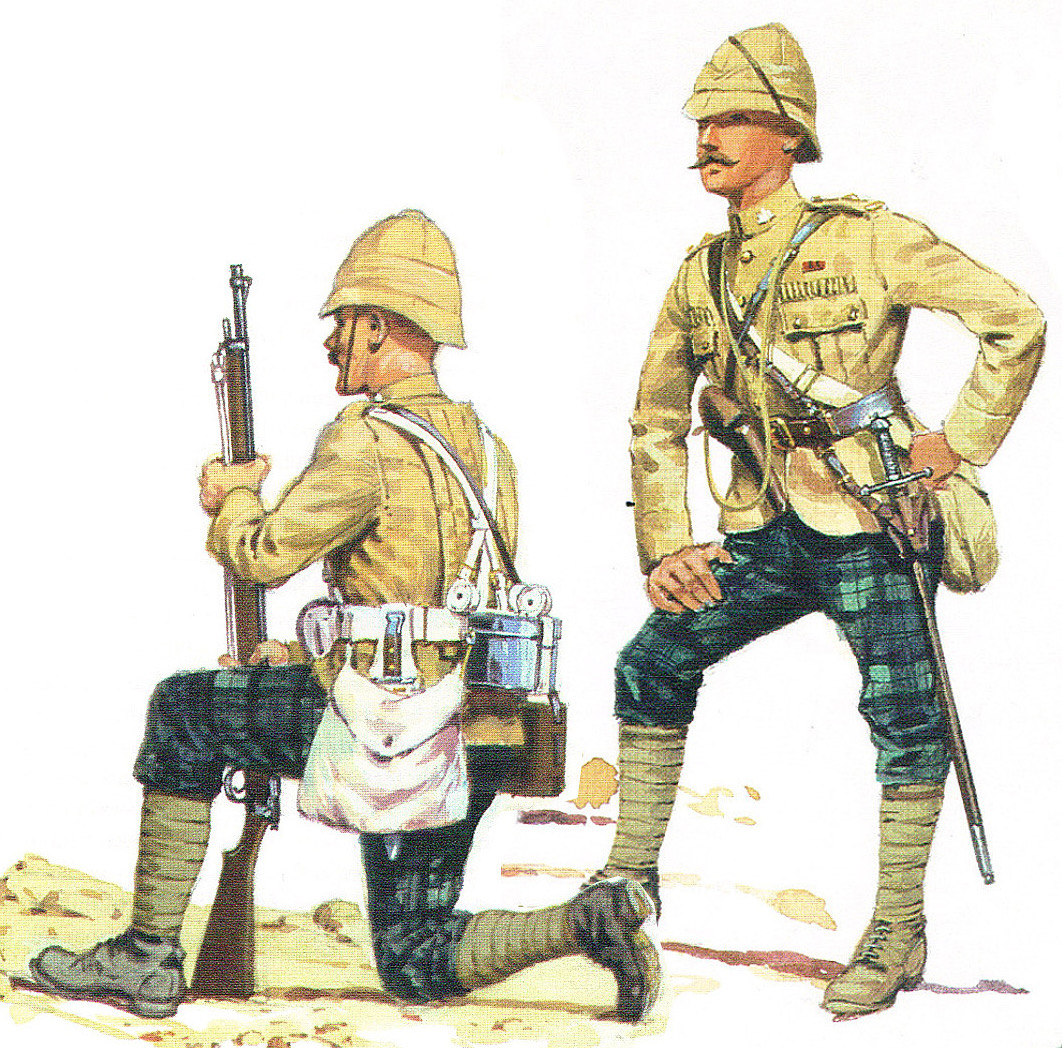
Khaki drill had been worn in India since 1885 but was not authorised for British regiments on foreign service until 1897. It was worn on the Northwest Frontier and in the Sudan. In 1897 the 2nd Battalion KOSB was in the 4th Brigade, 2nd Division, in the Tirah Operation commanded by Lieutenant‑General Sir William Lockhart. The Orakzai tribesmen had established their defensive position on the heights of Dargai. This had to be attacked twice, firstly on 18 October 1897. The 3rd Gurkhas and KOSB assaulted the heights and drove the tribesmen off, suffering 20 casualties, 6 of which were Borderers. But the heights were not held, and later the tribesmen regained the position in even greater numbers. A more well‑known attack defeated the tribesmen on 20 October, in which the Gordon Highlanders and 2nd Gurkhas distinguished themselves.
The illustration is by Douglas Anderson, published in Military Illustrated, July 1994. The Private and officer wear khaki drill tunics with collar badges, and government tartan trousers. They have khaki puttees and lace‑up boots. The khaki covered foreign service helmets have pugarees and leather chin straps. The officer has a brown leather Sam Browne belt to support his broadsword which has a hilt with cross‑bar for active service. There is a pistol in a holster on the other side. He has a white haversack and a water‑bottle on the other side. There is a red and green striped ribbon for the India medal, having served in the Chitral campaign.
The kneeling Private is armed with a Lee‑Metford rifle and has Slade Wallace belts that support his mess tins. He also has a white canvas haversack and a square‑shaped water‑bottle.

