

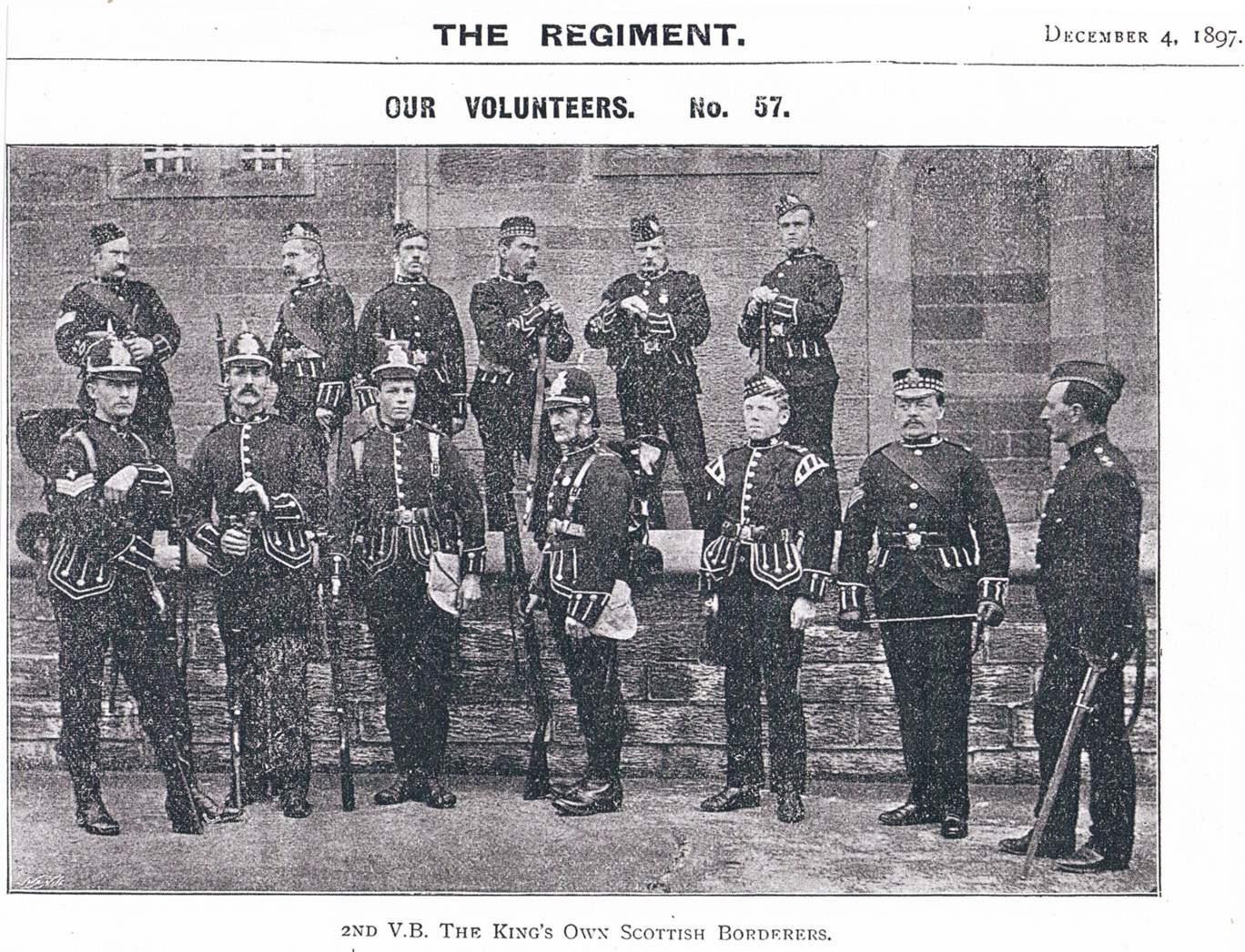
From 1887 the King’s Own Scottish Borderers, as well as two Regular battalions, had a 3rd Militia Battalion, and four Volunteer Battalions. The 1st VB (Roxburgh & Selkirk VRC) was based at Newton St Boswells, the 2nd VB (Berwickshire) based at Duns, the 3rd VB based at Dumfries and the 4th VB (Galloway VRC), which joined the KOSB as late as 1899, was based at Castle Douglas.
This page from ‘The Regiment’, dated 4 Dec 1897, shows men of the 2nd Volunteer Battalion. The unit dated from 1859, known as the 1st Berwickshire Rifle Volunteer Corps, previously connected to the Royal Scots. In 1859 they had their HQ at Duns but the seven companies ‘A’ to ‘G’ were from Duns, Coldstream, Ayton, Greenlaw, Lauderdale, Earlston and Chirnside. In 1891 a new company ‘H’ was formed at Duns, and ‘I’ company raised at Ladykirk in 1900, but re-designated as ‘H’ Company when the new company at Duns was disbanded.
At first glance the uniforms would appear to be the same as those worn by the regular battalions; scarlet doublets with blue facings and government tartan trews (Leslie tartan from 1900). They had always worn scarlet tunics, blue facings. However, the straps and belts are black instead of white, and there do not seem to be any ammunition pouches on the front of the waist-belt. The white canvas haversacks are attached to the waist-belt with short leather slings instead of a canvas strap over the right shoulder.
The men in the back row have frock tunics and undress glengarry caps, proficiency badges can be seen on their right forearms, the long diamond shape was for rifle drill, and five-pointed stars for other skills. The sergeant on the left has a silver four-pointed star over three silver chevrons. The Battalion Sergeant-Major, in a peaked forage cap, has four chevrons and another badge, probably a crown on his right arm. He also wears a frock tunic, with a black belt. On the right is a captain in a blue patrol jacket and trews, wearing a plain glengarry.
Standing next to the sergeant-major is a drummer/bugler wearing a dress doublet that has eight buttons down the front as opposed to seven buttons worn by the two men on his right side. He has shoulder wings but no special drummers’ lace on the sleeves.
Only one man has a medal, but after 1902 they would all be wearing medals for the South African war as the four volunteer battalions served there and earned a battle honour; SOUTH AFRICA 1900-02.

