

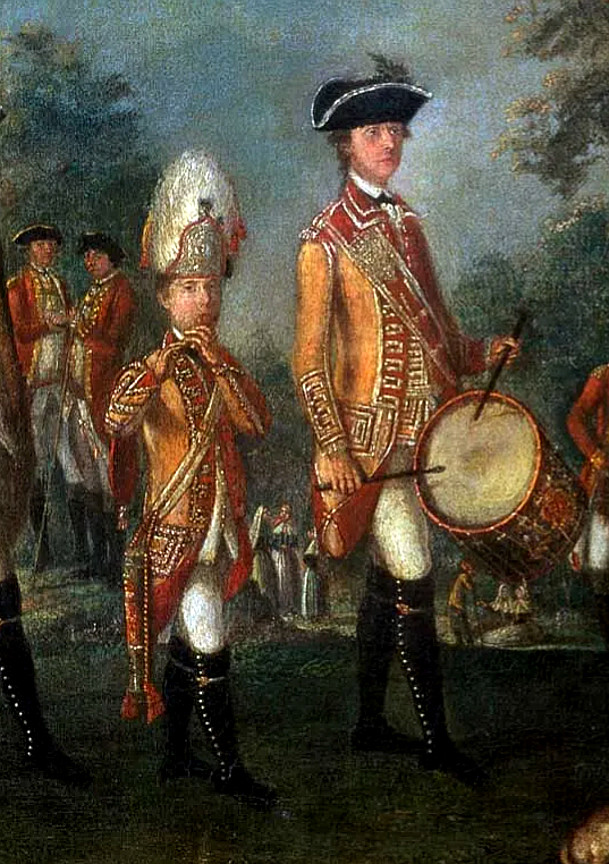
These two soldiers belong to the 25th Regiment’s Corps of Drums. Each company had a drummer, employed to transmit orders by beat of drum. They were invariably boys, sons of men of the regiment, trained from an early age while their wrists were supple enough for the rapid movements. The drummer boys also learned to play the fife. The uniform for line infantry regiments that did not have a ‘Royal’ title was a reverse colour coat: deep yellow with red facings. It was heavily decorated with a special pattern lace, white with evenly spaced blue chevrons, distinct from the lace worn by the rest of the regiment. One of the hanging sleeves can just be seen behind the right shoulder; it is lined red but has the same pattern as the sleeve on the other side. Hanging sleeves had been part of drummers’ uniform since the 16th century, but were discontinued in the Clothing Warrant of 1768. The 25th Regiment departed for Minorca in early 1769 and therefore did not have time to adopt the new uniforms before leaving England.
The ornate fife-case is suspended from a cord running through the centre of the white shoulder-belt, with a buckle visible in the middle. The waistcoat and breeches are white. The white fur cap has a red-edged silver plate on the front, similar to that worn by the grenadier sentry of 1769. Red tassels hang on the left side, and a yellow bag with a tassel hangs to the right. Drummers’ caps followed a similar pattern to those of the grenadier company. Until 1766, grenadiers and drummers of the 25th wore an embroidered cloth mitre cap with a yellow front. Lord George Lennox, the colonel of the regiment, maintained tight control of regimental distinctions and requested permission to replace the cloth mitres with fur caps as early as 1763, but approval was delayed until 1766. The grenadiers received black fur caps and the drummers white.
The man playing the drum is the drum-major. It is unusual to see prints or paintings depicting this senior NCO actually playing a drum. Since the 1780s drum-majors have carried only a mace and worn their embroidered shoulder-belt on the left shoulder, but this detail from a painting of the 25th Regiment in Minorca provides valuable evidence that drum-majors of this period played the drum. Uniform experts Percy Sumner and W. Y. Carman both agreed that this figure is the drum-major. The red drum-carriage is edged in silver and bears a large silver badge above two small drumsticks, conforming to the traditional ornamental belt worn by drum-majors for more than two centuries.
The uniform is deep yellow with red facings and silver lace. The sleeves are not covered with lace chevrons like those of the fifer. The cuffs are round with a yellow slash flap edged in silver and have four silver buttonholes and buttons. A silver epaulette on the shoulder secures the shoulder-belt. His waistcoat is yellow and heavily edged with silver lace and buttonholes. There appears to be a waist-belt under the coat to support a sword, although the fifer does not have a visible waist-belt but must have a short sword attached to a hidden belt. The drum-major’s black tricorn hat has a silver lace edge and a sprig of green leaves.

