

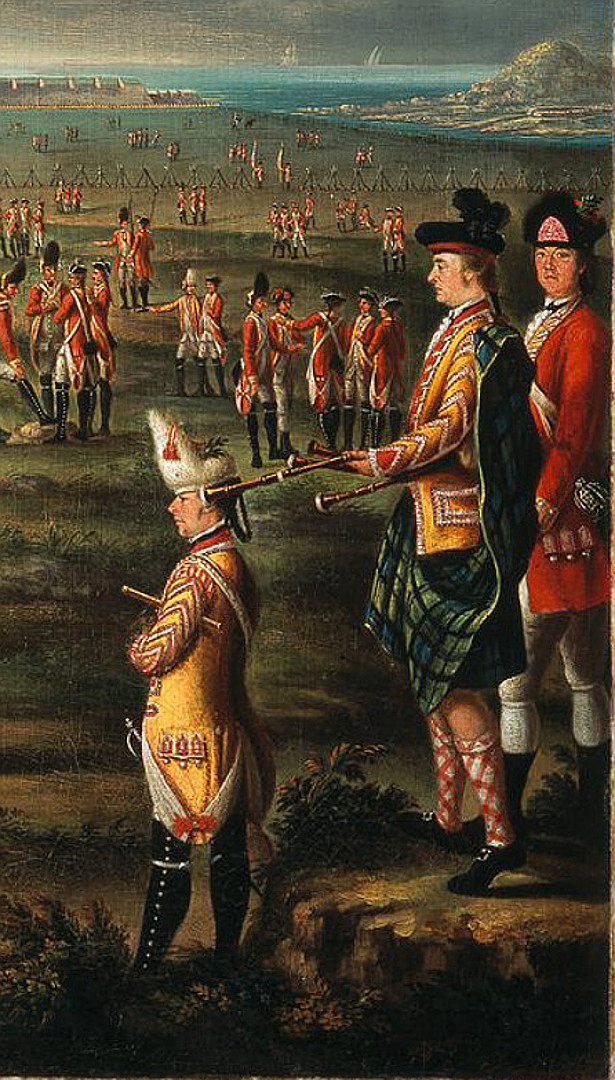
Guiseppe Chiesa’s painting of 1771 has this detail on the extreme right, depicting a group of men of the 25th Regiment stationed on Minorca in the 1770s. The bagpiper is the only man in the regiment dressed in Scottish kilt and plaid. The figure standing in front of him is a drummer who has a fife under his arm. Members of the Corps of Drums had the dual role of drummers and fifers, usually boys, but this fifer looks more mature.
An Inspection Return of 13 May 1768 mentions that there is a ‘bag-piper in the Band of Music’. So although there was a regimental band there was not a pipe band as such. We don’t know what other instruments were played in the band. Normally the band and Corps of Drums were separate but at this period there may have been more cooperation. This is suggested by the similarity of uniforms. Another Inspection Return of 21 June 1777 says;
‘The Drum Major plays on the cymbal…..15 Music. The Musicians now wear hats with red feathers, instead of caps, which they had last year.’
The bagpiper has an adaptation of the coat to allow the plaid to be pulled up to the left shoulder; the lower part of the coat has been cut away. The distinctive musicians’ coats are deep yellow with red facings, the reverse of coats worn by the rest of the regiment. The patterned lace on the sleeves, lapels, collar and pockets is different from that of the fighting troops. The regimental lace had straight lines running through, blue, yellow and red. But the drummers and musicians had evenly spaced blue chevrons, not visible in this reproduction. The edges of the lace appear to be decorated with red.
The profile view of these men gives a clear view of the pocket flaps. The fifer has three laced button-hole loops, but the buttons are placed below the flap rather than beneath, thus being more decorative than practical. A similar pattern can be seen on the coat of the light company man behind the bagpiper.
The fifer can be compared to the fifer of the 1770 painting. The white fur cap is different, being plain-fronted, without the silver plate (plain-fronted black grenadier caps can be seen in the background). The turn-backs of the coat are white instead of red. But there is still the white shoulder-belt with a central red twisted cord for the fife-case. This view also shows that he carries a sword, slung from a waist-belt beneath his coat.
The bag-piper is not armed. His coat has similar lace chevrons on the sleeve, and the red cuff can be seen to be pointed. The collar does not conform to the regimental turn-down pattern but has an edging of lace. The red lapels are edged and have button-holes and silver buttons evenly spaced. The pocket flap, however, differs from the fifer in that it is edged all around with lace and has an inner row of lace. No buttons are visible below the pocket. His bonnet follows the pattern worn by The 42nd Royal Highland Regiment prior to the introduction of the diced band c1776.

