

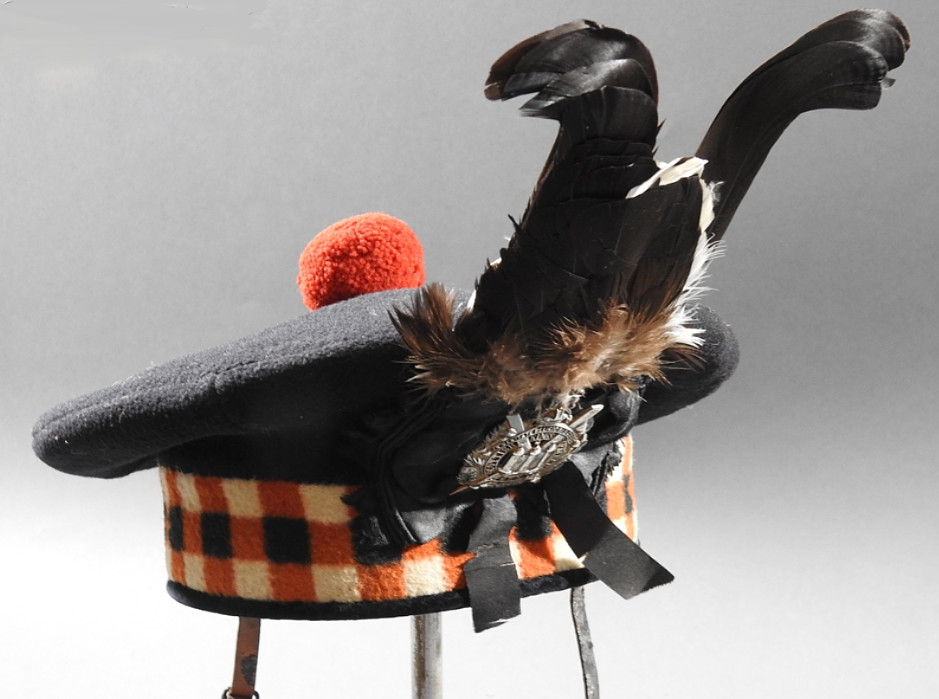
The Kilmarnock Bonnet cocked was adopted in 1903 by the King’s Own Scottish Borderers and the Royal Scots to replace the blue helmet. It was broad-topped, stiffened to enlarge the bonnet, and tilted towards the right side to show the badge, black cockade and blackcock tail feathers on the left. The head-band was diced, red, white and dark green and the lower edge bound with black silk that had a bow at the back. The black silk cockade had two small ribbon tails, and on this was placed the regimental white metal badge, the same as worn on the Glengarry. A red tourie topped the bonnet.
The ‘cocked’ part of the bonnet was made up of several feathers from the tail of the male black grouse. The bird is well known for its mating display, called a ‘lek’ whereby it fans out the tail, showing several of these curled black feathers. White feathers also fan out behind the black ones, and this example of a KOSB officers’ bonnet shows white as well as brown downy feathers.
The bonnet was worn on dress occasions and parades, by all ranks, although the rank-and-file had a lesser quality bonnet than the officers and Warrant Officers. Officers continued to wear it in no.1 dress after WW1 and it was still worn by the Drum Major up until 2006. But for the rank-and-file the stiffened bonnet was discontinued in 1914 and thereafter replaced by the blue Lowland Bonnet cocked which inspired the regimental march ‘Blue Bonnets over the Border’.

