

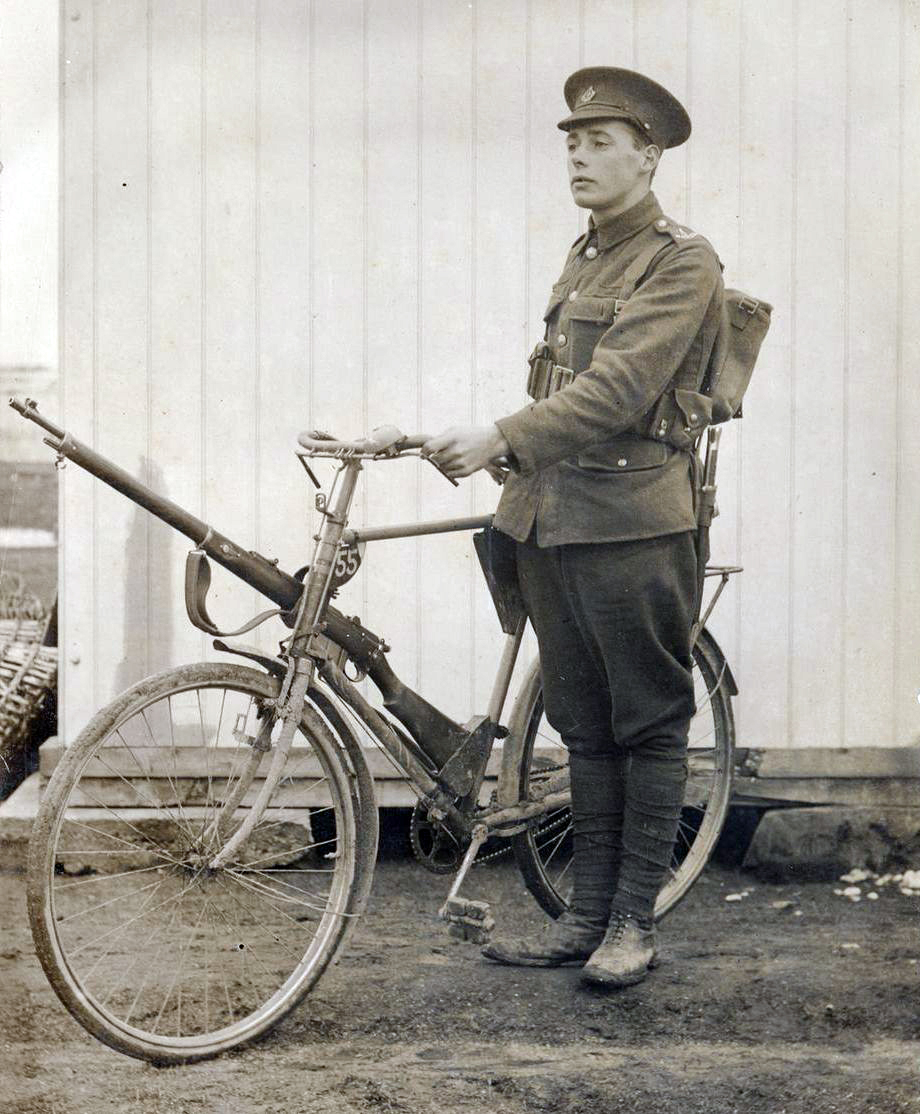
The 7th (Cyclist) Battalion of the Devonshire Regiment emerged in 1908 as part of the sweeping reorganisation that created the Territorial Force. It drew its nucleus from the cyclist sections of earlier Volunteer Battalions, but it was a new formation in its own right, reflecting the Edwardian belief that mobility and local knowledge could be decisive in home defence. With its headquarters in Exeter, the battalion recruited widely across Devon, establishing companies in Exeter, Plymouth, Torquay, Crediton, Dartmouth and Cullompton, with smaller detachments in surrounding villages.
By the outbreak of war in August 1914 the battalion had grown to 463 men, rising rapidly to more than 900 by November. The expansion was such that a second-line battalion was created in March 1915, the original becoming 1/7th and the new formation 2/7th. Both units would spend the war in a mixture of coastal defence, training duties and reinforcement drafts to other battalions of the Devonshire Regiment.
The military use of bicycles had begun in the 1880s, when Volunteer units experimented with cyclist sections intended to act as scouts and rapid-response defenders in the event of invasion. Their usefulness was confirmed during the Boer War, where cyclists proved effective in reconnaissance, message-carrying and supporting machine-gun detachments. By the early twentieth century some 8,000 cyclists served in various Volunteer and Territorial units, and the idea spread into youth organisations such as the Boy Scouts and the Church Lads’ Brigade.
The cycle itself was designed as a self-contained fighting platform. A rifle bucket, carrier, groundsheet, cape, mess-tin and small kitbag could all be attached to the frame, while “cycle artificers” — trained mechanics within each battalion — kept the machines serviceable. On good roads the bicycle offered swift and economical movement; on rough ground or in heavy mud it was often more hindrance than help, and riders sometimes had to abandon their machines altogether.
When war came in 1914 the 7th Battalion was at its annual camp at Churston. Mobilisation orders sent the men first to Newton Abbot and then by train to the north-east coast, where they were assigned to coastal defence duties from Scarborough to Seaton Delavel. Headquarters was established at Seaton Carew. A second-line battalion was raised in the autumn under Major Hibberd, drawing heavily from Totnes and the surrounding district.
Although the battalion’s primary role remained home defence, individual cyclists and small drafts were sent to France and Flanders from 1915 onwards. Some were attached to other regiments for signalling, scouting or orderly work; others were absorbed into infantry units as the war demanded. The first significant action involving men of the 7th Cyclists came in July 1916, when a draft was posted to “A” Company of the 2nd Devons in the Cuinchy sector. As the war progressed and horses became scarce, some infantry platoons attempted to convert to cyclist units, though with limited success.
At the Armistice the two battalions were still stationed on the North Sea coast — 1/7th at Canterbury and 2/7th at Maldon. They were not stood down until early 1919. Although briefly reconstituted within the post-war Territorial Army, the battalion was finally disbanded in 1921.
The battalion’s peacetime organisation reflected its broad recruiting base. Eight companies were distributed across Devon:
These local ties are useful when tracing individual soldiers: a man from Crediton, for example, would almost certainly have served in E Company. Surviving regimental numbers also allow enlistment dates to be estimated, with examples ranging from 387 (March 1910) to 1625 (December 1914). Such sequences help place a man within the battalion’s rapid pre-war expansion.
Although the 7th (Cyclist) Battalion never served overseas as a complete unit, it played a significant role in home defence, reinforcement and training throughout the First World War. Its history reflects a brief but distinctive phase in British military thinking, when the bicycle was seen as a practical tool for mobility, scouting and communication — a concept overtaken by the mechanisation that followed, but one that left a clear imprint on the Territorial Force of Devon.

This is an account of the 1912 Army Manoeuvres which Francis Henry Ridgeway may well have participated in. It was a very important exercise in the lead up to the war and the 7th (Cyclist) Battalion was deployed extensively throughout. The account was very kindly provided by Nick Balmer whose great uncle was in the Cambridge University Officers Training Corps and observed these exercises from his motorcycle.
7th DEVONS – Return of Cyclist Battalion from Manoeuvres.
The 7th Devons (Cyclists) returned from manoeuvres on Saturday evening, having left Royston at 9 a.m. It was a long and tedious journey to Exeter, and even then some of the companies had a good way to go. The men were looking well, but some were a bit knocked up with the arduous work they had gone through.
In the various accounts that have appeared of the doings of the Battalion, reference only has been made to those companies which formed part of Col. Lawder's Brigade and which did some splendid work at Castle Camps, and to Major Hibberd's company which went off on a scouting campaign and saw no fighting at all, although some of them got in touch with the enemy, and one was made prisoner.
Not a word has appeared, however, about the work of the Crediton Company, who, under Capt. Harvey, were perhaps set the severest task of the lot. They left Baldock on the Sunday afternoon and rode to a farm a little to the south-west of Cambridge, and were just settling down comfortably for the night when they were ordered to move to another spot to the north-west of the town, where they joined with a troop of Life Guards.
They were entrusted with a special mission, which was to get around behind the enemy, follow close on his heels, and by means of wireless telegraph and despatch riders, keep the Blue Commander advised of the direction the Red Force was taking. Operating as they were in the enemy's country, they had to move with extreme caution, and do a lot of scouting in all directions, perhaps lying low for hours by the day.
On the Monday the party moved off north beyond Ely, and then turned eastward into the Fen district. They reached their bivouac, which was not the one originally intended, as that was a bit too near the enemy's scouts, about 8 a.m. They had been at it all day, and were glad of the rest.
But there was to be no sleep for one of the party, for as he was about to turn in he received orders to take an important message back to the cavalry headquarters at Linton, some way below Cambridge, a distance of 40 miles. There were one or two of the Cyclists who had rides like this.
During the night there were a couple of alarms, but nothing came of them, and the next day and night the mission was completed, the Cyclists getting as far as Mildenhall. From there they rode the next morning, without any breakfast most of them, across Newmarket Heath to Cambridge where Capt. Harvey gave the men a brief interval for refreshments.
Later they returned to their rest camp at Baldock, and having some time on their hands, paid a visit to the garden city of Letchworth. They had earned their relaxation, for during the time they were out they must have covered 150 miles or more.
On the way to Cambridge on the Sunday afternoon, one of the men had a very bad spill, being thrown from his machine onto a wall. Fortunately his injuries were not so bad as first feared, but he was conveyed into Cambridge on the transport and left at the hospital.
Western Times – Tuesday 24 September 1912
The 7th (Cyclist) Battalion of the Devonshire Regiment played a part in the 1912 Army Manoeuvres in East Anglia, which were based on the premise that the Germans had been able to land invading forces on the East Anglian coast and were advancing inland in a south-westerly direction.
One of the officers (unnamed) was an able reporter who published several articles on the manoeuvres. We have no idea if Francis Ridgway had taken part in the events of 1912, but given the early date of his death in 1914, it is quite possible that he had been in this TA battalion before the outbreak of war.
ARMY MANOEUVRES
Cavalry Brigades Preparing for Action. Yesterday the whole of the Cavalry and Royal Horse Artillery left Aldershot to take part in the Army Manoeuvres, under the command of General Kavanagh. They will endeavour to seize crossings over the River Thames held by the Household Cavalry, Mounted Infantry, and Territorial Cyclists. If they fail to capture the crossings, they are prepared to cross on rafts made with air-bags during the night. The second and fourth Cavalry Brigades are moving up from Salisbury Plain.
THE ARMY MANOEUVRES.
The army manoeuvres in East Anglia began in earnest this week. Norfolk and Cambridgeshire resounded to the booming of guns. There are two divisions: the first under Major-General L. H. Lomas, and the second commanded by Major-General H. M. Lawson. Each division is 14,000 strong, and as the manoeuvres progress the total will exceed 60,000. Our photograph shows artillery galloping into action.
The 7th Devons in Action
On the last day of the manoeuvres the Devon Cyclists were fighting practically the whole time the operations were in progress, and took part in the stirring events connected with the capture, loss, and recapture of Castle Camp. They also, writes “Scout,” frustrated a determined attempt on the part of a Guards battalion to capture their maxims.
They left their bivouac at Steeple Bumpstead at 9 a.m. and proceeded to Helion Bumpstead, where they quickly came in contact with a large body of the enemy. The main attack was made under cover of heavy artillery fire, the Cyclists being on the right flank of the attacking line, with Cavalry and Yeomanry on the left, and the K.R.R. and Cameron Highlanders in the centre.
The Reds were driven back towards Castle Camp. The 7th Maxims were responsible for a smart piece of work. They got their gun mounted on the car across a long field and played havoc with a battalion of Coldstreams, who made a mad rush to capture them. The Cyclists, however, put on top speed and got away, the 25th City of Londons coming up and covering their retreat. The umpires ordered the Coldstreams to retire.
Next the 7ths were engaged in a successful effort to dislodge the Reds from Castle Camp and were congratulated on their work by the Brigadier. Afterwards the position was retaken by the Reds, but the Blues once more drove them out. It was a great day for the Devons, and they were highly pleased with themselves.
Wednesday night the day’s doings were celebrated with a camp smoker. On Thursday the Battalion left for Baldock. Col. Lawford, who commanded the Cyclist Brigade, was very pleased with their work, and the quickness with which they carried out movements quite surprised him.
The Torquay Company captured a large farm held by a strong force of Scots Greys. It was recaptured by the enemy, but a strong force of Cyclists, supported by the Cameron Highlanders and 2nd Life Guards, were soon in possession of it again.

