

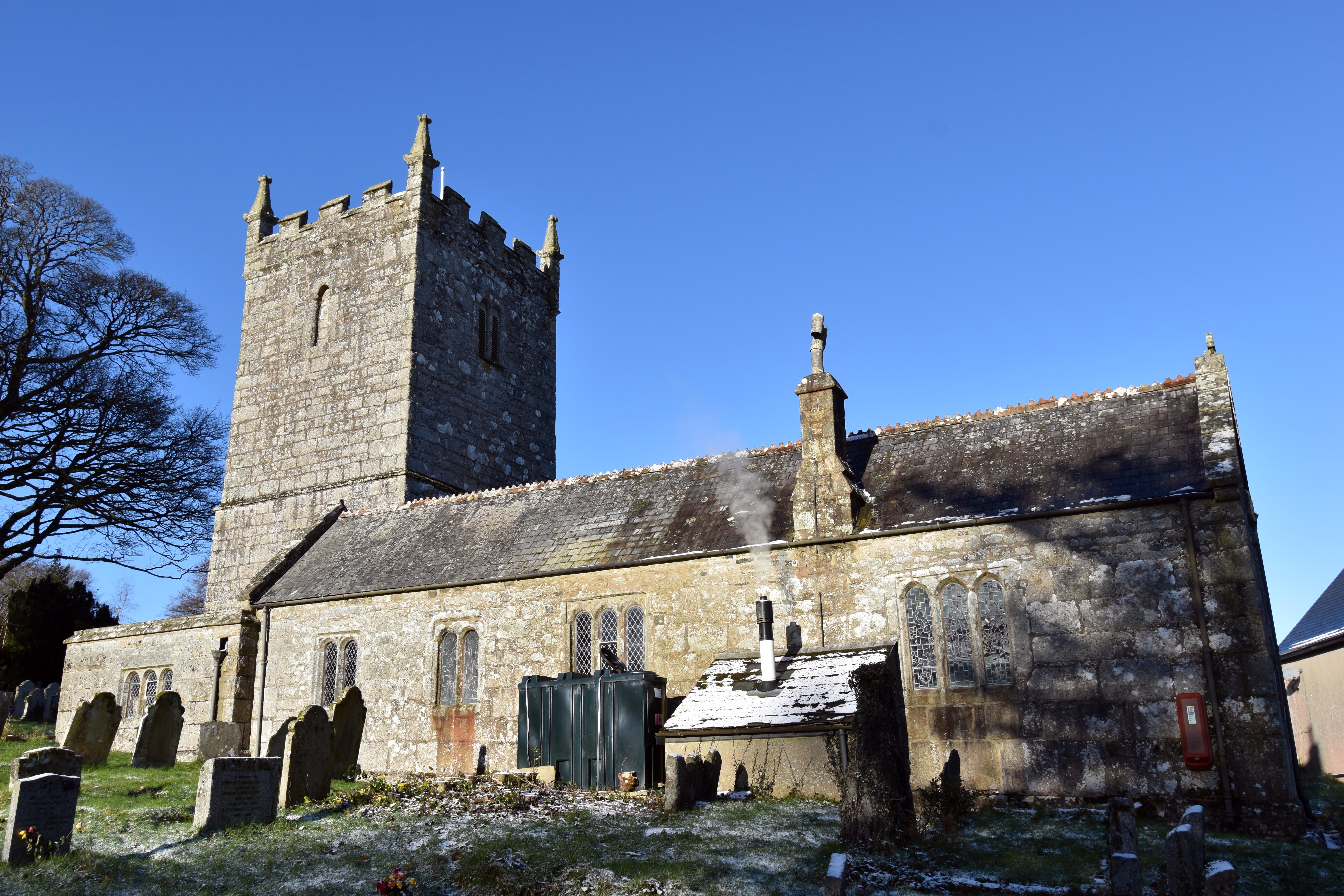
St Mary the Virgin sits at the centre of Belstone in the way a good village church should: quietly, without fuss, and with the sort of steady presence that makes you realise how long it has been part of the landscape. You don’t approach it as a landmark so much as find yourself beside it, turning a corner past the green and suddenly noticing the tower above the rooftops. It feels entirely natural, as though the village grew around it rather than the other way round.
The earliest parts of the church go back to the twelfth century, when Belstone was little more than a handful of farms and a few strips of workable land between the Taw and the East Okement. The granite walls and simple layout still carry that sense of practicality. This was never a wealthy parish, and the church reflects that: solid, functional, and built to withstand whatever the moor decided to throw at it. Later centuries added their own touches — the fifteenth‑century tower, the aisle, the usual Victorian repairs — but the building has never lost its straightforward character.
Inside, the church has the sort of atmosphere that comes from long use rather than architectural ambition. The light falls softly, the pews are plain, and the medieval font looks as though it has seen more baptisms than anyone could count. Nothing is showy. It’s the kind of interior where you can imagine generations of Belstone families sitting through winter sermons while the wind rattled the windows, or gathering for harvest festivals when the fields were finally in. The building has absorbed all of that without making a spectacle of it.
The churchyard is one of the most telling parts of the place. It rises gently around the building, dotted with stones that lean at angles dictated by time and weather. Some of the older slate markers still carry their eighteenth‑century carvings; others are granite slabs from families who have been here for centuries. From the higher ground you can look straight out to Belstone Tor, which feels entirely appropriate — the moor has always been part of the parish’s identity, and the church sits right on that boundary between settlement and open ground.
St Mary’s has had its share of repairs, as any rural church does. The Victorians did their usual tidy‑up, replacing seating and shoring up the fabric, and later generations have kept the building going with the sort of quiet maintenance that rarely makes it into guidebooks. What matters is that the church has remained in use. Even as congregations shrank and the village changed, St Mary’s continued to host the moments that mark a rural community’s life: weddings, funerals, Christmas services, and the occasional event that brings everyone together regardless of how often they attend.
What stands out most is how naturally the church fits its surroundings. From the ridge above the village, the tower is a familiar sight — a marker for anyone walking between Belstone Tor and Cosdon, and a reminder that the village is never far away even when the weather makes it feel otherwise. It doesn’t dominate the landscape; it simply belongs to it. That sense of belonging is part of the church’s charm. It isn’t trying to impress anyone. It’s just doing what it has always done: offering a place of gathering and continuity on the edge of the high ground.
St Mary the Virgin is not a church that demands attention, and that is precisely why it works. It reflects the village it serves — modest, enduring, and shaped by the moor rather than competing with it. If you step inside on a quiet afternoon, you can feel that long history without needing to be told about it. The building has been part of Belstone for nearly a millennium, and it shows its age in the best possible way: not as a relic, but as a place that has simply carried on, year after year, doing what the village needed it to do.

