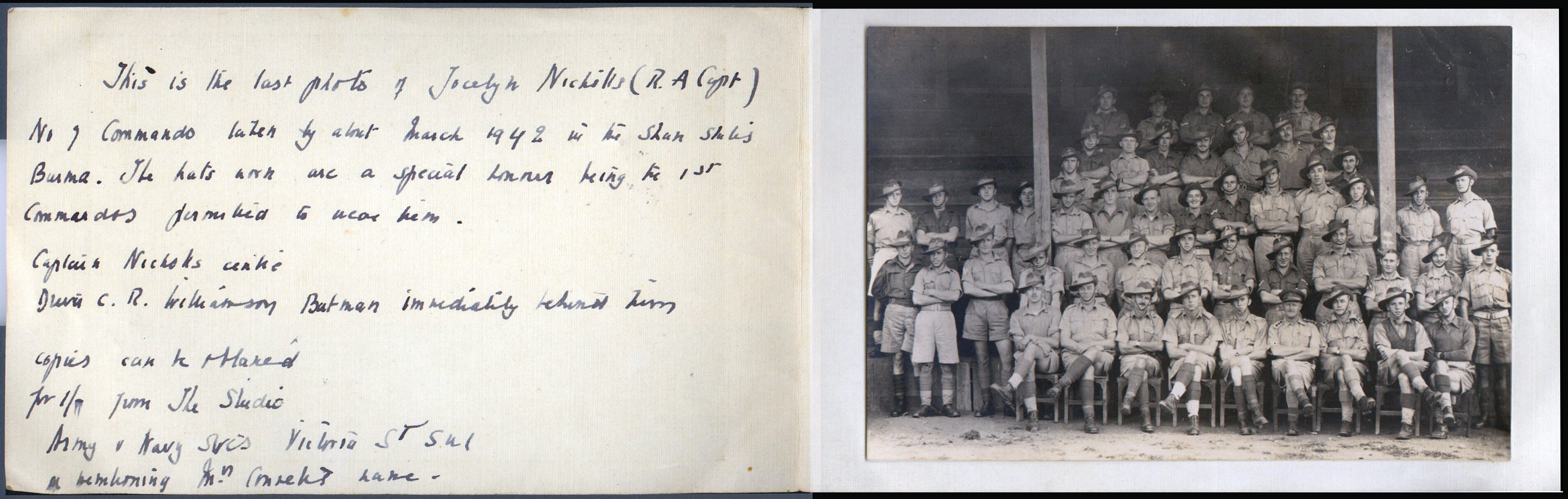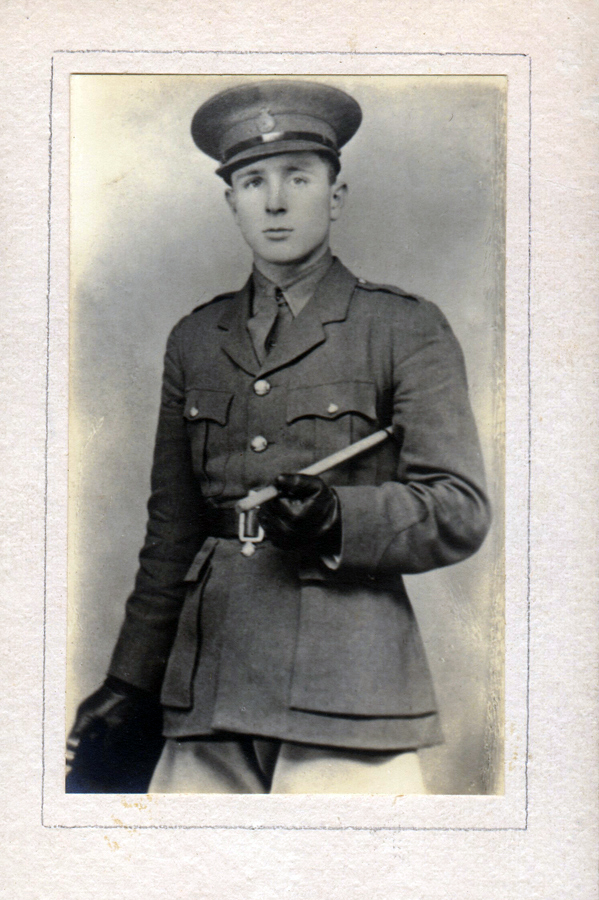
Captain F. R. Jocelyn Nicholls, Royal Artillery, was regarded by the men who served under him as one of the finest young Regular officers of the war. Former other ranks placed annual memorial notices in The Times for years after his death, a rare tribute that reflected the trust and loyalty he inspired. A surviving photograph of him as a cadet at Woolwich in 1935 shows the beginning of a career shaped by technical competence, physical resilience and a consistent willingness to volunteer for demanding service.
At the outbreak of the Second World War Nicholls was serving as A.D.C. to the Governor of Fiji, seconded from the Royal Artillery. He immediately sought to return to Britain to join the fighting. On arrival in 1940 he volunteered for a Special Service detachment intended for operations in Finland against the Soviet Union. He completed arduous mountain and ski training with the unit, but the collapse of Finnish resistance ended the project and the detachment was disbanded.
Nicholls then volunteered for the newly formed Commandos and sailed for the Middle East in early 1941 aboard H.M.S. Glengyle. After several weeks of desert manoeuvres he took part in the raid on Bardia on 19–20 April 1941. The landing was carried out in heavy seas from a 30‑foot assault craft directly onto rocks, making the operation hazardous even before contact with the enemy. Once ashore, his troop destroyed the coastal guns assigned to them and withdrew without loss. His calm and resolute leadership during the raid was noted by all ranks involved.
In May 1941 No. 7 Commando was redesignated “A” Battalion of Layforce and sent to Crete. During the retreat across the island, with little food or sleep and under constant German air attack, Nicholls gathered a mixed body of 200 Layforce men and turned them into an effective rearguard. In the final days before the evacuation at Sphakia he led a bayonet charge against German paratroopers who had ambushed his own troop and New Zealand units. His personal example broke the ambush and secured the position. Casualties in Crete were severe and Layforce was disbanded soon afterwards; Nicholls temporarily commanded “A” Battalion until its dissolution.
After the disbandment of Layforce he volunteered for service with the Chinese Army. Many of his former men attempted to follow him, but only a limited number were accepted. The British contingent, later known as Mission 204, was originally intended to operate as irregulars against the Japanese before Japan entered the war. While undergoing sabotage and guerrilla training in northern Burma, Japan declared war on Britain and the unit’s role changed to infantry operations with the Chinese 6th Army.
In 1942 the Japanese advance drove a wedge between the British and Chinese forces, forcing the Middle East Contingent of Mission 204 into a long retreat on foot towards China. The march crossed mountains, rivers and rice fields with minimal supplies. Japanese air attack was constant, and the narrow tracks made men and mules easy targets. The Chinese forbade ground‑to‑air fire, and the British were armed only with Thompson sub‑machine guns and Mauser rifles. Conditions were severe, with hunger, exhaustion and exposure affecting the entire column.
On 11 May 1942 Captain Nicholls was killed by a bomb dropped by a low‑flying Japanese aircraft. His men regarded him as the finest officer they had ever served under, a leader who combined technical skill with personal courage and an ability to inspire confidence in all ranks, from farm labourers to university graduates. His death ended a career that had already raised the reputation of the Royal Regiment in the eyes of the infantrymen who fought beside him. The principal facts of his service were recorded by R. A. Knapton in The Gunner (September 1951), from which this account is drawn.