

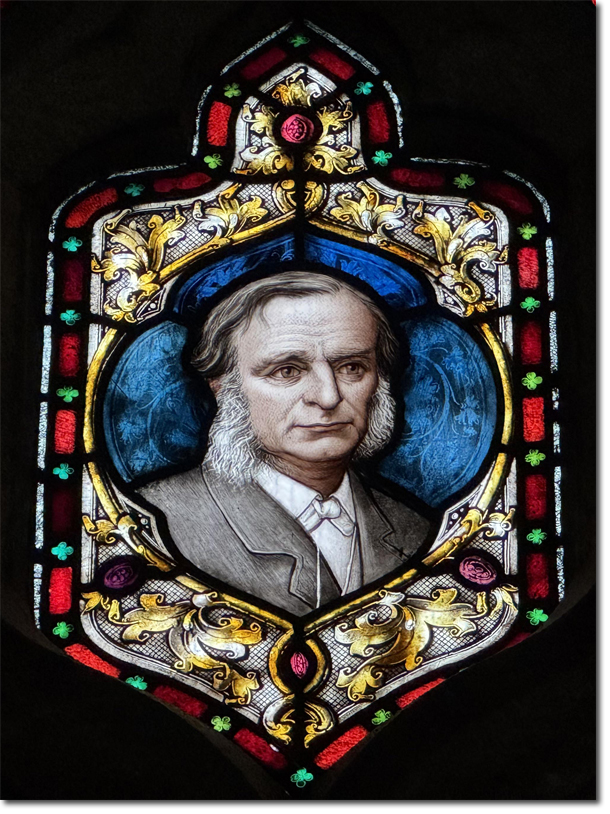
Not a war memorial, but one of the most fascinating stained glass tributes in Holne Church is dedicated to the author and priest Charles Kingsley. Born in Holne Vicarage on 12 June 1819, the son of the parish clergyman, Kingsley grew up in Devon surrounded by the moorland landscape. From an early age he developed a love of nature study and geology, interests that would later shape his writing. His birthplace connects him directly to the parish, and the window installed in his honour is a reminder that this quiet Dartmoor village produced one of the giants of the Victorian age.
Kingsley was educated at Magdalene College, Cambridge, graduating in 1842. He was ordained that same year as curate of Eversley, and two years later became parish priest there, a position he held for the rest of his life. Much influenced by the theologian Frederick Denison Maurice, Kingsley became in 1848 a founding member of the Christian Socialist movement, which sought to address the evils of industrialism through Christian ethics. He advocated adult education, improved sanitation, and the cooperative movement, preferring practical social reform to revolutionary politics. His vigorous Broad Church Protestantism gave rise to the term “muscular Christianity,” a phrase often applied to his novels and sermons.
His first novel, Yeast (1848), explored the relationship between the landed gentry and the rural poor. His second, Alton Locke (1850), told the story of a tailor-poet who rebels against sweated labour and becomes a Chartist leader. Later works included historical novels such as Hypatia (1853), set in early Christian Egypt, Westward Ho! (1855), an imperialist adventure of the Elizabethan age, and Hereward the Wake (1866), about Anglo-Saxon England and the Norman Conquest. His fear of the Oxford Movement’s drift toward Roman Catholicism led to a notorious controversy with John Henry Newman, whose Apologia pro Vita Sua (1864) was written in response to Kingsley’s attack.
Kingsley’s most famous book remains The Water-Babies (1863), a didactic children’s fantasy that combined his concern for sanitary reform with his interest in natural history and Darwin’s theory of evolution. He was one of Darwin’s earliest defenders and friends, offering support from a religious perspective at a time when many in the church opposed Darwin’s ideas. Kingsley also wrote poetry, including ballads such as “The Sands of Dee” and “Airly Beacon,” and retold Ancient Greek myths in a lively style that made them accessible to young readers, effectively popularising them for the first time outside the confines of classical education.
His public life was equally distinguished. He became chaplain to Queen Victoria in 1859, professor of modern history at Cambridge from 1860 to 1869, and canon of Westminster in 1873. He was also part of the Edward Eyre Defence Committee, alongside Thomas Carlyle, John Ruskin, Charles Dickens, and Alfred Tennyson, supporting the controversial governor of Jamaica after the suppression of the Morant Bay rebellion in 1865. This stance placed him in opposition to his friend Darwin, who supported the Jamaica Committee calling for Eyre’s trial. The clash between these two groups of eminent Victorians dominated the press for months and showed how Kingsley’s convictions could place him at the centre of national debate.
Kingsley died in 1875 at Eversley, aged 55, but his legacy endures in literature, theology, and social reform. His stained glass memorial in Holne Church, installed in 1894 after a fundraising campaign supported by bishops, archdeacons, lords, and local patrons, depicts the Nativity and includes a portrait of Kingsley himself. It is a beautiful window, rich in colour and symbolism, and a fitting tribute to a man whose life spanned parish ministry, royal service, literary achievement, and social activism. For visitors, it is a reminder that Holne’s little granite church nurtured a figure whose influence reached across Victorian Britain and beyond.

