

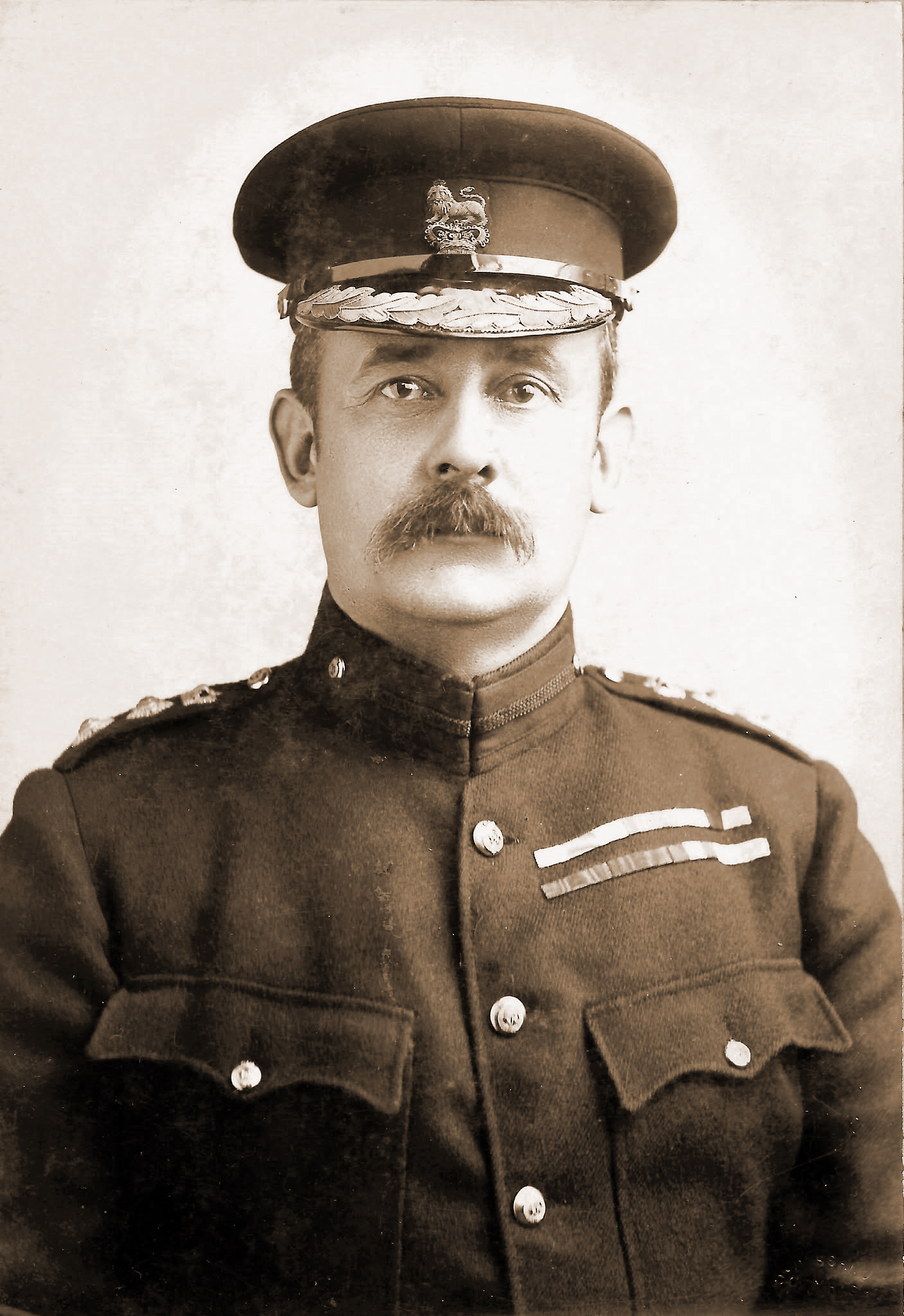
In St David’s Church in Exeter there is a memorial plaque to Major-General Sir Charles Sim Bremridge Parsons, KCMG, CB, FRGS, who served for decades across the African continent and whose long military career placed him at the centre of many of the British Empire’s most demanding campaigns. He is buried in the family vault in St David’s, close to the parish where his family had deep roots. Born on 9 May 1855, he was the elder son of John Parsons of Ringmore near Shaldon in South Devon. Educated at Rugby School, he entered the Royal Military Academy, Woolwich, which trained officers for the Royal Artillery and Royal Engineers.
Commissioned into the Royal Artillery in 1876, Parsons was posted to South Africa where he commanded mobile field batteries during the 1877–1879 Gaika War and the 1879 Anglo‑Zulu War. In 1879 he was a lieutenant with N Battery, 5 Brigade, Royal Artillery, and was out with Lord Chelmsford when the Zulus attacked the camp at Isandlwana. His battery was selected to accompany Chelmsford’s detachment, while the other battery left behind was overwhelmed and all its men killed. Parsons later fought at the Battle of Ulundi in July 1879, the final major engagement of the war.
He next served in the 1880–1881 First Boer War, fighting at Laing’s Nek and Ingogo (Schuinshoogte), where he was badly wounded. After recovering, he returned to Egypt for the 1882 campaign and was present at Mahsama, Kassassin and Tel‑el‑Kebir, receiving the Egypt Medal. This campaign saw significant technical innovations, including the construction of military railways and telegraph lines, developments that would shape Parsons’s later career.
With the Egyptian Army being reconstructed under British supervision, Parsons took command of its artillery arm. When Kitchener became Commander‑in‑Chief (Sirdar) of the Egyptian Army in 1892, he appointed Parsons Governor of the Red Sea Littoral during the 1896–1899 Anglo‑Egyptian conquest of Sudan. Although the territory consisted largely of the port of Suakin, it was a vital supply base and the hub of the railway built to support the campaign. Parsons also supervised the transfer of Kassala in Italian Eritrea to Egyptian control, part of a diplomatic adjustment recognising Italian colonial claims in the Horn of Africa.
In September 1898, a British battalion commanded by Parsons took possession of Gedaref after defeating a Dervish force of 3,500 men. For his service he received the Ottoman Order of the Medjidie, Second Class, and was made KCMG in 1899. After leaving Sudan he served as assistant adjutant‑general at the Royal Arsenal, Woolwich, and later as Colonel of the Royal Artillery in Ireland.
Parsons returned to South Africa during the 1900–1902 Second Boer War. He commanded a squadron of the Imperial Yeomanry in the November 1900 relief of Koffiefontein, an episode referred to as “Parson’s Pantomime” in Rudyard Kipling’s short story “The Captive”. He was subsequently appointed Deputy Military Governor of Northern Cape Colony, Commandant of the West Kimberley District and Assistant Inspector‑General of the Southern Lines of Communication. His logistical expertise was particularly valuable, as the Boer War saw the first widespread use of railways for military supply rather than reliance on horses.
After a brief period in England as assistant adjutant‑general at Woolwich, Parsons ended his military career as staff Colonel commanding British regular forces in Canada, with the temporary rank of Major‑General. He was the last officer to hold this position; after his retirement in 1906, Canada assumed full control of its own military forces and British troops were withdrawn. He was appointed a Companion of the Order of the Bath and later served as Commissioner of the Royal Hospital, Chelsea.
Parsons married Margaret Christian in 1898 and they had two daughters. He died on 25 June 1923. His long career, spanning conflicts in South Africa, Egypt, Sudan and Canada, reflected the breadth of imperial military service in the late nineteenth and early twentieth centuries. His memorial in St David’s Church stands as a reminder of a soldier whose life intersected with many of the major campaigns of the era and whose expertise in artillery and logistics made him one of Kitchener’s most trusted subordinates.
The photograph is from c1900 during his Boer War years

