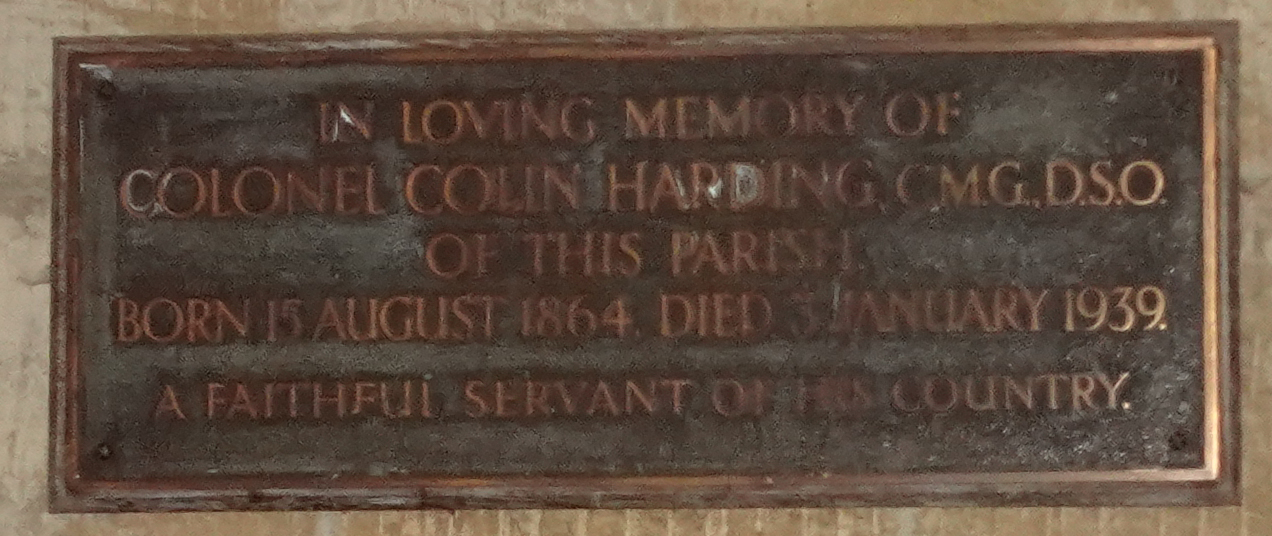
Edwin Colin Harding was born on 15 August 1863, a son of Charles Harding of Abbey Farm, Montacute, Somerset. Privately educated, he spent much of his early life hunting on his pony Glover. The death of his father revealed the family’s precarious finances and forced the Hardings to leave their long‑loved home. With no profession and no means to acquire one, Harding resolved to start again abroad. In January 1894 he left Montacute for South Africa, travelling steerage on the S.S. German. The voyage was rough and uncomfortable, and he spoke to no fellow passengers until reaching Lisbon.
At Cape Town he met an old hunting friend, Toms, and travelled with him by ox‑wagon to Bulawayo, a six‑week journey. Harding arrived with only ten pounds and no trade. He sold his saddle, bridle, breeches and shotgun to survive. He worked briefly as a sawyer’s mate, then as a bricklayer, and later as a painter of shop fronts. He eventually became chief clerk to a solicitor, Mr Gatehouse, learning the basics of legal work in a corrugated iron office. His early months in Bulawayo were marked by hardship, makeshift employment and the rough camaraderie of a frontier town.
In late 1895 he left office work to join a small mining camp at Manzi Inyama, south of Bulawayo. He worked with local labourers to sink a prospecting shaft, using dynamite and improvised equipment. On one occasion he narrowly escaped death when a rope broke as he was being hauled from the shaft with lit fuses below him. He credited the courage of his African assistants with saving his life. Fever later forced him to walk fifteen miles to a store where he lay ill for a fortnight.
Harding’s mining ventures were interrupted by the growing unrest that preceded the Matabele Rebellion of 1896. He encountered two Englishwomen, Miss De Trafford and Miss Amy Norton, who were travelling north. Harding accompanied them by coach to Mafeking, then returned to England. There he learned of the outbreak of the Mashona Rebellion and the murder of the Norton family at Porta Farm. Miss Norton asked him to investigate the killings, and he resolved to return to Mashonaland.
He travelled to Beira with Captain Armstrong, escorting horses and mules for the forces. After a difficult journey inland, he reached Old Umtali and joined Major C. N. Watts of the 2nd West Riding Regiment. Harding and his friend Robin Grey became gallopers for Watts. Harding took part in operations against Chief Chingaira Makoni, whose stronghold at Gwindingwi Mountain had resisted earlier attacks. Harding helped capture a fleeing warrior and later volunteered to place dynamite charges at the cave entrances under heavy fire. He also rescued a blind Mashona child from a cave moments before volleys were fired into it.
Chief Makoni was captured on 4 September 1896. Harding was placed in charge of the firing party at the execution. Makoni died bravely and asked Harding to take charge of his two young sons, which he did. An inquiry later exonerated Major Watts for the conduct of the court martial.
Harding continued to serve in Mashonaland, taking part in patrols and skirmishes. Lieutenant‑Colonel Alderson praised his conduct at Simbanoota’s kraal, noting that Harding paid “no more attention to the Mashona bullets than if they were snowballs.” Harding also visited Porta Farm, where he exhumed and buried the remains of the Norton family, describing the scene in detail.
In 1898 Harding was posted to Northern Rhodesia to command and reorganise the Barotse Native Police. He later served as acting Resident Commissioner in Barotseland and was promoted to Colonel. In 1909 he became a District Commissioner in the Gold Coast. On leave in England in 1914 he helped raise the 2nd King Edward’s Horse and went to France in 1915, serving under Lieutenant‑General Alderson. He fought until 1916, when appendicitis ended his front‑line service. He was awarded the DSO.
In 1917 he returned to the Gold Coast as Provincial Commissioner and served on the Legislative Council until retiring in 1921. He married Margaret Porter in 1899. Harding died on 3 January 1939 aged 75 and was buried at St Catherine’s Church, Montacute.
His career spanned the early years of Rhodesia, the Mashona and Matabele conflicts, the formation of the Barotse Native Police, colonial administration in Barotseland and the Gold Coast, and service in the First World War. He was awarded the CMG and DSO and left extensive memoirs of frontier life, military operations and colonial administration.