

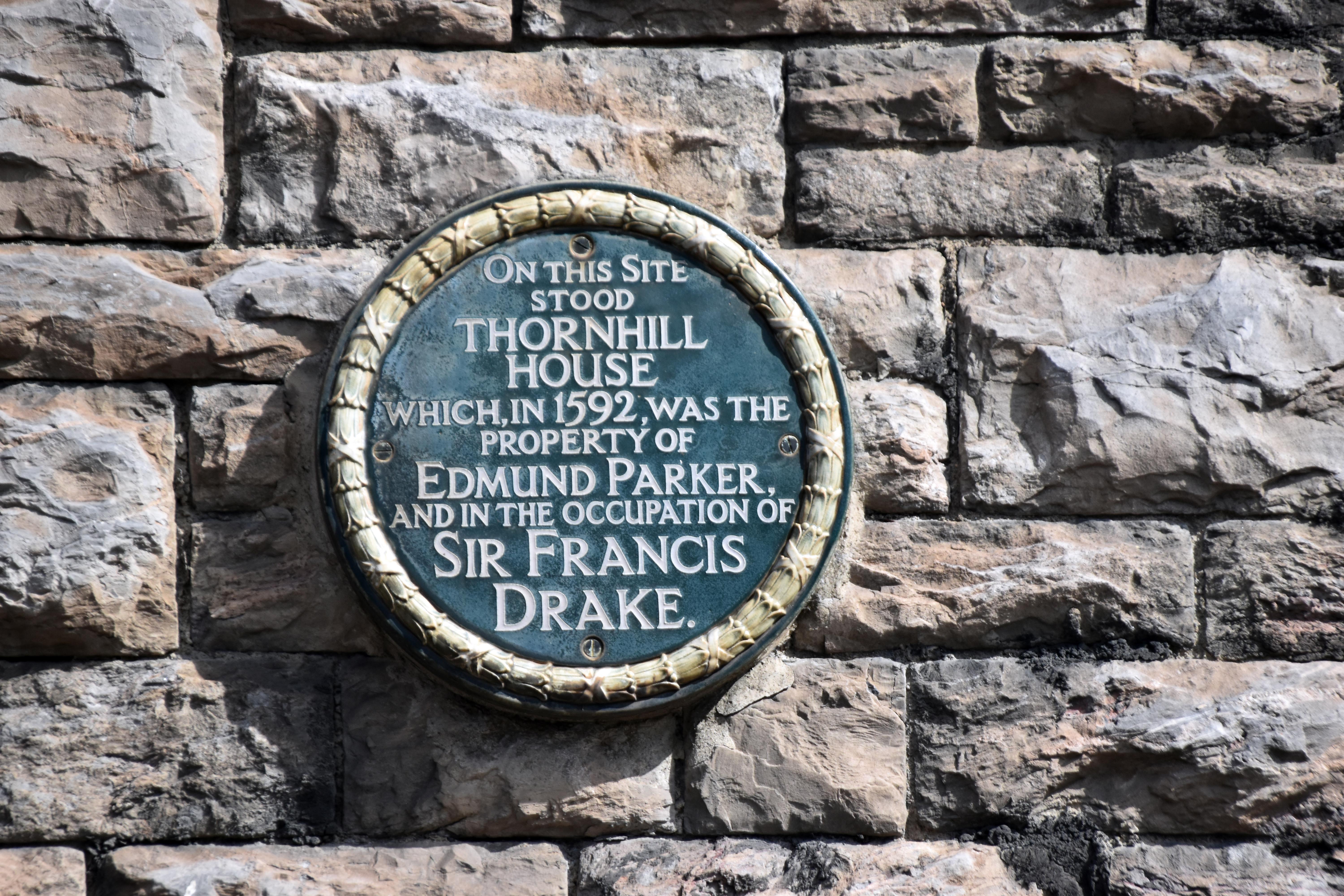
Sir Francis Drake occupied Thornhill House at Hyde Park in 1592. The house stood on the site now occupied by Hyde Park School, where a plaque records that it was the property of Edmund Parker and in the occupation of Drake. The distinction is important. Drake lived in the house, but Parker owned it.
Thornhill House was not Drake’s principal residence. In 1581 he had purchased Buckland Abbey from Sir Richard Grenville following his return from the circumnavigation of the world. Grenville had already converted much of the former Cistercian abbey into a substantial Tudor house. Buckland provided Drake with a country estate and remained the principal landed property associated with him and his family.
Buckland Abbey was reasonably close to Plymouth, but it was not a convenient base for every piece of business that Drake conducted in the town. He had served as mayor of Plymouth, represented the borough in Parliament and maintained interests in its harbour, shipping and mills. Thornhill House gave him accommodation on the northern approach to Plymouth, considerably closer to the Corporation and Sutton Harbour than Buckland Abbey.
Edmund Parker’s ownership of Thornhill House is known from the record commemorated by the plaque, but little reliable information about Parker himself has been published. His occupation, his usual place of residence and the terms under which Drake used the house are not stated. Parker may have leased the property to Drake, although no surviving agreement has been identified. It is therefore safer to describe Drake as the occupant rather than Parker’s tenant.
The house stood outside the boundaries of Tudor Plymouth in an area of fields and scattered properties beside the road leading towards Tavistock. Its position offered Drake access to the town without placing him inside its crowded streets. It also stood directly on the route of Plymouth Leat.
The leat crossed the grounds of Thornhill House before continuing towards Mutley Plain and the centre of Plymouth. Its course ran across the land now occupied by Hyde Park School, between the present building and playground. The channel had to follow the contours in order to preserve the shallow fall required to carry water towards the town.
The presence of the leat explains why Thornhill House appears in records connected with Drake in 1592. Construction of the watercourse had been completed and water had reached Plymouth in 1591. The date on the plaque is a year later, but there is no contradiction. Finishing the channel did not settle all the claims arising from its construction. Ownership, occupation and compensation still had to be established after the digging had ended.
The Corporation had provided a separate fund to compensate those whose property was crossed or otherwise affected by the leat. Some claims were settled with money, while some landowners accepted rights to draw water. These arrangements took time to resolve, particularly where the owner and occupant of a property were different people.
At Thornhill House, Edmund Parker owned the land while Drake occupied it. Parker therefore held the permanent interest in the property, but Drake could claim an interest as its occupant. Drake was also the man administering the project and the compensation money on behalf of Plymouth Corporation. He consequently occupied the unusual position of overseeing compensation connected with land upon which he himself was living.
This did not make Drake the owner of Thornhill House. Nor does the surviving evidence establish how any compensation relating to the property was divided between Parker and Drake. The owner could seek payment for the lasting effect of the channel upon the land, while the occupant might claim for disruption or loss of use. The surviving record confirms the separate interests of Parker and Drake but does not provide the details of their settlement.
Drake’s decision to use Thornhill House was practical. It placed him close to Plymouth while the accounts, compensation claims and other business arising from the leat were being settled. It also allowed him to attend to his commercial interests in and around the town without repeatedly travelling from Buckland Abbey.
Those commercial interests included mills supplied by the leat. Drake had supported the addition of milling to the authorised uses of the water and subsequently acquired interests in several mills along its course. Thornhill House therefore stood beside a watercourse that Drake had overseen as a public undertaking but from which he also expected to receive private income.
The arrangement illustrates the overlap between public office, private property and commercial investment in Tudor Plymouth. Drake supervised the construction of a municipal water supply, administered money provided by the Corporation and developed businesses that used the water. At the same time, he occupied Parker’s house on land crossed by the project and became involved in the resulting compensation arrangements.
There is no need to treat Thornhill House as a rival to Buckland Abbey. Buckland was Drake’s own estate and principal residence. Thornhill House belonged to Edmund Parker and provided Drake with a local base while conducting business in Plymouth. The two properties served different purposes.
Little is known about the appearance of Thornhill House or how long Drake remained there. The house was demolished before Hyde Park School opened on the site in 1904. The plaque preserves the essential information: Edmund Parker owned Thornhill House, Sir Francis Drake occupied it in 1592, and the leat completed the previous year crossed its grounds while the compensation arising from the project was still being settled.
``
