

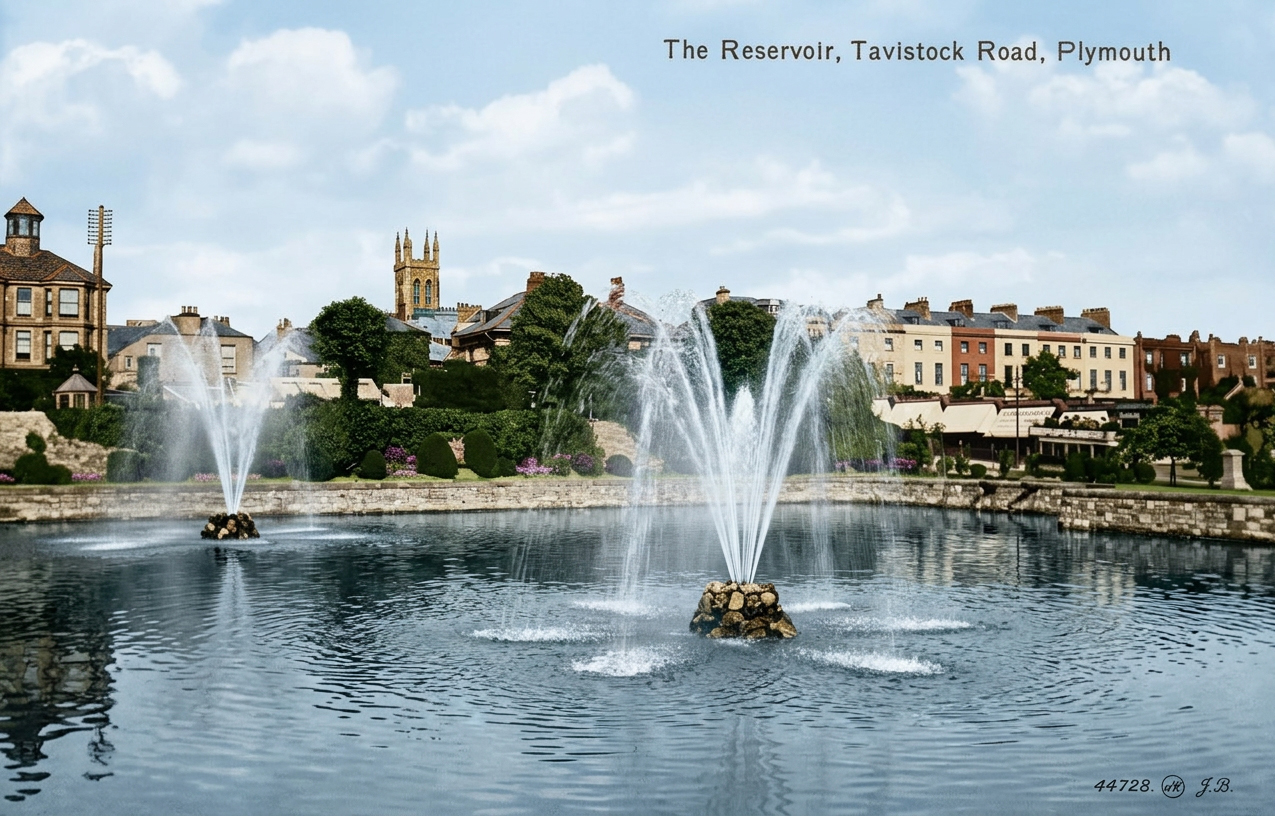
Drake’s Place Reservoir represents a decisive stage in the development of Plymouth’s water supply. Plymouth Leat had brought water from the River Meavy to the town since the end of the sixteenth century, but the original system depended upon a continuous flow through an open channel. Sir Francis Drake and the contractors responsible for building the leat had constructed no substantial reservoir within Plymouth. Their purpose was to convey water into the town, where it could supply public conduits, ships, mills and other users. For more than two centuries Plymouth possessed a remarkable watercourse but no large reserve of stored water at the point where the leat entered the increasingly populous urban area.
The weakness of this arrangement became apparent during the severe winter of 1823, when ice and snow obstructed the leat and interrupted the flow of water into Plymouth. Drought was not necessarily the greatest danger to the system because the Dartmoor catchment usually continued to discharge water during dry weather. Prolonged freezing conditions presented a more serious problem. If the open channel became blocked, the town had little stored water upon which it could draw. This threatened domestic supplies, the victualling of ships and the availability of water for firefighting.
The difficulty occurred as the Admiralty was developing plans for a new victualling establishment at Stonehouse, later known as the Royal William Yard. Plymouth’s water supply was therefore no longer merely a matter of local convenience. It had become part of the infrastructure required to support the Royal Navy and the expanding naval establishments surrounding Plymouth Sound. A reservoir near the point at which the leat entered the town would provide a reserve against temporary interruptions and allow the water to be managed more systematically.
The first reservoir at Drake’s Place was constructed in 1825 on land previously associated with one of the mills powered by Plymouth Leat. The location was well chosen. Water arrived there by gravity before descending towards the older parts of Plymouth, whilst the site stood sufficiently high above much of the town to permit onward distribution. The reservoir converted a constantly flowing but vulnerable supply into one that could be collected, retained and released according to demand.
A second reservoir was added in 1828. The two basins performed different parts of the treatment and storage process. Water entering the upper reservoir was allowed to settle so that heavier material could sink and floating matter could be removed. The clearer water could then pass into the lower reservoir before being distributed. This was not water treatment in the modern sense, but it represented a considerable improvement upon delivering water directly from an open leat that had travelled for approximately seventeen miles across Dartmoor and through agricultural land before entering Plymouth.
The construction of the reservoirs coincided with a fundamental change in the manner by which water was supplied to the inhabitants of the town. Plymouth had traditionally distributed water through public conduits, from which residents could collect it without payment. During the 1820s the Corporation increasingly adopted iron pipes to convey water directly through the borough. This made it possible to supply individual properties, although householders were charged for the service. Drake’s Place Reservoir consequently belonged to the transition from a communal system of open leats and public conduits to a controlled system of storage and piped distribution.
The reservoirs also preserved physical evidence of the earlier water supply. The Morshead Conduit, dating from 1754, survives beside the steps leading towards the reservoir. It had occupied the site before the reservoirs were constructed and was later incorporated into the complex. Its present height results from alterations undertaken during the redevelopment of 1891, when additional accommodation was created for lavatories and storage. The building therefore combines fabric associated with the eighteenth-century conduit and the later Victorian treatment of the site.
The Trelawny Conduit provides an even earlier connection with Plymouth Leat. Dating from 1598, it originally stood in Old Town Street and supplied water brought into Plymouth by the leat. It was removed after the introduction of the nineteenth-century piped system but was preserved rather than destroyed. In 1874 it was incorporated into the outer wall of Drake’s Place Reservoir as part of a drinking fountain for people and horses ascending North Hill. Although it no longer stands in its original position, it remains one of the oldest surviving structures associated with Plymouth’s historic water supply.
By the later nineteenth century the reservoirs were no longer regarded solely as utilitarian pieces of civil engineering. The surrounding district had become increasingly urbanised, whilst the mills formerly occupying the site had declined and were demolished during the 1880s. This made it possible to reconsider Drake’s Place as a public space. Victorian concern over the loss of open ground within expanding towns encouraged local authorities to create parks and gardens, particularly in densely built urban districts.
In 1891 the reservoirs were reconstructed and incorporated into a new public garden intended both to improve the appearance of the area and to commemorate the importance of Plymouth’s historic water supply. A broad promenade was created along the reservoir dam, raised above a granite colonnade overlooking the gardens. Columns from Plymouth’s former market were incorporated into the structure, giving architectural material associated with the older town a new purpose within the scheme. A tower, cascade, ornamental fountain, walls and railings completed the redevelopment.
The 1891 work transformed a practical reservoir into a deliberate civic monument. The water remained central to the design, but the engineering was now intended to be seen and appreciated rather than hidden. Visitors could walk above the colonnade, look across the reservoir and descend into gardens occupying land once dominated by water-powered mills. The site brought together several distinct stages in Plymouth’s history: the original sixteenth-century leat, the eighteenth-century conduits, the reservoirs of 1825 and 1828 and the ornamental public gardens of 1891.
The redevelopment also reflected a changing understanding of Sir Francis Drake’s connection with the town. The reservoirs had been constructed more than two centuries after his death, but their dependence upon water delivered by Plymouth Leat allowed them to be presented as part of his legacy. The gardens opened in 1891 as a tribute to Drake, reinforcing the association between his name and the water supply that had served Plymouth since the Tudor period.
Drake’s Place Reservoir remained part of Plymouth’s water system until the twentieth century, although its importance diminished after the construction of new reservoirs at Hartley and Burrator. These later works provided Plymouth with greater storage capacity and a supply delivered through pipes rather than through the vulnerable open leat. The Drake’s Place reservoirs eventually passed out of use during the 1970s, but their survival preserved an important stage between the original Tudor watercourse and the modern reservoir system.

