

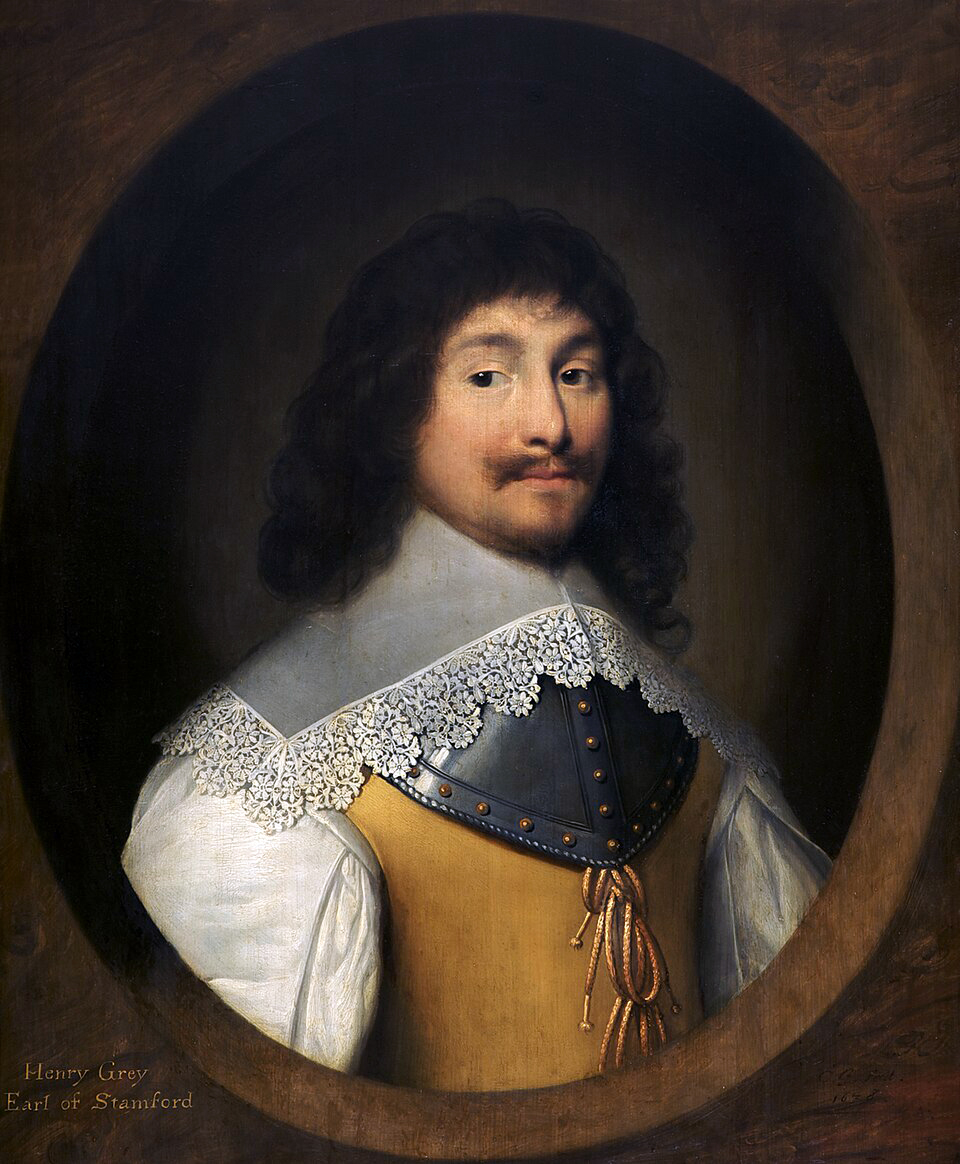
Henry Grey, 1st Earl of Stamford (1599–1673), was the Parliamentary commander whose name became permanently attached to the landscape of north‑east Cornwall through the ridge now known as Stamford Hill. Born in 1599, the son of Sir John Grey and Elizabeth Nevill, he succeeded as 2nd Baron Grey of Groby in 1614 and was created Earl of Stamford in 1628. In 1620 he married Lady Anne Cecil, daughter of William Cecil, 2nd Earl of Exeter, and Elizabeth Drury. Their children included John Grey, Thomas Grey, Anchitel Grey and several daughters, linking the family to a wide network of aristocratic and political connections. Stamford’s prominence in Parliament and his early loyalty to the Parliamentary cause ensured that he was entrusted with senior military responsibilities when the Civil War began.
At the outbreak of war Stamford was appointed to command in the West Country, where Parliament’s position was fragile and required reinforcement. He played a significant role in the defence of Plymouth in late 1642 and early 1643, when the town was subjected to repeated Royalist pressure. Stamford’s presence helped stabilise the garrison and maintain Parliamentary control of the port, which remained one of the few secure Parliamentary footholds in the region. He was also involved in the Parliamentary attempts to relieve and support Exeter during the early stages of the conflict, before the city fell under Royalist control. These operations formed the background to his later campaign in Cornwall, where Parliament hoped he could reverse Royalist gains and prevent Hopton’s army from linking with forces advancing from Somerset.
In early 1643 Stamford drew reinforcements from Devon and advanced westward, crossing the Tamar and moving into Cornwall with the intention of checking Hopton’s movements. His occupation of the long ridge above Stratton on 15 May 1643 gave his name to the feature thereafter known as Stamford Hill, the most substantial Parliamentary encampment ever established on the site. The ridge offered natural strength, with steep approaches on several sides and an ancient earthwork suitable for mounting guns, and Stamford dispersed his infantry along the crest in preparation for a defensive battle. Yet the strength of the position was undermined by the absence of most of his horse, which had been detached under Sir George Chudleigh to Bodmin.
When Hopton attacked at dawn on 16 May, the Royalists advanced in four converging columns up the western, southern and northern slopes. Stamford’s line, stretched thinly along the summit, lacked coordination and depth. Although his infantry fought stubbornly in places, the Royalist assaults gradually gained ground. The crisis came when Major General James Chudleigh led a counter‑attack against Sir Bevil Grenville’s regiment, only to be driven back and taken prisoner. As the Royalist columns closed together near the centre of the ridge, the Parliamentary defence collapsed. Stamford ordered a final salvo from his guns and fled the field, retreating first to Bideford and then to Exeter, abandoning his artillery and stores on the hill.
The defeat at Stratton was decisive. Parliament lost around 300 killed and 1,700 taken prisoner, together with all thirteen guns and a large magazine of provisions. For Stamford personally, the consequences were severe. His reputation as a field commander never recovered, and he was removed from active military leadership soon afterwards. Although he continued to serve Parliament in political and administrative roles, Stratton effectively ended his career as a general. The Royalist victory opened the way for Hopton to advance into Devon and join forces with the Marquis of Hertford and Prince Maurice, while Stamford’s army ceased to exist as an effective force.
Stamford lived for another thirty years, dying on 21 July 1673, but his military legacy is inseparable from the events of May 1643 when his active service effectively concluded on the ridge that still bears his name. Stamford Hill remains the only lasting trace of his brief command in Cornwall.

