

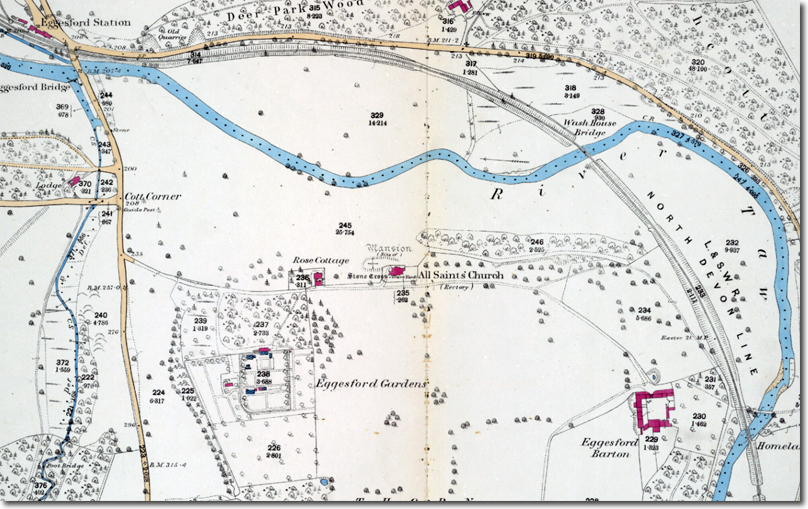
The nineteenth century altered Eggesford more profoundly than any period since the manor was first consolidated. The valley, long defined by its church, its Barton and the wooded slopes rising towards the house, began to absorb the pressures and opportunities of a modernising county. The estate itself changed shape. The earlier house on the hill, already showing its age by the early decades of the century, was replaced by a new mansion for the Portsmouth family, larger and more imposing, set to command the river bend with the confidence expected of a Victorian landowner. Its construction brought masons, carpenters and labourers into the parish, and for several years the quiet of the valley was broken by the movement of carts, scaffolding and stone. The Barton was altered and expanded, its ranges adapted to more systematic agricultural practice, and the walled kitchen gardens were laid out with high rubble walls and ordered plots intended to supply a household of considerable size.
The improvement of access to Eggesford did not begin with the Victorians. The turnpike trusts had already cut and straightened the old lanes in the eighteenth century, giving the valley more dependable routes towards Chulmleigh, Winkleigh and Crediton. By the nineteenth century these roads were established features of the landscape. Carriers and estate traffic still used them, and the movement of goods was less dependent on the weather than it had been in the days of unmetalled tracks. The tolls and gates were part of the accepted order, but their importance was gradually overshadowed as new forms of transport appeared. The Victorian period did not bring the turnpikes to Eggesford; it inherited them and then watched their relative significance decline.
The decisive change in the Victorian era was the arrival of the railway. When the North Devon line was surveyed, the engineers chose the Taw valley for its gentle gradients, and Eggesford found itself placed on a main route between Exeter and Barnstaple. The station opened in 1854, a modest building of brick and timber, but its effect was immediate. Timber from the estate could be moved more easily, livestock could be sent to market without long drives over the hills, and visitors arrived in numbers that would have been unthinkable a generation earlier. The post came with greater speed, and the estate’s correspondence, once dependent on irregular carriers, became part of the national rhythm. The sight of steam above the trees and the sound of trains crossing the river became part of daily life in a valley that had previously known only carts and riders.
The internal economy of the estate adapted to these changes. The Barton’s ranges were repaired and extended, with new linhays, workshops and storage areas added as farming methods shifted. The walled kitchen gardens, enclosed by high rubble walls with ashlar dressings, produced fruit and vegetables for the house throughout the year. Gardeners worked in a system that combined traditional estate self‑sufficiency with the new possibility of supplementing supplies by rail. The cottages around the Barton were occupied by labourers, craftsmen and estate workers whose families had lived in the valley for generations. Their lives were still shaped by the rhythms of the land, but the railway and the established turnpike roads offered options beyond the immediate parish for those prepared to travel.
All Saints Church continued as the parish’s anchor. Its fifteenth‑century tower remained, but the nave and chancel were rebuilt in 1867, giving the building the Victorian character it retains. Monuments to the Chichesters and Fellowes were cleaned and reset, and new stained glass was installed, including work commemorating Isaac Newton, fifth Earl of Portsmouth. The churchyard expanded, and nineteenth‑century graves of estate workers, servants and soldiers lie beneath the yews. The church marked the passage of time in a community that was changing, but it preserved continuity in a landscape where the house, the Barton and the railway were all visible signs of alteration.
By the end of the Victorian era, Eggesford had become a place where older structures and newer systems coexisted. The rebuilt house dominated the hillside, the Barton remained the practical heart of the estate’s agricultural life, and the railway carried people and goods through the valley with a speed unimaginable to earlier generations. The turnpike roads, laid out in the previous century, continued to serve local traffic even as their tolls were removed and their relative importance diminished. All Saints Church stood as it had for centuries, now with Victorian fabric added to medieval foundations. Eggesford did not lose its character in the nineteenth century, but it absorbed the changes of the period in ways that shaped its future and left a visible legacy in the valley.

